Party comparisons · UK general election manifestos, June 2024 · 7 parties, 7 issues
What did the parties promise—and who would pay?
In their June 2024 manifestos, Labour ruled out raising National Insurance, VAT or the rates of income tax, and the Liberal Democrats said they would fund their plans without raising income tax, National Insurance or VAT; the Conservatives promised to cut employee National Insurance, Reform to raise the income-tax starting point to £20,000 and the Greens proposed a wealth tax on assets above £10 million. Compare seven parties’ 2024 proposals on seven issues — mechanism, costing, funding and timing on the same basis; they are not necessarily current policy.
Site purpose (informational): Enable like-for-like comparison of the parties’ proposals — mechanisms, costs, funding and trade-offs — without endorsing any party or policy.
Evidence last reviewed 3 October 2026
Overview
The short version
Three key measures
How many parties published costings?
5 of 7with a costings table
The SNP manifesto published no costings; Plaid Cymru’s gave one yield figure. Costings use different years and bases, so they cannot be ranked on one scale.
Published costings and scrutiny →UK · June 2024
Source: How many parties published costings?
Site calculation · Institute for Fiscal Studies, manifesto analysis: Paul Johnson’s opening remarks (cross-party)
Which proposals could be tested in office?
411Labour seats
Labour formed the government after the 4 July 2024 election, so its pledges can be checked against delivery; the other parties’ proposals remain pledges, not records.
Law, pledge or suggestion? →United Kingdom · 4 July 2024
Source: Which proposals could be tested in office?
Official statistic · House of Commons Library, General election 2024 results (CBP-10009)
How much does the comparison cover?
49 of 49party–issue cells
Seven parties across seven issues, using their 2024 manifestos. Proposals may no longer be current; Northern Ireland parties are not included.
Choose an issue →UK-wide and devolved proposals, labelled per cell · Manifestos published 10–19 June 2024
Definition, limits and source: How much does the comparison cover?
Labour, Conservative, Liberal Democrats, Reform UK, Green Party of England and Wales, SNP, Plaid Cymru × Housing, NHS, Tax and spending, Work, Education, Energy, Immigration: each cell gives the proposal, mechanism, published cost, funding, timing and what remains unclear, from the party’s own 2024 manifesto with a page reference. These are 2024 proposals, not necessarily current policy; not every UK party, and Northern Ireland parties are not yet included.
Site calculation · Party manifestos, 2024
The evidence
The evidence, question by question
Choose an issue
Each column is one party; each row is the same question asked of every party. Entries paraphrase the party’s own 2024 general election manifesto, with the page it came from. They describe what was proposed, not whether it would work.
Showing Housing for 7 parties. Every entry is labelled “2024 manifesto pledge” — not current law or an enacted change.
Labour
2024 manifesto pledge
- Proposal
- Build 1.5 million new homes over the next parliament, restore mandatory housing targets, and deliver the biggest increase in social and affordable housebuilding in a generation. Also a permanent mortgage guarantee scheme for first-time buyers and immediate abolition of Section 21 'no fault' evictions.
- Scope
- England (the manifesto states the 1.5 million homes are 'across England'; planning and housing are devolved policy areas).
- Mechanism
- Update the national planning framework (named in the manifesto as the National Policy Planning Framework), take a brownfield-first approach with prioritised release of 'grey belt' land under 'golden rules', build a new generation of new towns, require strategic planning by Combined and Mayoral Authorities, reform compulsory purchase compensation, and fund additional planning officers.
- Cost (as published)
- 300 new planning officers: £20m in 2028-29. No other housing cost published in the manifesto.
- Funding (as stated)
- Planning officers funded by increasing the stamp duty surcharge on residential purchases by non-UK residents by 1% (£40m revenue, 2028-29). Affordable Homes Programme changes to deliver more homes 'from existing funding'.
- Delivery time
- 1.5 million homes over the next parliament; planning framework updated 'immediately'; Section 21 abolished 'immediately'.
- What remains unclear
- The manifesto gives no year-by-year build profile and does not state how many of the 1.5 million homes would be social or affordable.
Change: Labour Party Manifesto 2024, PDF pp. 36-39 (printed pp. 36-39); PDF p. 79 (printed p. 79); PDF p. 127 (printed p. 127) · published 13 June 2024
Conservative
2024 manifesto pledge
- Proposal
- Deliver 1.6 million homes in England in the next Parliament, permanently abolish Stamp Duty for first-time buyers on homes up to £425,000, and launch a new Help to Buy scheme offering an equity loan of up to 20% towards a new build home.
- Scope
- England for the 1.6 million homes target and social housing tests (stated in the manifesto); the manifesto does not state a jurisdiction for the Stamp Duty and Capital Gains Tax measures.
- Mechanism
- Abolish EU 'nutrient neutrality' rules to unlock 100,000 homes, fast-track brownfield planning in the 20 largest cities and raise inner London density; a two-year Capital Gains Tax relief for landlords selling to tenants, and a Renters Reform Bill with court reforms to fully abolish Section 21.
- Cost (as published)
- Costings Document: Stamp Duty abolition for first-time buyers £320m in 2025-26 rising to £590m in 2029-30; Help to Buy £665m in 2025-26 and £940m in 2026-27; CGT relief on sales to tenants £20m a year in 2025-26 and 2026-27 (nominal terms).
- Funding (as stated)
- Help to Buy to be part funded by contributions from house builders; the Costings Document states the manifesto as a whole is fully funded, with tax cuts offset by welfare reform and tax gap measures.
- Delivery time
- 1.6 million homes over the next Parliament; nutrient neutrality change to 'immediately unlock' 100,000 homes; CGT relief is two-year and temporary.
- What remains unclear
- The documents do not break down how many of the 1.6 million homes each measure would deliver, or the size of house builder contributions to Help to Buy.
The Conservative and Unionist Party Manifesto 2024 (Clear Plan. Bold Action. Secure Future.), Manifesto PDF p. 54-55 (printed p. 52-53); Costings Document PDF p. 3 and p. 5 · published 11 June 2024
Reading the mechanism and scope rows. Two parties can share a goal and differ entirely on how they would reach it — planning rules or public building, tax rates or allowances, a cap or a points system. Scope matters as much: housing, health and education are devolved, so a Westminster party’s proposal on them usually applies to England only, and the SNP and Plaid Cymru entries separate their requests of Westminster from commitments for Scotland and Wales.
Published costings and scrutiny
The parties’ own costings are not comparable on one scale. They use different end years (2028–29, 2029–30, or an annual average over a five-year term), different price bases and different treatments of one-off and recurring money, and they cover different parts of the UK. Ranking them by a single price would mislead, so this page shows each party’s published basis and the Institute for Fiscal Studies’ independent reaction instead.
Across the parties, the IFS noted that neither main party mentions the roughly £10 billion a year tax rise from continued threshold freezes; unprotected services face cuts of £10-20 billion a year; Labour boosts green investment by about £5 billion a year; Lib Dems raise £27 billion to fund £4 billion for benefits and £23 billion for services plus £20 billion investment; Reform proposes £90 billion of tax cuts and £50 billion of spending rises; the Greens rely in large part on £80 billion a year of extra borrowing and a £90 billion carbon tax. (IFS, 24 June 2024)
| Party | Costings | IFS summary of the plans | IFS’s main caveat |
|---|---|---|---|
| Labour | Published a costings table or document | a top-up of almost £5 billion to day-to-day public service spending in 2028-29 (mostly NHS and schools), slightly more than matched by permanent tax rises scored at just over £7 billion a year, mostly from reduced tax avoidance. Green investment of £23.7 billion over the parliament (about £4.7 billion a year), with £17.5 billion borrowed over five years. | With no overall NHS or schools funding plans and unprotected services still facing real-terms cuts, the manifesto does not say where extra money would come from if growth disappoints. Source |
| Conservative | Published a costings table or document | about £17 billion a year of tax cuts, the largest a 2p cut in employee NICs (8% to 6%, over £10 billion a year) plus abolishing the main self-employed NICs rate, funded by a £12 billion cut to projected welfare spending and tax avoidance/evasion measures. Public service spending plans topped up by only £500 million by 2029-30. | The tax cuts are definite but the savings are uncertain and unspecific; the stated welfare policies are not enough for £12 billion, and the manifesto is silent on the £10-20 billion of cuts implied for unprotected services. Source |
| Liberal Democrats | Published a costings table or document | tax rises claimed to raise £27 billion in 2028-29, funding a £26.8 billion (0.8% of national income) increase in day-to-day spending in 2028-29, plus £19.7 billion a year of extra investment on average, financed by borrowing. | The risks to the £27 billion are on the downside, the windfall tax is one-off revenue, unprotected services would still face cuts, and no date is set for debt to fall. Source |
| Reform UK | Published a costings table or document | tax cuts the party estimates at nearly £90 billion a year and spending increases of £50 billion a year, which it says would be paid for by £150 billion a year of reductions in other spending (public services, debt interest, working-age benefits). | Savings would be smaller and tax cuts costlier than stated by tens of billions of pounds a year, so the sums do not add up even on optimistic growth assumptions. Source |
| Green Party of England and Wales | Published a costings table or document | tax increases of over £170 billion a year by the end of the parliament to fund a £160 billion boost to day-to-day spending, plus an extra £90 billion a year of capital spending; even on the party's figures borrowing ends up around £80 billion a year higher. | The tax measures are unlikely to raise what is claimed, especially a carbon tax that shrinks its own base, and would carry real economic costs felt well beyond the wealthy. Source |
| SNP | No costings published | UK-wide top-ups including £18 billion for unprotected departments by 2028-29, £6 billion then a further £10 billion for NHS England, at least £28 billion a year of green investment and a £20 billion essentials guarantee; to be funded by UK tax rises (higher income tax matching Scotland, estimated £16.5 billion in 2028-29), an assumed £30 billion a year from rejoining the EU, and extra borrowing. IFS gave no single net total. | The EU revenue assumes rejoining within the parliament, which IFS called seemingly unlikely; plans imply higher borrowing and debt rising for longer, and the independence case ignores the fiscal challenges. Source |
| Plaid Cymru | Published one yield figure, no costings table | calls for higher funding for Welsh public services and investment, to be funded by UK-level tax rises, more tax devolution and reform of the funding settlement; IFS did not give overall totals. It estimated the £20 a week Child Benefit rise at around £600-700 million a year in Wales. | A needs-based funding formula would not necessarily mean more money for Wales and could cut Welsh Government funding by around £1 billion a year; the manifesto is not candid about the fiscal implications of independence. Source |
IFS reactions were published on the day of, or shortly after, each manifesto launch (10–24 June 2024). Paraphrased; follow each link for the full text.
What is law, a pledge or a suggestion?
- Current law. In force now. Not used for any entry on this page.
- Enacted change. Passed by Parliament since the manifesto. Tracked for the governing party on the pledge tracker, not here.
- 2024 manifesto pledge. Every entry on this page. A commitment made to voters in June 2024; it is not a record of delivery.
- Post-election announcement. A position set out after July 2024 (for example at a conference or by a new leader). Not yet reviewed, so not shown; parties’ positions may have changed.
Not yet included: the Northern Ireland parties (DUP, Sinn Féin, Alliance, SDLP, UUP), whose 2024 manifestos have not been reviewed on the same fields. Manifestos compared: Labour (13 June 2024); Conservative (11 June 2024); Liberal Democrats (10 June 2024); Reform UK (17 June 2024); Green Party of England and Wales (12 June 2024); SNP (19 June 2024); Plaid Cymru (13 June 2024).
Voting record and delivery, where relevant
A delivery assessment applies only to a party with the power to deliver. Labour formed the government after July 2024, so its pledges are tested on the manifesto tracker. Opposition proposals cannot have failed in government and are never given a delivery verdict. MPs’ individual voting records are not compiled on this site; the UK Parliament’s division records are the primary source.
Shareable visual summary
Visual summary
Editorial explainerAn explanation of how to read the evidence. It shows no statistic.
Seven party profiles. One standard of evidence.
The site profiles seven parties using the same comparison fields and source standard. It does not rank them, and it is not every UK party.
How to read it
- Step 1Same fields
- Step 2Same sources
- Step 3No ranking
- Step 4Coverage stated
Editorial explainer: no statistic is shown.
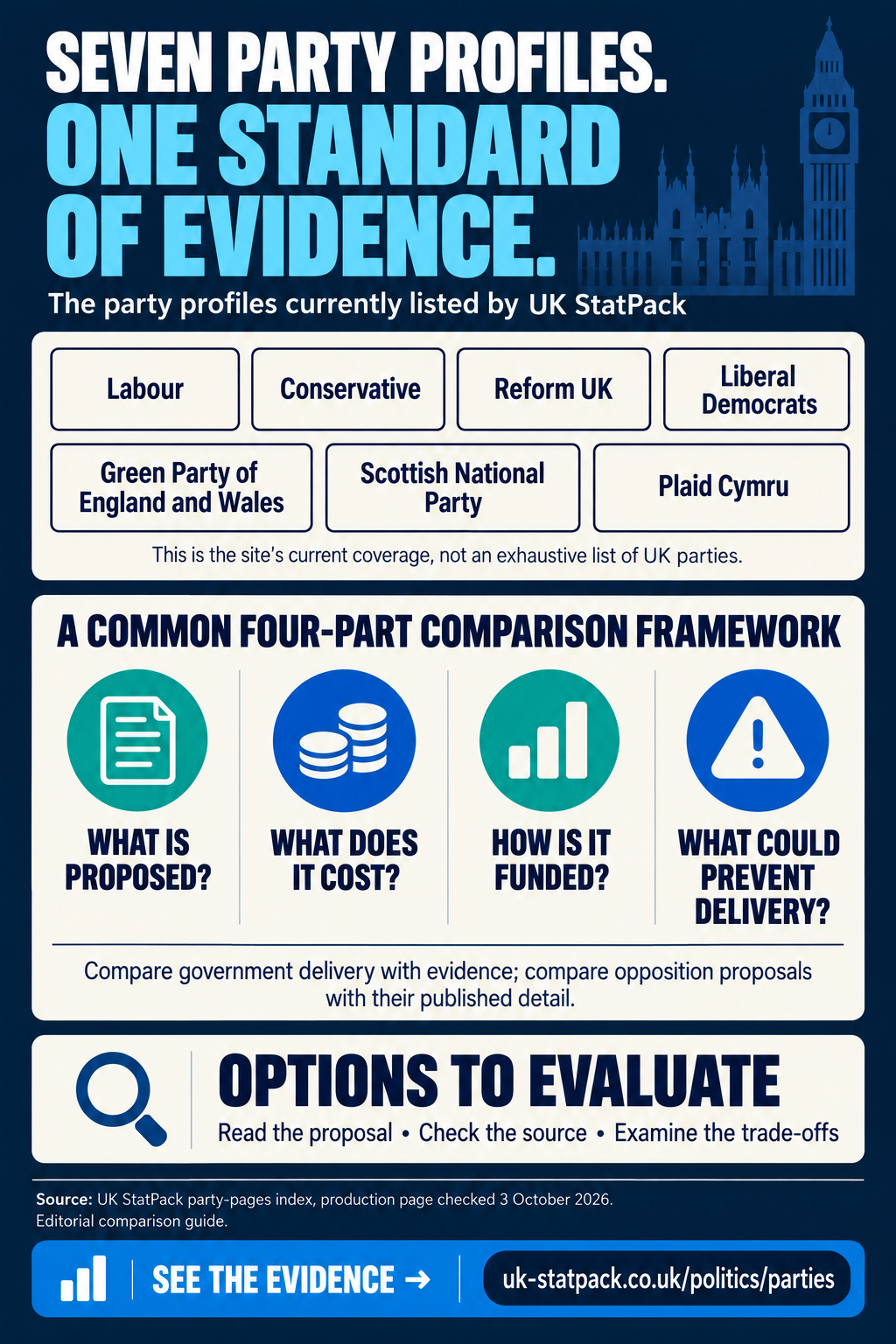
Text and data version
Seven party profiles. One standard of evidence. The site profiles seven parties using the same comparison fields and source standard. It does not rank them, and it is not every UK party.
Editorial explainer: no statistic is shown.
Image description: Seven party profiles. One standard of evidence — editorial explainer from UK Facts.
All visual summaries, their source records and their publication state are listed on Shareable visuals.
Go deeper
What does each party propose on an issue?Housing, NHS, Tax and spending, Work, Education, Energy, Immigration.Side by side on identical fields.Read the chapter → What does each party propose on an issue? How would each proposal work?Mechanisms differ more than headlines suggest.Read the mechanism and scope rows together.Read the chapter → How would each proposal work? Were the sums checked?The IFS reviewed every party’s 2024 plans.Its summary and main caveat for each party.Read the chapter → Were the sums checked? Is it law, a pledge or a suggestion?A manifesto pledge is not an enacted change.How each status is labelled here.Read the chapter → Is it law, a pledge or a suggestion? What has the governing party delivered?Delivery is assessed only where a party holds office.Go to the pledge tracker.Read the chapter → What has the governing party delivered?
Evidence → choices → outcomes
What the evidence can tell us
Readers can compare what each party proposes — mechanism, cost, funding and timing — on the same basis, with gaps shown as gaps and 2024 proposals kept separate from current policy.
How we assessed these options
What would it take to improve this?
What would make parties easier to compare?
The outcome we want: Readers can compare what each party proposes — mechanism, cost, funding and timing — on the same basis, with gaps shown as gaps and 2024 proposals kept separate from current policy.
The main constraint: Comparison is limited by what parties publish: costings use different years, bases and coverage, devolved parties propose changes to different powers, and no independent body costs manifestos on a common basis — an evidence constraint that depends on parties’ choices.
Constraint type: evidence, coordination.
The position today
Which quadrant a point sits in is our analytical judgement, not a statistical category. Each point says whether it is a measured fact, our synthesis or a risk.
What we can build on Strengths
Parties publish their programmes, and this page sets 7 parties’ 2024 manifesto proposals on 7 issues side by side on identical fields (49 of 49 cells), each with a page reference.
Our synthesisConfidence: High
Source: Labour, Change: Labour Party Manifesto 2024 (Manifesto (page references in each cell)); Conservative, The Conservative and Unionist Party Manifesto 2024 (Clear Plan. Bold Action. Secure Future.) (Manifesto (page references in each cell)); Liberal Democrats, For a Fair Deal: Liberal Democrat Manifesto 2024 (Manifesto (page references in each cell)); Reform UK, Our Contract with You (Manifesto (page references in each cell)); Green Party of England and Wales, Real Hope. Real Change. (Green Party 2024 General Election Manifesto, long version) (Manifesto (page references in each cell)); SNP, A Future Made in Scotland (SNP General Election Manifesto 2024) (Manifesto (page references in each cell)); Plaid Cymru, For Fairness, For Ambition, For Wales (Plaid Cymru Manifesto for the Westminster General Election 2024) (Manifesto (page references in each cell))
What government has committed to
No commitment found. No legal standard or official process for setting party manifestos side by side.
Searched: gov.uk search; Hansard “cost manifestos” 2025–2026; 4 Oct 2026
Checked 4 October 2026. A commitment is not delivery.
Options (2)
Apply the same independent costing test to every manifesto
One template for every party keeps the comparison fair.
Who: UK Facts; independent fiscal bodies · Evidence: Expert or audit recommendation · Status: Site-editorial action
Source: Institute for Fiscal Studies, manifesto analysis: Paul Johnson’s opening remarks (cross-party) (Opening remarks, PDF pp.2–3)
Label every proposal by status
Shows which proposals are pledges, policies or aspirations.
Who: UK Facts · Evidence: Untested proposal · Status: Site-editorial action
Independent fiscal scrutiny of every main party’s plans was published before polling day.
Measured factConfidence: High· June 2024· United Kingdom
Source: Institute for Fiscal Studies, manifesto analysis: Paul Johnson’s opening remarks (cross-party) (Opening remarks, PDF pp.1–3)
What government has committed to
Legislation: The OBR may not consider the effect of alternative policies, which bars it from costing opposition manifestos; independent scrutiny comes from bodies such as the IFS.
- Who and when:
- Earlier UK government (before July 2024), 22 March 2011.
- Since 20 July 2026:
- Kept by the Burnham government. Standing law; no Burnham-era proposal to change it was found. Source: legislation.gov.uk, Budget Responsibility and National Audit Act 2011, section 5 (In-force text).
- Source:
- legislation.gov.uk, Budget Responsibility and National Audit Act 2011, section 5 (Section 5(3)(b))
Checked 4 October 2026. A commitment is not delivery.
Options (2)
Independent official costing of manifestos
An OBR remit would put every party’s plans on one official basis; it needs a change to the 2011 Act.
Who: Parliament; HM Treasury; OBR · Evidence: Expert or audit recommendation · Status: External proposal
Source: Institute for Government, Asking the OBR to cost manifestos could make sense, but would be complicated (19 November 2019) (Article text)
Apply the same independent costing test to every manifesto
Uses the existing independent scrutiny consistently.
Who: UK Facts · Evidence: Expert or audit recommendation · Status: Site-editorial action
Source: Institute for Fiscal Studies, manifesto analysis: Paul Johnson’s opening remarks (cross-party) (Opening remarks)
What is holding us back Weaknesses
5 of 7 parties published a costings table (not SNP or Plaid Cymru), and those tables use different years and bases, so they cannot be ranked on one scale.
Our synthesisConfidence: Moderate
Source: SNP, A Future Made in Scotland (SNP General Election Manifesto 2024); Plaid Cymru, For Fairness, For Ambition, For Wales (Plaid Cymru Manifesto for the Westminster General Election 2024); Institute for Fiscal Studies, manifesto analysis: Paul Johnson’s opening remarks (cross-party) (Opening remarks, PDF p.2 (“so-called fully costed manifestos”))
What government has committed to
No commitment found. No requirement for parties to publish costings on a common basis; the OBR is barred from costing alternatives (Budget Responsibility and National Audit Act 2011, s.5(3)(b)).
Searched: gov.uk; Hansard; legislation.gov.uk; 4 Oct 2026
Checked 4 October 2026. A commitment is not delivery.
Options (2)
ShortlistedApply the same independent costing test to every manifesto
Asks every party to cost on one baseline and year.
Who: UK Facts; parties · Evidence: Expert or audit recommendation · Status: Site-editorial action
Source: Institute for Fiscal Studies, manifesto analysis: Paul Johnson’s opening remarks (cross-party) (Opening remarks)
Independent official costing of manifestos
Official costing on one basis.
Who: Parliament; OBR · Evidence: Expert or audit recommendation · Status: External proposal
Source: Institute for Government, Asking the OBR to cost manifestos could make sense, but would be complicated (19 November 2019) (Article text)
Almost all parties counted on raising £5 billion or more from tackling tax evasion and avoidance — a yield the IFS treated as uncertain.
Measured factConfidence: High· June 2024· United Kingdom
Source: Institute for Fiscal Studies, manifesto analysis: Paul Johnson’s opening remarks (cross-party) (Opening remarks, PDF p.3)
What government has committed to
Target: The government’s own tax-gap package is expected to raise £10bn a year by 2029-30 (Autumn Budget 2024 £6.5bn, extended at Spring Statement 2025 and Budget 2025), already in the forecasts.
- Who and when:
- Starmer government (to July 2026), 26 November 2025.
- Since 20 July 2026:
- Kept by the Burnham government. HMRC restated the total under the Burnham government (13 August 2026). Source: HM Revenue and Customs, HMRC performance update: 2026 to 2027 quarter 1 (13 August 2026) (“£10 billion of additional tax revenue per year by 2029 to 2030”).
- Source:
- HM Treasury, Budget 2025 (HTML) (Section 3.3 “Further reforms to close the tax gap”)
Checked 4 October 2026. A commitment is not delivery.
Options (2)
ShortlistedApply the same independent costing test to every manifesto
Scores compliance yields separately and labels them uncertain.
Who: UK Facts · Evidence: Expert or audit recommendation · Status: Site-editorial action
Source: Institute for Fiscal Studies, manifesto analysis: Paul Johnson’s opening remarks (cross-party) (Opening remarks)
Give every commitment an owner, budget and measurable result
Tracks delivery of tax-gap pledges against HMRC’s tax-gap statistics.
Who: Cabinet Office; HM Treasury · Evidence: Expert or audit recommendation · Status: External proposal · Works through Follow the money: Reporting the package’s cash outturn on the follow-the-money page tests whether evasion yields promised by parties are realistic.
Source: National Audit Office, Lessons learned: a planning and spending framework that enables long-term value for money (HC 234, Session 2024-25) (Summary paragraph 11)
What could improve things Opportunities
One scrutiny template for every party, and delivery evidence for the party that won, would connect what was promised with what happened.
Depends on: The template is fixed before review, applied to all parties, and missing costings stay visibly missing.
Our synthesisConfidence: Moderate
Source: Institute for Fiscal Studies, General Election 2024: IFS manifesto analysis (event page; opening remarks by Paul Johnson published as a PDF) (Event page); National Audit Office, Lessons learned: a planning and spending framework that enables long-term value for money (HC 234, Session 2024-25) (Summary paragraph 11)
What government has committed to
No commitment found. No commitment to publish delivery evidence for the winning party’s pledges was found; outcome delivery plans have not been republished and the new OneGov Delivery Agency runs operational services, not commitment tracking.
Searched: gov.uk “outcome delivery plans”, “Plan for Change milestones” since 2025; machinery-of-government fact sheet (July 2026); 4 Oct 2026
Checked 4 October 2026. A commitment is not delivery.
Options (3)
ShortlistedGive every commitment an owner, budget and measurable result
Delivery evidence for the winning party connects promise to result.
Who: Cabinet Office; HM Treasury · Evidence: Expert or audit recommendation · Status: External proposal · Works through Manifesto tracker: A plan per pledge gives the manifesto tracker an official measure for pledges it cannot grade.
Source: National Audit Office, Lessons learned: a planning and spending framework that enables long-term value for money (HC 234, Session 2024-25) (Summary paragraph 11, recommendation (a))
ShortlistedApply the same independent costing test to every manifesto
One scrutiny template for every party.
Who: UK Facts · Evidence: Expert or audit recommendation · Status: Site-editorial action
Source: Institute for Fiscal Studies, manifesto analysis: Paul Johnson’s opening remarks (cross-party) (Opening remarks)
Label every proposal by status
Separates 2024 pledges from current policy.
Who: UK Facts · Evidence: Untested proposal · Status: Site-editorial action
What could make it worse Threats
Incomplete coverage of national and devolved parties, selective presentation, and treating a 2024 pledge as current policy could all mislead readers.
Risk, not a certaintyConfidence: Moderate
Source: Institute for Fiscal Studies, General Election 2024: IFS manifesto analysis (event page; opening remarks by Paul Johnson published as a PDF) (Event page (distinguish proposals from enacted policy))
What government has committed to
No commitment found. No government commitment applies to how the site presents party proposals.
Searched: Not applicable (site method), 4 Oct 2026
Checked 4 October 2026. A commitment is not delivery.
Options (2)
Label every proposal by status
Stops a 2024 pledge being read as current policy.
Who: UK Facts · Evidence: Untested proposal · Status: Site-editorial action
Apply the same independent costing test to every manifesto
Extends identical fields to devolved parties to avoid selective coverage.
Who: UK Facts · Evidence: Expert or audit recommendation · Status: Site-editorial action
Source: Institute for Fiscal Studies, manifesto analysis: Paul Johnson’s opening remarks (cross-party) (Opening remarks)
The actions worth examining
These actions concern transparency, accountability and informed choice — not a spending programme, and not a view on which party or system is right.
Action 1A38Policy status: site-editorial action
Apply the same independent costing test to every manifesto
Compare every party’s mechanisms, spending paths, funding assumptions and distributional effects on one template, keeping missing estimates visible rather than filling them in.
The thread: issue, evidence, action
- Who decides:
- UK Facts and independent analysts (scrutiny); parties (proposals); Parliament (any statutory costing role) (UK)
- Evidence:
- Expert or audit recommendation. Independent fiscal scrutiny by the IFS; not an evaluation of whether common scrutiny changes what parties propose or how people vote.
- Expected effect:
- Direction plausible; size not established.
- Cost and funding
Not yet costed
Funding: Not a direct public-spending programme
Why it is shortlisted here: Makes the comparison this page exists for fairer: one template, gaps visible, every party on the same standard.
What it takes
The problem
Party costings use different years, bases and coverage, and independent scrutiny in 2024 found the main manifestos silent on the largest fiscal choices.
Who is affected, and where
Voters comparing party programmes. Territory: UK. Devolved parties often propose changes to devolved powers, so the template must show the scope of each proposal. Northern Ireland parties are not yet covered on this site.
Policy status
UK Facts proposal. The party comparison already shows each 2024 proposal on identical fields. Official costing of manifestos by the OBR is a separate option kept on the parties page; the OBR does not currently cost manifestos.
The evidence
- What the research found:
- The IFS said neither main manifesto faced up to the fiscal choices: plausible settlements for the NHS, childcare and defence would likely leave other services facing cuts of £10–20 billion a year, with £18 billion a year of real-terms cuts to investment by 2030 under existing plans. Almost all parties relied on raising £5 billion or more from tackling evasion and avoidance.
- Evaluated on:
- The 2024 general election manifestos, mainly Conservative and Labour; United Kingdom, June 2024
- Our recommendation (separate from the research):
- Publish a fixed comparison template, apply it to every party on the same evidence standard, date each assessment and keep a correction history; treat a missing costing as missing, never as zero.
- Strongest counter-evidence:
- Manifestos are statements of intent, not budgets. A common template can create false precision and favours parties with costing capacity; devolved parties’ powers differ, which limits like-for-like comparison.
Cost and funding
Cost completeness: Not yet costed. Funding: Not a direct public-spending programme.
- Common comparison template and dated assessments of every manifesto (private contribution; paid by UK Facts): Not yet costed. Editorial cost only. The parties’ own policy packages are not costs of this action.
- Who pays:
- UK Facts and independent analysts (research time). Parties’ policy packages carry their own costs, which stay uncommitted unless adopted and funded through the proper process.
- Financing proposed:
- UK Facts’ research budget.
- Gap remaining:
- Staff time not costed.
What delivery needs
- Skills:
- Fiscal analysts.
- Operational capacity:
- Review time during an election period.
- Infrastructure:
- The party-comparison data.
- Permissions:
- None.
- Law:
- None (a statutory OBR role would need legislation).
- Public consent:
- Parties publishing enough detail to assess.
First step and stages
First step: Publish a fixed comparison template, and seek clarification from parties only through an authorised editorial process. (owner: UK Facts editors)
- Publish the template — UK Facts editors (proposed stage, not an official timetable)
- Source review of every party — UK Facts with independent analysts (proposed stage, not an official timetable)
- Dated assessments with a correction history — UK Facts editors (proposed stage, not an official timetable)
Depends on: Parties publishing costings; A37: delivery evidence for the party in office
Trade-offs
- Who gains and who loses:
- Informs all voters; parties with complete costings are easier to scrutinise, which may disadvantage small parties with little costing capacity.
- What else the money or effort could do:
- Editorial time.
- Strongest counterargument:
- Detailed costing rewards parties with civil-service-style capacity and can crowd out debate about values and priorities.
- Risks:
- False precision, different devolved powers, and confusing a missing costing with a deliberately zero-cost policy.
How we would judge it
- Baseline:
- Party–issue cells covered and parties with published costings (party comparison page).
- Leading indicator:
- Share of proposals assessed on the template with a dated source.
- Outcome:
- Unresolved costing gaps visible for every party; reproducible judgements.
- Continue, adapt or stop:
- Revise the template if two reviewers reach different results on the same proposal.
Earlier option on this page
This card replaces the option “Ask parties to cost on a common basis” (external option). Its evidence: In 2024 parties used different years and bases (see the costings section). There is no UK evaluation of whether a common template changes what parties propose. Institute for Fiscal Studies, manifesto analysis: Paul Johnson’s opening remarks (cross-party)
Sources
- Institute for Fiscal Studies, manifesto analysis: Paul Johnson’s opening remarks (cross-party), Opening remarks, PDF pp.2–3 (2024-06-24; full text checked)
- Institute for Fiscal Studies, General Election 2024: IFS manifesto analysis (event page; opening remarks by Paul Johnson published as a PDF), Event page summarising the same analysis (2024-06-24; relevant passages checked)
Source published 24 June 2024 (IFS); evidence reviewed 2026-10-04. Reconsider if: A general election is called; A party publishes a new programme; Legislation gives the OBR a manifesto-costing role.
Also on: /manifesto — one shared record, so its cost is counted once.
Action 2A37Policy status: external proposal
Give every commitment an owner, budget and measurable result
Departments publish dated delivery plans with baselines, milestones and spending for each commitment, keep the original promise and every revision, and explain slippage — so progress is judged against a plan rather than a speech.
The thread: issue, evidence, action
- Issue Weakness (Manifesto tracker): Of 11 tracked pledges, 0 state no baseline, 1 has no published measure that matches the promise and 2 are too early to judge, so only 8 can be graded today. Also: opportunityHow acting here reaches it: For the party in office, an owner, budget and measure for each pledge lets the manifesto tracker grade pledges it cannot grade today.
- Evidence Tracked pledges that can be graded today
- Action A37, this action
- Who decides:
- Cabinet Office and HM Treasury, with each responsible department; Parliament scrutinises (UK)
- Evidence:
- Expert or audit recommendation. An independent audit recommendation drawn from NAO value-for-money work; no evaluation shows that published plans improve delivery.
- Expected effect:
- Direction plausible; size not established.
- Cost and funding
Not yet costed
Funding: Not a direct public-spending programme
Why it is shortlisted here: For the party in office, links proposals to owners, budgets and measured results, so promises can be checked against delivery.
What it takes
The problem
Half the commitments tracked on this site lack a dated, costed plan, and departments have not published outcome delivery plans since July 2021, so delivery is hard to judge against what was promised.
Who is affected, and where
Voters, Parliament and the people who use the services each commitment affects. Territory: UK. UK government departments; many commitments apply to England only. Devolved governments publish their own programmes and are not covered here.
Policy status
Proposed by researchers or others, not government policy. Recommended by the National Audit Office (October 2024). Outcome delivery plans were produced after the 2020 Spending Review and published in July 2021, but not since; ministers told a Commons committee in 2023 that they were used internally. UK Facts’ own registry tracks plan, authority, delivery and outcome for each tracked commitment — a site-editorial complement, not a substitute.
The evidence
- What the research found:
- The NAO recommends publishing departmental outcome delivery plans and cross-cutting mission plans at least annually, plus a summary of spending choices after each spending review. It finds government “prone to under-estimate on costs and over-promise on outcomes”.
- Evaluated on:
- UK central government planning and spending, 1998–2024; UK central government
- Our recommendation (separate from the research):
- Fill the missing owner, baseline, outcome, budget and milestone fields for every tracked commitment, publish them in the next planning cycle, and report plan completeness and service outcomes separately.
- Strongest counter-evidence:
- Plans continued inside government after 2021 without visible effect; published targets can be gamed and add workload, and publication is not delivery.
Cost and funding
Cost completeness: Not yet costed. Funding: Not a direct public-spending programme.
- Departmental analytical, finance and delivery staff time for published plans (administration; paid by central government): Not yet costed. No grant programme, but existing staff time has an opportunity cost; it is not zero. The NAO does not cost its recommendation.
- Who pays:
- Departments, from administrative budgets: analytical, finance and delivery staff time. There is no grant programme, but the staff time is a real cost.
- Financing proposed:
- A named departmental or Cabinet Office allocation, or an explicit statement of which existing work gives way.
- Gap remaining:
- Staff time not costed — not zero.
What delivery needs
- Skills:
- Analysts, finance and delivery staff.
- Operational capacity:
- Departmental performance data matched to each commitment.
- Infrastructure:
- A public register of commitments with revision history.
- Permissions:
- None.
- Law:
- None: an administrative decision.
- Public consent:
- Ministers accepting public milestones that may be missed.
First step and stages
First step: Complete the missing owner, baseline, outcome, budget and milestone fields for each tracked commitment. (owner: Cabinet Office with each department (UK Facts for its own registry))
- Complete the missing fields — Departments; UK Facts for its registry (proposed stage, not an official timetable)
- Publish in the next planning cycle — Cabinet Office and HM Treasury (proposed stage, not an official timetable)
- Report against stable milestones — Departments, scrutinised by Parliament and the NAO (proposed stage, not an official timetable)
Depends on: A matching official statistic for each commitment; Funding decisions at fiscal events
Trade-offs
- Who gains and who loses:
- Voters and Parliament gain information; the cost falls on departmental staff time.
- What else the money or effort could do:
- Analyst and finance time not spent on delivery itself.
- Strongest counterargument:
- Fixed public targets can distort priorities and invite gaming; plans existed internally without improving outcomes.
- Risks:
- Target gaming, bureaucratic workload, and treating publication as delivery.
How we would judge it
- Baseline:
- Share of tracked commitments with a dated, costed plan (this site’s delivery board).
- Leading indicator:
- Plans published with owner, baseline, budget and milestones for each commitment.
- Outcome:
- Timely service outcomes for each commitment, reported separately from plan completeness.
- Continue, adapt or stop:
- Treat plan completeness as an input only; judge success on measured outcomes, and flag any commitment whose milestones slip without a published explanation.
Sources
- National Audit Office, Lessons learned: a planning and spending framework that enables long-term value for money (HC 234, Session 2024-25), Summary paragraph 11, recommendation (a) (printed p.9) (2024-10-27; relevant passages checked)
- National Audit Office, Lessons learned: a planning and spending framework that enables long-term value for money (HC 234, Session 2024-25), Paragraph 1.17 (printed p.18): plans not published since July 2021 (2024-10-27; relevant passages checked)
- National Audit Office, Lessons learned: a planning and spending framework that enables long-term value for money (HC 234, Session 2024-25), Paragraph 2.52 (printed p.40) (2024-10-27; relevant passages checked)
- National Audit Office, Lessons learned: a planning and spending framework that enables long-term value for money (HC 234, Session 2024-25), Paragraph 2.16 (printed p.26): plans kept internally; some metrics poorly aligned to outcomes (2024-10-27; relevant passages checked)
Source published 27 October 2024 (NAO); evidence reviewed 2026-10-04. Reconsider if: The government publishes outcome delivery plans; The Budget confirms or changes funding for tracked commitments; A further NAO report on planning and spending.
Also on: /government, /manifesto — one shared record, so its cost is counted once.
Decision briefs
The leading option set out as a decision someone could take: who decides, who benefits, the best evidence, cost and funding, and the main trade-off. The full research record is one click away.
Decision briefStatutory/accountability reformReviewed 2026-10-04
Cost every main party’s manifesto independently, then track the winner’s promises against those costings
The thread: issue, evidence, action
- Issue Weakness (Manifesto tracker): Of 11 tracked pledges, 0 state no baseline, 1 has no published measure that matches the promise and 2 are too early to judge, so only 8 can be graded today. Also: opportunityHow acting here reaches it: For the party in office, an owner, budget and measure for each pledge lets the manifesto tracker grade pledges it cannot grade today.
- Evidence Tracked pledges that can be graded today
- Action Give every commitment an owner, budget and measurable result
- Decision required
- Parliament decides whether to give the Office for Budget Responsibility (or a parliamentary budget office) a duty to publish, after each general election, a costing of the main parties’ commitments on a common basis, with a voluntary costing service during the campaign; the governing party’s commitments are then tracked from the original promise through later changes to enacted policy.
- Who and where
- Voters comparing party programmes; Parliament. Applies in: UK.
- Accountable body
- Parliament, on a proposal from HM Treasury
- Intervention
- Cost the main parties’ commitments on one baseline and report after the election, then track the winner’s commitments against those costings.
- Best evidence, and where it applies
- Australia’s Parliamentary Budget Office has, by law, published a costing of the major parties’ election commitments after every federal election since 2013; in the Netherlands, eight parties volunteered their 2023 programmes for the CPB’s common costing.Studied in: Major Australian parties’ election commitments (Elections 2013–2025).How closely the comparison transfers to this decision: Australia — partial.
- Extra cost of this change
- Capital: none identified in the brief.Recurring: Departmental analytical time for tracking the governing party’s commitments — Not yet costed; Independent costing of manifestos (OBR or parliamentary budget office) — not yet established.
- Funding
- Mainly a legal or regulatory change: administration costs still need a budget.Committed to this change: none.Possible source, not an award: none identified.Unfunded: Not costed.
- Savings and wider benefits
- Not yet specified: no cashable saving or avoided cost has been costed for this change. Expected outcomes are listed one by one in the research appendix and are never added together or counted as money available.
- First 90-day step
- HM Treasury and the Treasury Committee consult on an OBR election-costing remit, using the Australian and Dutch designs as optionsThe proposed first milestone; a 90-day date is not yet specified. Owner: HM Treasury with the Commons Treasury Committee. Proposed by UK Facts, not an official deadline.
- Twelve-month milestone
- Not yet specified.Time to a first useful result: The next general election after legislation.
- Outcome, and when to scale or stop
- Measure: Parties submitting policies to the voluntary service.Scale if: Costings are published for the main parties on a common basis and are not successfully challenged as biased.Stop if: Not a stop decision: if the role damages the OBR’s forecasting independence, move it to a separate parliamentary body.
- Main trade-off
- An independent costing role draws the OBR into contested political territory and favours parties with policy capacity; without it, party costings use different years, bases and coverage.
- Source and review date
- 2025 Election commitments report (foreword and legislative requirements) (20 June 2025); manifesto analysis: Paul Johnson’s opening remarks (cross-party) (June 2024). Reviewed 2026-10-04.
An editorial proposal by UK Facts for discussion, not government policy. Records: A37, A38 · costs C-A37-ANALYSTS
Research appendix: study design, effect sizes and limits, alternatives, full costing, international comparisons and how we would know
1.The change, in plain words
Cost every main party’s manifesto independently, then track the winner’s promises against those costings
2.The decision requested
- Decision
- Decide whether to legislate for a post-election costing of the main parties’ commitments by the OBR (or a new parliamentary body), and whether to offer parties a confidential costing service during campaigns; meanwhile, keep this site’s comparison separating each party’s original 2024 policy, later changes and enacted policy.
- Accountable institution
- Parliament, on a proposal from HM Treasury
- Geography
- UK
- Powers
- A new OBR function needs primary legislation (the Budget Responsibility and National Audit Act 2011 sets its remit); parties’ participation in any pre-election service would be voluntary.
- Delivery partners
- Office for Budget Responsibility; HM Treasury and HMRC (costing data); Political parties; Commons Treasury Committee
3.Who it is for, and what changes beyond today
- Target population
- Voters comparing party programmes; Parliament.
- Eligibility
- The main parties standing at a general election; on this site, the 7 parties whose 2024 manifestos are compared.
- Scale
- One costing exercise per general election, plus ongoing tracking of the governing party’s commitments.
- Baseline
- 5 of 7 parties compared on this site published a costings table in 2024. The OBR does not cost manifestos. The IFS found neither main 2024 manifesto faced up to the fiscal choices, and almost all parties relied on raising £5bn or more from tackling evasion and avoidance.
Source: Institute for Fiscal Studies, manifesto analysis: Paul Johnson’s opening remarks (cross-party) (Opening remarks, PDF pp.2–3); Labour, Change: Labour Party Manifesto 2024 (Costings section)
- Change beyond existing law or funding
- Independent think tanks scrutinise manifestos voluntarily and this site applies one template; no body has a duty to cost all parties on a common basis or to report afterwards on what was promised and what it cost. The change creates that duty, or tests a voluntary version first.
4.How it would work
Do: Cost the main parties’ commitments on one baseline and report after the election, then track the winner’s commitments against those costings Changing: so that promises can be compared before polling day and checked against delivery afterwards
Comparable published costings for the main parties’ commitments
Hypothesis to test
An accountability output; Australia’s post-election reports show it can be done, not that it changes votes.
Fewer uncosted commitments relying on uncertain yields (such as tax-gap revenue)
Hypothesis to test
No evaluation estimates this effect.
Outcomes are kept separate and never added into one impact figure.
5.Best evidence
2025 Election commitments report (foreword and legislative requirements)
- Author or institution:
- Parliamentary Budget Office (Australia)
- Published:
- 20 June 2025
- Evaluation period:
- Elections 2013–2025
- Design:
- Statutory reporting function; reviewed by audit and parliamentary bodies
- Sample or population:
- Major Australian parties’ election commitments
- Effect and uncertainty:
- Section 64MA of the Parliamentary Service Act 1999 requires a post-election report by the later of 30 days after the caretaker period or 7 days before Parliament sits; five reports since 2013.
- Limits:
- Reports after the election; no evaluation of effects on voters or policy; read via an archived copy.
Where: Foreword; legislative requirements; reviews of the PBO. Affiliation is provenance, not proof of quality.
manifesto analysis: Paul Johnson’s opening remarks (cross-party)
- Author or institution:
- Institute for Fiscal Studies
- Published:
- June 2024
- Evaluation period:
- 2024 manifestos
- Design:
- Independent analysis of manifestos
- Sample or population:
- Main parties’ 2024 manifestos
- Effect and uncertainty:
- Plausible settlements for the NHS, childcare and defence would likely leave other services facing cuts of £10–20bn a year; almost all parties relied on £5bn or more from tackling evasion and avoidance.
- Limits:
- Voluntary think-tank scrutiny on its own assumptions.
Where: Opening remarks, PDF pp.2–3. Affiliation is provenance, not proof of quality.
6.Alternatives, counter-evidence and who loses
- Closest feasible alternative
- Continue voluntary scrutiny by independent think tanks and this site’s common template.
- Strongest counter-evidence
- Manifestos are statements of intent, not budgets; a common costing can create false precision, favours parties with costing capacity, and devolved parties propose policies for different powers.
Source: Institute for Fiscal Studies, manifesto analysis: Paul Johnson’s opening remarks (cross-party) (Opening remarks)
- Distributional effects
- Small parties with little policy capacity may look worse; voters gain comparable information.
- Main downside
- The OBR’s perceived neutrality could suffer if parties dispute its costings during a campaign.
| Option | Who is reached | Evidence | Likely outcome and timing | Cost and funding | Main trade-off |
|---|---|---|---|---|---|
| The proposalStatutory post-election costing (with a voluntary campaign service) and tracking of the winner’s commitments | Voters and Parliament | Australian PBO (statutory since 2012); Dutch CPB (voluntary) | From the next election after legislation | Not costed | Draws the OBR into politics |
| Current policyCurrent practice: voluntary think-tank scrutiny; this site’s common template | Readers of that scrutiny | IFS 2024 analysis | Each election | Privately funded; site time | Different bases; no duty to cover every party |
| AlternativeVoluntary pre-election costing only (Dutch model) | Parties that opt in | CPB Charted Choices: eight parties in 2023 | Next election | Not costed | Parties can opt out |
The options compared, including current policy
The proposal
Statutory post-election costing (with a voluntary campaign service) and tracking of the winner’s commitments
- Who is reached
- Voters and Parliament
- Evidence
- Australian PBO (statutory since 2012); Dutch CPB (voluntary)
- Likely outcome and timing
- From the next election after legislation
- Cost and funding
- Not costed
- Main trade-off
- Draws the OBR into politics
Current policy
Current practice: voluntary think-tank scrutiny; this site’s common template
- Who is reached
- Readers of that scrutiny
- Evidence
- IFS 2024 analysis
- Likely outcome and timing
- Each election
- Cost and funding
- Privately funded; site time
- Main trade-off
- Different bases; no duty to cover every party
Alternative
Voluntary pre-election costing only (Dutch model)
- Who is reached
- Parties that opt in
- Evidence
- CPB Charted Choices: eight parties in 2023
- Likely outcome and timing
- Next election
- Cost and funding
- Not costed
- Main trade-off
- Parties can opt out
7.What other countries or the devolved nations show
Country lesson · Australia, PBO established 2012; post-election reports since 2013 (fifth in 2025)
Independent costing of election commitments in Australia
Evidence: Expert or audit recommendationPartial match: some conditions differ
- What was changed
- The Parliamentary Budget Office costs policies confidentially for parties during the campaign on request and, by law, publishes the budget impact of major parties’ election commitments after each election.
- Study design and population
- Statutory function; reviewed by audit and parliamentary bodies, not causally evaluated Australian parliamentary parties and voters
- Measured outcome there
- Administrative result: a published, comparable costing of each major party’s commitments after every federal election since 2013; reviews in 2014, 2016–17 and 2019–20.
- Cost status
- PBO running costs not taken from a primary source here.
- What failed or remains uncertain
- The statutory report comes after polling day, so it informs accountability more than the vote; campaign costings depend on parties choosing to submit them. The Netherlands’ CPB does pre-election costing but participation is voluntary.
- Why the UK differs
- The OBR has no remit to cost manifestos; UK elections are not fixed-date; devolved parties propose policies for different powers.
- First change required here
- Decide whether to give the OBR (or a new parliamentary body) a statutory duty to publish a post-election costing of the main parties’ commitments, and a voluntary pre-election service.
Not a UK forecast: the effect above was measured in that place and population. Source: Parliamentary Budget Office (Australia), 2025 Election commitments report (foreword and legislative requirements) (Foreword; legislative requirements); CPB Netherlands Bureau for Economic Policy Analysis, Charted Choices 2025–2028 (Keuzes in Kaart) (Publication page). Reviewed 2026-10-04.
8.What delivery needs first
- law — Primary legislation to give the OBR (or a new body) the remit. (Genuine veto: nothing proceeds without it; owner: Parliament)
- staff — OBR or new-body analysts and HMRC costing support during campaign periods. (Scarce resource shared with other priorities; owner: OBR with HM Treasury)
- public consent — Cross-party acceptance that an independent body will cost all parties. (Requirement; owner: Parties)
9.What it would cost
How the cost is built up: Costing staff per election (OBR or new body, plus HMRC support) + departmental tracking time. Parties’ policy costs are not costs of this proposal.
| Component | Unit and quantity | Unit cost or amount | Type, price year, period | Status |
|---|---|---|---|---|
| Departmental analytical time for tracking the governing party’s commitmentsDepartments with tracked commitments | staff time; quantity to be set from need and capacity | Not yet costed (ledger C-A37-ANALYSTS) | recurring; price year not stated; Ongoing | Not yet established |
| Independent costing of manifestos (OBR or parliamentary budget office)Main parties at each general election | per election; quantity to be set from need and capacity | Not yet established | recurring; price year not stated; Each general election | Not yet established |
Departmental analytical time for tracking the governing party’s commitments
Departments with tracked commitments
Not yet costed (ledger C-A37-ANALYSTS)
recurring; price year not stated; Ongoing; Not yet established
Independent costing of manifestos (OBR or parliamentary budget office)
Main parties at each general election
Not yet established per election
recurring; price year not stated; Each general election; Not yet established
10.Who pays, and what is missing
- Programme envelope (a possible route, not an award)
- None identified
- Allocation committed to this change
- None
- Remaining gap
- Not costed.
- Proposed financing
- A budget line for the OBR or new body set by Parliament; departmental administration budgets for tracking.
- Responsible payer
- central government
- Budget displaced
- OBR forecasting capacity during election periods, unless separately resourced.
11.First milestone and time to a useful result
HM Treasury and the Treasury Committee consult on an OBR election-costing remit, using the Australian and Dutch designs as options (Owner: HM Treasury with the Commons Treasury Committee. Proposed by UK Facts, not an official deadline.)
Time to first useful result: The next general election after legislation.
What could delay it: Parties oppose the remit The OBR judges the role a threat to its independence
12.How we would know
- Baseline
- 5 of 7 parties published a costings table (2024); no independent statutory costing.
- Comparison
- Coverage and consistency of costings at the next election against 2024.
- Leading indicator
- Parties submitting policies to the voluntary service.
- Follow-up
- The post-election report; tracking of the governing party’s commitments against it.
- Continue if
- Costings are published for the main parties on a common basis and are not successfully challenged as biased.
- Adapt if
- Parties decline the pre-election service: keep the post-election report only.
- Stop if
- Not a stop decision: if the role damages the OBR’s forecasting independence, move it to a separate parliamentary body.
- Thresholds
- Not yet set: An institutional design question; no numerical threshold is justified.
What is not yet known, and how to find out
- Cost of an election-costing function (cost)Next step: OBR and HM Treasury to estimate staffing, drawing on the Australian PBO’s published resources.Scope: One general election cycle · Data or quotes needed: Staff and HMRC support estimates · Who can estimate it: Office for Budget Responsibility with HM Treasury
- Whether independent costing changes manifestos or votes (effect)Next step: Compare the share of costed commitments before and after the remit.Defensible route: legal or accountability reform
Sources last checked 4 October 2026 · Owner: Evidence editor (James Harris) · Next check: the first trigger: The next general election timetable or manifesto publication.
Decision briefSite-maintenance taskReviewed 2026-10-04
Move the party page’s own quality checks to the methods, and lead with the choices
The thread: issue, evidence, action
- Issue Weakness: 5 of 7 parties published a costings table (not SNP or Plaid Cymru), and those tables use different years and bases, so they cannot be ranked on one scale. Also: weakness, opportunity
- Evidence Parties that published a costings table
- Action Apply the same independent costing test to every manifesto
- Decision required
- UK Facts moves its comparison template, the cell-coverage check and the plan to add Northern Ireland parties into the methods section, labelled as site maintenance, and opens the page with the substantive differences between parties on each issue.
- Who and where
- Readers of /politics/parties. Applies in: UK.
- Accountable body
- UK Facts editors
- Intervention
- Separate the site’s quality checks from the comparison itself.
- Best evidence, and where it applies
- IFS analysis of the 2024 manifestos: neither main manifesto faced up to the fiscal choices, which is why one template with visible gaps is used for every party.
- Extra cost of this change
- Capital: none identified in the brief.Recurring: Template maintenance and dated assessments — Not yet costed.
- Funding
- Not funded yet: a possible funding route exists, but nothing is allocated to this change.Committed to this change: none.Possible source, not an award: none identified.Unfunded: Staff time not costed.
- Savings and wider benefits
- Not yet specified: no cashable saving or avoided cost has been costed for this change. Expected outcomes are listed one by one in the research appendix and are never added together or counted as money available.
- First 90-day step
- Methods section “How the party comparison is checked” published; page opens with issue-by-issue differencesThe proposed first milestone; a 90-day date is not yet specified. Owner: UK Facts editors. Proposed by UK Facts, not an official deadline.
- Twelve-month milestone
- Not yet specified.Time to a first useful result: One release.
- Outcome, and when to scale or stop
- Measure: Methods section published with every check listed.Scale if: Readers identify party differences faster and can still find the coverage information.Stop if: Not applicable: the checks continue in the methods either way.
- Main trade-off
- Moving checks out of the main flow makes the page shorter, but readers must click through to see how complete the comparison is.
- Source and review date
- No external study: see the records listed below. Reviewed 2026-10-04.
An editorial proposal by UK Facts for discussion, not government policy. Records: A38 · costs C-A38-EDITORIAL
Research appendix: study design, effect sizes and limits, alternatives, full costing, international comparisons and how we would know
1.The change, in plain words
Move the party page’s own quality checks to the methods, and lead with the choices
2.The decision requested
- Decision
- Relocate the coverage statistic, template rules, costing-status method and Northern Ireland completion plan to the methods section; keep a one-line coverage note beside the comparison.
- Accountable institution
- UK Facts editors
- Geography
- UK
- Powers
- An editorial decision for this website.
- Delivery partners
- Independent analysts who review the template
3.Who it is for, and what changes beyond today
- Target population
- Readers of /politics/parties.
- Eligibility
- The 7 parties whose 2024 manifestos are compared; Northern Ireland parties to be added under the same template.
- Scale
- One page; no change to the underlying records.
- Baseline
- 49 of 49 party–issue cells have a verified, page-referenced entry; 5 of 7 parties published a costings table (not: SNP, Plaid Cymru). Northern Ireland parties are not yet included.
Source: Labour, Change: Labour Party Manifesto 2024 (Manifesto (page references in each cell))
- Change beyond existing law or funding
- The coverage check currently appears as a headline finding. The change moves quality checks to the methods and adds a dated plan for the Northern Ireland parties.
4.How it would work
Do: Separate the site’s quality checks from the comparison itself Changing: so that the first screen shows what parties propose, not how complete the site is
Readers find the substantive differences between parties sooner
Hypothesis to test
A presentation outcome; to be checked in reader sessions. No policy effect.
Outcomes are kept separate and never added into one impact figure.
6.Alternatives, counter-evidence and who loses
- Closest feasible alternative
- Keep the coverage check at the top as a trust signal.
- Strongest counter-evidence
- Readers may trust the comparison less if completeness is not visible up front.
- Distributional effects
- None. Smaller parties with no costings table remain shown as gaps, not zeros.
- Main downside
- Coverage gaps (Northern Ireland) are less visible.
| Option | Who is reached | Evidence | Likely outcome and timing | Cost and funding | Main trade-off |
|---|---|---|---|---|---|
| The proposalChecks in the methods; page leads with party differences | All readers of the page | Reader-journey review in the improvement plan | One release | Site time | Completeness less visible up front |
| Current policyCurrent page: coverage check as a headline finding | All readers of the page | The coverage statistic is a quality check, not a finding | No change | None | The main choices sit lower on the page |
The options compared, including current policy
The proposal
Checks in the methods; page leads with party differences
- Who is reached
- All readers of the page
- Evidence
- Reader-journey review in the improvement plan
- Likely outcome and timing
- One release
- Cost and funding
- Site time
- Main trade-off
- Completeness less visible up front
Current policy
Current page: coverage check as a headline finding
- Who is reached
- All readers of the page
- Evidence
- The coverage statistic is a quality check, not a finding
- Likely outcome and timing
- No change
- Cost and funding
- None
- Main trade-off
- The main choices sit lower on the page
8.What delivery needs first
- data — Northern Ireland party manifestos compiled on the same template before the coverage note can say “UK-wide”. (Requirement; owner: UK Facts editors)
9.What it would cost
How the cost is built up: Editorial time only.
| Component | Unit and quantity | Unit cost or amount | Type, price year, period | Status |
|---|---|---|---|---|
| Template maintenance and dated assessmentsUK Facts research time | staff time; quantity to be set from need and capacity | Not yet costed (ledger C-A38-EDITORIAL) | recurring; price year not stated; Each manifesto cycle | Not yet established |
Template maintenance and dated assessments
UK Facts research time
Not yet costed (ledger C-A38-EDITORIAL)
recurring; price year not stated; Each manifesto cycle; Not yet established
10.Who pays, and what is missing
- Programme envelope (a possible route, not an award)
- None identified
- Allocation committed to this change
- None
- Remaining gap
- Staff time not costed.
- Proposed financing
- UK Facts’ editorial budget.
- Responsible payer
- UK Facts
- Budget displaced
- Editorial time for other pages.
11.First milestone and time to a useful result
Methods section “How the party comparison is checked” published; page opens with issue-by-issue differences (Owner: UK Facts editors. Proposed by UK Facts, not an official deadline.)
Time to first useful result: One release.
What could delay it: Northern Ireland manifestos take longer to compile on the template
12.How we would know
- Baseline
- 49 of 49 cells; coverage check shown as a headline.
- Comparison
- The current page in reader sessions.
- Leading indicator
- Methods section published with every check listed.
- Follow-up
- Next reader-testing round.
- Continue if
- Readers identify party differences faster and can still find the coverage information.
- Adapt if
- Readers cannot find the coverage information.
- Stop if
- Not applicable: the checks continue in the methods either way.
- Thresholds
- Not yet set: A site presentation change; no numerical threshold.
What is not yet known, and how to find out
- Time needed to add Northern Ireland parties on the template (cost)Next step: Compile one Northern Ireland manifesto as a trial and time it.Scope: Northern Ireland parties’ 2024 manifestos · Data or quotes needed: Hours for one trial manifesto · Who can estimate it: UK Facts editors
Sources last checked 4 October 2026 · Owner: Site methods editor (James Harris) · Next check: the first trigger: A change to the party page’s data sources or methods.
More decision briefs on other pages
- Put every government commitment on a triage board: next decision, whose desk, what money is missing — the brief for “Give every commitment an owner, budget and measurable result”, on Government delivery
What it would take
The order things have to happen in
First, the prerequisite
Fix the comparison template and status labels before review
Owner: UK Facts editors
No date: the timing depends on the steps before it.
Then, the decision
Parties publish costings at the next general election; the governing party publishes delivery plans
Owner: Political parties; Cabinet Office and departments
No date: the timing depends on the steps before it.
Then, delivery
Dated assessments of every party on the template, with a correction history
Owner: UK Facts with independent analysts
No date: the timing depends on the steps before it.
Finally, the measured outcome
Comparable coverage, unresolved costing gaps visible, reproducible judgements
Owner: UK Facts
No date: the timing depends on the steps before it.
Who pays, and what is still missing
Cost, committed funding and the remaining gap for the same scope and years. A programme envelope is not an award to a project; a proposal is not committed money. None of these costs has been established yet, so no total is shown.
Cost and funding ledger
Common comparison template and dated assessments of every manifesto
A38 · private contribution · not costed
- Amount
- Not yet costed
- Who pays
- UK Facts
- Committed
- None identified
- Proposed, not committed
- —
- Gap
- Not established
Departmental analytical, finance and delivery staff time for published plans
A37 · administration · not costed
- Amount
- Not yet costed
- Who pays
- central government
- Committed
- None identified
- Proposed, not committed
- —
- Gap
- Not established
“Not yet costed” means no defensible cost has been found — not that the action is free. Lifetime benefits, benefit-cost ratios and forecast savings are never shown here as money available to spend.
What the evidence says each action changes
No effect has been established for these actions yet: direction plausible; size not established.
How we would know
The outcome measures to watch. A baseline is where we start, not a target; where there is no official target we say so.
Party–issue cells with a verified, page-referenced entry
cells · United Kingdom
- Baseline
- Not published
- Latest
- 49 of 49
- June 2024 manifestos
Target: none — coverage is complete for the parties included; Northern Ireland parties are not yet included.
Source: Labour, Change: Labour Party Manifesto 2024 (Labour cells; the other six manifestos are listed under sources and compiled the same way (2026-10-03)). Next release: when parties publish new programmes (check the release calendar).
Parties that published a costings table
parties · United Kingdom
- Baseline
- Not published
- Latest
- 5 of 7
- June 2024
Target: none — a party’s choice; recorded, not targeted.
Source: SNP, A Future Made in Scotland (SNP General Election Manifesto 2024) (No costings table; costing status read from each of the seven manifestos listed under sources). Next release: the next general election (check the release calendar).
Where the ideas come from
Research, counter-evidence and methods (10 sources; 2 claims held back)
- Change: Labour Party Manifesto 2024 — Labour, 13 June 2024.Party manifesto (primary text); United Kingdom. Relevant passages checked, 2026-10-04.
- The Conservative and Unionist Party Manifesto 2024 (Clear Plan. Bold Action. Secure Future.) — Conservative, 11 June 2024.Party manifesto (primary text); United Kingdom. Relevant passages checked, 2026-10-04.
- For a Fair Deal: Liberal Democrat Manifesto 2024 — Liberal Democrats, 10 June 2024.Party manifesto (primary text); United Kingdom. Relevant passages checked, 2026-10-04.
- Our Contract with You — Reform UK, 17 June 2024.Party manifesto (primary text); United Kingdom. Relevant passages checked, 2026-10-04.
- Real Hope. Real Change. (Green Party 2024 General Election Manifesto, long version) — Green Party of England and Wales, 12 June 2024.Party manifesto (primary text); United Kingdom. Relevant passages checked, 2026-10-04.
- A Future Made in Scotland (SNP General Election Manifesto 2024) — SNP, 19 June 2024.Party manifesto (primary text); United Kingdom. Relevant passages checked, 2026-10-04.
- For Fairness, For Ambition, For Wales (Plaid Cymru Manifesto for the Westminster General Election 2024) — Plaid Cymru, 13 June 2024.Party manifesto (primary text); United Kingdom. Relevant passages checked, 2026-10-04.
- manifesto analysis: Paul Johnson’s opening remarks (cross-party) — Institute for Fiscal Studies (Paul Johnson), 2024-06-24.Independent fiscal scrutiny (opening remarks, manifesto analysis); United Kingdom. Full text checked, 2026-10-04. Limits: Projections and judgements at June 2024 about the 2024 manifestos; not current party policy.
- General Election 2024: IFS manifesto analysis (event page; opening remarks by Paul Johnson published as a PDF) — Institute for Fiscal Studies, 2024-06-24.Cross-party fiscal scrutiny of the 2024 manifestos; United Kingdom. Relevant passages checked (read from an Internet Archive copy), 2026-10-04. Limits: An event summary; figures used on this site are taken from the opening-remarks PDF (registered separately), which was read in full. Projections at June 2024.
- Lessons learned: a planning and spending framework that enables long-term value for money (HC 234, Session 2024-25) — National Audit Office, 2024-10-27.Audit synthesis of NAO value-for-money work (HC 234, 2024–25); UK central government. Relevant passages checked, 2026-10-04. Limits: Written before the 2025 Spending Review; a published plan is an input to accountability, not a service improvement.
Counter-evidence and criticism
- Apply the same independent costing test to every manifesto: Manifestos are statements of intent, not budgets. A common template can create false precision and favours parties with costing capacity; devolved parties’ powers differ, which limits like-for-like comparison.
- Give every commitment an owner, budget and measurable result: Plans continued inside government after 2021 without visible effect; published targets can be gamed and add workload, and publication is not delivery. (National Audit Office)
Claims held back
- Any ranking of parties by cost, honesty or feasibility — Costings use different years and bases, and value judgements belong to readers. Needed: Not releasable as a score; comparisons stay field by field.
- Positions announced after July 2024 — Not yet reviewed with the same fields and a distinct status label. Needed: Review against the template with a “post-election announcement” label.
“Full text checked” means we read the report itself; “relevant passages” means the sections behind each figure; “summary or abstract only” means we could not read the full study, so no number from it is published here without another source.
Other options compared — not on the shortlist (2)
Other options compared
Options from earlier work on this page that are not on the shortlist. They remain valid choices; their evidence is shown as before.
- structuralStatus: external option
Independent official costing of manifestos
- Aims to:
- An official, consistent estimate of each party’s main tax and spending measures before polling day.
- How:
- An independent public body (such as the OBR) costs submitted manifesto measures on its forecast basis, as some other countries’ fiscal institutions do.
- Who decides:
- Parliament (remit); the OBR or another body (delivery).
- Main constraint:
- Would draw a fiscal watchdog into the campaign; tight timetable.
- Evidence:
- Limited evidence — plausible mechanism, little direct evaluation
See the trade-offs and evidence
- What the evidence shows
- The OBR does not currently cost manifestos. Independent analysis in 2024 came from the IFS and others; official costing elsewhere depends on institutional design, and its effect on proposals has not been evaluated in the UK.
- Resources
- Additional analytical staff during a short campaign window.
- Consent and decisions needed
- Legislation to change the OBR’s remit.
- Time
- Earliest at the general election after legislation.
- Cost and yield
- No official costing.
- Trade-offs and who pays
- Authoritative numbers; risk to the body’s perceived neutrality.
- How we would know it worked
- Leading indicator: Share of manifesto measures costed before polling day. Outcome: Fewer disputes over arithmetic during the campaign. It would not be working if: Parties decline to submit measures.
- preventionStatus: operating
Label every proposal by status
- Aims to:
- Readers can tell current law, enacted change, manifesto pledge and informal suggestion apart.
- How:
- Each cell carries a status label and source date; later announcements are added as a distinct status rather than overwriting the manifesto record.
- Who decides:
- This site’s editors.
- Main constraint:
- Announcements outside manifestos are frequent and not always documented.
- Evidence:
- Not evaluated — a mechanism to test, not an evidenced fix
See the trade-offs and evidence
- What the evidence shows
- An editorial practice applied on this page. No evaluation of its effect on reader understanding.
- Resources
- Editorial review time at each new announcement.
- Consent and decisions needed
- None required.
- Time
- Operating now for 2024 manifestos; later announcements not yet reviewed.
- Cost and yield
- Editorial time only.
- Trade-offs and who pays
- Clearer status; the page lags fast-moving announcements.
- How we would know it worked
- Leading indicator: Share of cells with a dated source. Outcome: Reader corrections about status fall. It would not be working if: Status disputes persist.
| Option | Resources | Time | Evidence | Outcome to watch |
|---|---|---|---|---|
| Independent official costing of manifestos | Additional analytical staff during a short campaign window. | Earliest at the general election after legislation. | limited | Fewer disputes over arithmetic during the campaign. |
| Label every proposal by status | Editorial review time at each new announcement. | Operating now for 2024 manifestos; later announcements not yet reviewed. | not evaluated | Reader corrections about status fall. |
Plan reviewed 2026-10-04. How we judge evidence.
How this connects
- Has the governing party delivered its pledges?
Labour formed the government in 2024, so its manifesto can be tested against delivery. The tracker does that pledge by pledge.
Opposition proposals are never given a delivery verdict.
- What is the government doing now?
Current commitments, funding and milestones for the party in office.
- Who funds each party?
The register shows who gives to each party. It is not evidence that a donor shaped a policy.
- How did votes become seats in 2024?
Which party can enact its proposals depends on seats, not vote share alone.
Sources and methods (15)
- Labour, Change: Labour Party Manifesto 2024 (released 13 June 2024) — Every Labour cell (page references in each cell). Costings are in the manifesto itself (fiscal plan, PDF pp. 126-129).
- Conservative, The Conservative and Unionist Party Manifesto 2024 (Clear Plan. Bold Action. Secure Future.) (released 11 June 2024) — Every Conservative cell (page references in each cell).
- Liberal Democrats, For a Fair Deal: Liberal Democrat Manifesto 2024 (released 10 June 2024) — Every Liberal Democrats cell (page references in each cell).
- Reform UK, Our Contract with You (released 17 June 2024) — Every Reform UK cell (page references in each cell). Costings are on each policy page and in summary tables (PDF pp. 25-26).
- Green Party of England and Wales, Real Hope. Real Change. (Green Party 2024 General Election Manifesto, long version) (released 12 June 2024) — Every Green Party of England and Wales cell (page references in each cell). Statistical Appendix at PDF p. 25 (printed p. 45); PDF is laid out as two-page spreads.
- SNP, A Future Made in Scotland (SNP General Election Manifesto 2024) (released 19 June 2024) — Every SNP cell (page references in each cell).
- Plaid Cymru, For Fairness, For Ambition, For Wales (Plaid Cymru Manifesto for the Westminster General Election 2024) (released 13 June 2024) — Every Plaid Cymru cell (page references in each cell). Original URL on assets.nationbuilder.com now returns 403; Internet Archive copy of 27 June 2024 used.
- Institute for Fiscal Studies, manifesto analysis: Paul Johnson’s opening remarks (cross-party) (released 24 June 2024) — Cross-party comparison of the 2024 plans, including the different bases they use.
- IFS reaction: Labour (released 13 June 2024) — Independent scrutiny of the party’s tax and spending plans.
- IFS reaction: Conservative (released 11 June 2024) — Independent scrutiny of the party’s tax and spending plans.
- IFS reaction: Liberal Democrats (released 10 June 2024) — Independent scrutiny of the party’s tax and spending plans.
- IFS reaction: Reform UK (released 17 June 2024) — Independent scrutiny of the party’s tax and spending plans.
- IFS reaction: Green Party of England and Wales (released 12 June 2024) — Independent scrutiny of the party’s tax and spending plans.
- IFS reaction: SNP (released 19 June 2024) — Independent scrutiny of the party’s tax and spending plans.
- IFS reaction: Plaid Cymru (released 13 June 2024) — Independent scrutiny of the party’s tax and spending plans.
Method notes
- Each cell paraphrases the party’s own manifesto in neutral terms, close to its wording, with the PDF page. Numbers appear only if they are in the source document. Quotations are short.
- Scope is the party’s stated geography; where a manifesto does not say, the cell notes that the area is devolved and the scope is inferred.
- “What remains unclear” is drawn from gaps in the manifesto itself or, where marked “IFS:”, from the IFS reaction to that party.
- Positions announced after July 2024 are not included. They will be added only with the same fields and a distinct “post-election announcement” label.
- No party is given an overall honesty, competence or feasibility score.