AI capability & resilience · UK · cloud 2024 · adoption June 2026
Britain is adopting AI. Two US giants dominate its cloud market.
AWS and Microsoft each supplied 30–40% of UK cloud infrastructure and platform services in 2024, on Competition and Markets Authority estimates. Separately, 34.9% of UK businesses with ten or more employees reported using AI in June 2026.
Priority: Capture useful AI gains while reducing avoidable dependency and continuity risks. What would change it →
Evidence last reviewed 3 October 2026
Overview
The short version
Three key measures
What share of UK cloud infrastructure and platform services do AWS and Microsoft each supply?
30–40%each
CMA estimates for UK cloud infrastructure and platform services combined, in 2024. Cloud market shares do not measure all AI provision.
Cloud and model dependency →United Kingdom · 2024
Definition, limits and source: What share of UK cloud infrastructure and platform services do AWS and Microsoft each supply?
Amazon Web Services’ and Microsoft’s shares of UK cloud infrastructure and platform services (IaaS and PaaS combined) in 2024, as ranges estimated by the CMA for the UK alone (Appendix D, Table D.3), in a £10.5bn market. For infrastructure (IaaS) alone, AWS had 40–50% and Microsoft 30–40%. Cloud share is not a measure of all UK AI or model provision. Fewer than 1% of customers switch provider in a year.
Official estimate · CMA, Cloud services market investigation: final decision
Separately: how many businesses report using AI?
34.9%of firms with 10+ staff
Of UK businesses with ten or more employees, June 2026, up from 11.9% in September 2023. 28.2% of the smallest firms; 48.6% of the largest. Self-reported use.
Who uses AI, by firm size →United Kingdom · June 2026
Source: Separately: how many businesses report using AI?
Official estimate · ONS, Artificial intelligence in UK businesses: 2023 to 2026, Business Insights and Conditions Survey, wave 159 (15–28 June 2026)
How much public AI compute is there?
21AI ExaFLOPS
The AI Research Resource’s reported baseline in 2025, against a target of 420 by 2030. A public programme only — by its own account a small share of all UK compute, most of which is private.
Domestic compute and its limits →United Kingdom · 2025
Source: How much public AI compute is there?
Official estimate · DSIT, UK Compute Roadmap, Action 1
Who feels this most?
Smaller organisations are least likely to use AI — 28.2% of the smallest firms against 48.6% of the largest. That gap matters because adoption is where productivity gains are made. For organisations that do adopt, the dependency questions above apply whatever their size; how exposed each sector is has not been measured.
The evidence
Useful access today, dependable systems tomorrow
What can UK users access today?
Announced, installed and accessible are different stages. The public AI Research Resource now has 2 systems open to eligible researchers and smaller firms by application, a third announced, and a capacity target for 2030. Everyone else — most businesses and public services — buys AI on commercial terms from cloud and model providers. What it costs them is not measured.
AI-01 · What exists, and who can use it?
Two public systems are open by application; the 2030 target is 20 times the 2025 baseline
Each entry keeps its own published unit. Accelerator counts are hardware counts, not a common performance scale, so no row is added to another. Stage labels: accessible now, announced, or target.
| Facility or programme | Stage | Operational | Published capacity (own unit) | Who can apply | Access terms | Evidence date |
|---|---|---|---|---|---|---|
| Isambard-AI, University of Bristol (AIRR)BIST/UKRI, AI Research Resource (AIRR): advanced supercomputers for the UK | Accessible now | Fully running from July 2025 | 5,448 Nvidia GH200 superchips (hardware count, not a performance measure) | UK micro, small and medium organisations (Rapid Access, up to 20,000 GPU hours); academia, industry and other UK organisations (Gateway, up to 10,000 GPU hours) | Allocated by application through the AIRR portal; both routes open with no closing date. Charging terms not stated on the pages checked. | 28 September 2026 |
| Zenith, University of Cambridge (AIRR)BIST/UKRI, AI Research Resource (AIRR): advanced supercomputers for the UK | Accessible now | Listed as an AIRR access route; a £36m upgrade was announced in January 2026 | AMD-based system; published capacity not stated in a comparable unit | As for Isambard-AI (same AIRR routes) | As for Isambard-AI. The earlier Dawn system is now described in the past tense. | 28 September 2026 |
| New AIRR supercomputer, EdinburghDSIT, UK Compute Roadmap | Announced | Not yet operational | Not yet specified | Not yet published | Up to £750m announced | UK Compute Roadmap; UK AI Hardware Plan (June 2026) |
| AIRR programme as a wholeDSIT, UK Compute Roadmap | Target | 21 AI ExaFLOPS in 2025; 420 targeted by 2030 | AI ExaFLOPS (the precision basis is not stated, so not comparable with vendor chip figures) | Eligible UK researchers and organisations | Part of a Compute Roadmap commitment of up to £2bn to 2030, of which over £1bn is AIRR | No official update on delivered capacity against the target found |
| Commercial cloud (Microsoft, Amazon Web Services, Google and others)CMA, Cloud services market investigation: final decision | Accessible now | Operating | Not published for the UK | Any customer able to pay | Commercial contracts. The CMA found egress fees and software licensing make switching harder; fewer than 1% of customers switch each year. | CMA final decision, 31 July 2025 |
The AIRR target of 420 AI ExaFLOPS by 2030 is a published ambition; no official update on delivered capacity against it has been found. Even at full size, the programme describes itself as a small share of all UK compute, most of which is private and much of which is owned by overseas companies. Domestic compute, funding and electricity in detail.
Domestic compute and its limits
Building more compute in Britain needs chips made abroad, electricity at a competitive price, and a grid connection that can take years. Location is not control: a data centre in the UK may be owned and operated by a company elsewhere. The compute and access deep dive sets out each facility, the funding commitments (which overlap and must not be added together), data-centre electricity use and industrial power prices.
Where access could fail — and what would help
Microsoft and Amazon Web Services each supplied 30–40% of UK cloud infrastructure and platform services in 2024, on CMA estimates, and fewer than 1% of customers switch provider in a year. In March 2026 the CMA chose not to open cloud cases after both firms took steps on egress fees and interoperability; it is now investigating Microsoft’s business software, with a decision due by 13 February 2027. Since July 2026 the biggest cloud providers are also overseen as critical third parties to the financial system. None of this measures how dependent the wider economy is — there is no defensible single dependency percentage, and this page does not invent one.
AI-02 · Where could access fail?
Every AI service rests on a few layers that UK users do not control
Open a step to see what is observed, the alternatives, what makes switching hard, and what is unknown.
Mechanism diagram — who relies on whom; size does not encode risk
1Organisations using AIBusinesses, public services and researchers that build AI into their work.Show the evidence
- Observed
- 34.9% of firms with ten or more staff report using AI (June 2026); use rises with firm size.
- Alternatives
- Doing without, or using simpler non-AI tools.
- What makes switching hard
- Staff skills, workflows and data built around one provider’s tools.
- Evidence gap
- No measure of how dependent any sector is on AI services continuing.
2Application and model providersCompanies whose models and AI products organisations call on.Show the evidence
- Observed
- About 5,862 active AI companies in the UK (2024, government-commissioned count). Which models UK organisations actually rely on is not measured.
- Alternatives
- Other commercial models; open-weight models run on the organisation’s own or rented compute.
- What makes switching hard
- Prompts, fine-tuning and evaluation work may need redoing; terms of service can change.
- Evidence gap
- No official measure of the share of UK AI use served by UK-developed or UK-controlled models.
3Cloud and computeThe data centres and processors on which models are trained and run.Show the evidence
- Observed
- Microsoft and AWS each hold 30–40% of UK cloud infrastructure and platform services (2024, CMA estimates). Public AIRR compute: 21 AI ExaFLOPS (2025).
- Alternatives
- Other cloud providers; AIRR for eligible research and smaller firms; on-premises hardware.
- What makes switching hard
- The CMA found fewer than 1% of customers switch a year; egress fees and licensing are barriers.
- Evidence gap
- Total UK AI compute capacity, and how much is under UK operational control, are not published.
4ChipsSpecialist processors, designed and made by a small number of firms abroad.Show the evidence
- Observed
- UK public facilities run on Nvidia (Isambard-AI) and AMD (Zenith) hardware.
- Alternatives
- Few at the leading edge; the UK AI Hardware Plan funds domestic research.
- What makes switching hard
- Software is often optimised for one chip family.
- Evidence gap
- No measure of UK exposure to export controls or supply interruptions.
5Electricity and gridPower for data centres and a grid connection to deliver it.Show the evidence
- Observed
- GB data centres used 4.5 TWh of electricity in 2024 (DESNZ estimate). NESO’s reformed connections pipeline retained 283 GW of projects (8 December 2025).
- Alternatives
- Siting compute abroad, where power is cheaper or faster to connect.
- What makes switching hard
- New connections take years.
- Evidence gap
- No source quantifies how much UK compute growth is held back by grid connections versus other constraints.
6ConnectivityNetworks linking users to remote compute, much of it overseas.Show the evidence
- Observed
- Most AI services are delivered over the internet from data centres that may be in other countries.
- Alternatives
- Local or UK-hosted deployments for sensitive work.
- What makes switching hard
- Latency and data-protection rules affect where data may be processed.
- Evidence gap
- No public measure of how much UK AI use relies on overseas-hosted processing.
Sources: CMA, Cloud services market investigation: final decision; HM Treasury, UK financial system strengthened with new safeguards for major technology providers.
Who feels this most?
Are businesses adopting new technology?
About half of large firms use AI; just over a quarter of the smallest do
Percentage of UK trading businesses using at least one AI technology, by number of employees, June 2026.
June 2026
- 0–9 employees28.2%
- 10–49 employees33.1%
- 50–99 employees42.7%
- 100–249 employees45.1%
- 250 or more employees48.6%
Reported AI use among businesses with ten or more employees rose from 11.9% in September 2023 to 34.9% in June 2026. Larger firms are well ahead. Diffusion — existing firms taking up proven technology — is where most productivity gains from innovation are usually found, and it is the stage the UK measures least well.
United Kingdom · June 2026 · Official statistics in development; self-reported survey
Sources, definitions and data — About half of large firms use AI; just over a quarter of the smallest do
- Geography:
- United Kingdom — Trading businesses responding to the Business Insights and Conditions Survey
- Measure:
- % of businesses
- Period:
- June 2026
- Status:
- Official statistics in development; self-reported survey
- Calculation:
- UK Facts calculation from the ONS wave 159 dataset: 100% minus businesses answering “does not use” or “not sure”. This reproduces the figures ONS publishes (34.9% for 10+ employees; 28% for 0–9; 49% for 250+).
- Compare with:
- 11.9% of businesses with 10+ employees in September 2023
- Not included / breaks:
- Self-reported use, which may range from a chatbot trial to production systems. Use is not the same as productive use, and the survey cannot show whether AI raised output.
Source: ONS, Artificial intelligence in UK businesses: 2023 to 2026, Business Insights and Conditions Survey, wave 159 (15–28 June 2026) (released 20 July 2026). Chart INNOV-04.
View the data as a table
| Business size | % using AI |
|---|---|
| 0–9 employees | 28.2 |
| 10–49 employees | 33.1 |
| 50–99 employees | 42.7 |
| 100–249 employees | 45.1 |
| 250 or more employees | 48.6 |
Stress-test assumptions and methods
What would happen if a major overseas AI service were withdrawn or became much more expensive? No official estimate exists, and this site does not assign a probability. The stress-test deep dive offers two hypothetical calculators that run on your own assumptions, the four ways of “competing” in AI, and the questions the evidence cannot yet answer.
Shareable visual summary
Visual summary
Image currentEvery figure printed in the image matches today’s record, and its primary sources have been checked.
Britain is adopting AI. Two US giants dominate its cloud market.
AWS and Microsoft each supplied 30–40% of UK cloud infrastructure and platform services in 2024, on Competition and Markets Authority estimates. Separately, 34.9% of UK businesses with ten or more employees reported using AI in June 2026. Cloud share is not a measure of all UK AI or model provision.
CMA, cloud services market investigation (final decision, July 2025, Appendix D, Table D.3): Amazon Web Services and Microsoft each had a 30–40% share of UK cloud infrastructure and platform services combined in 2024. Published as ranges, not points.
Separately: AI adoption
- 34.9%UK businesses with ten or more employees using AI, June 2026
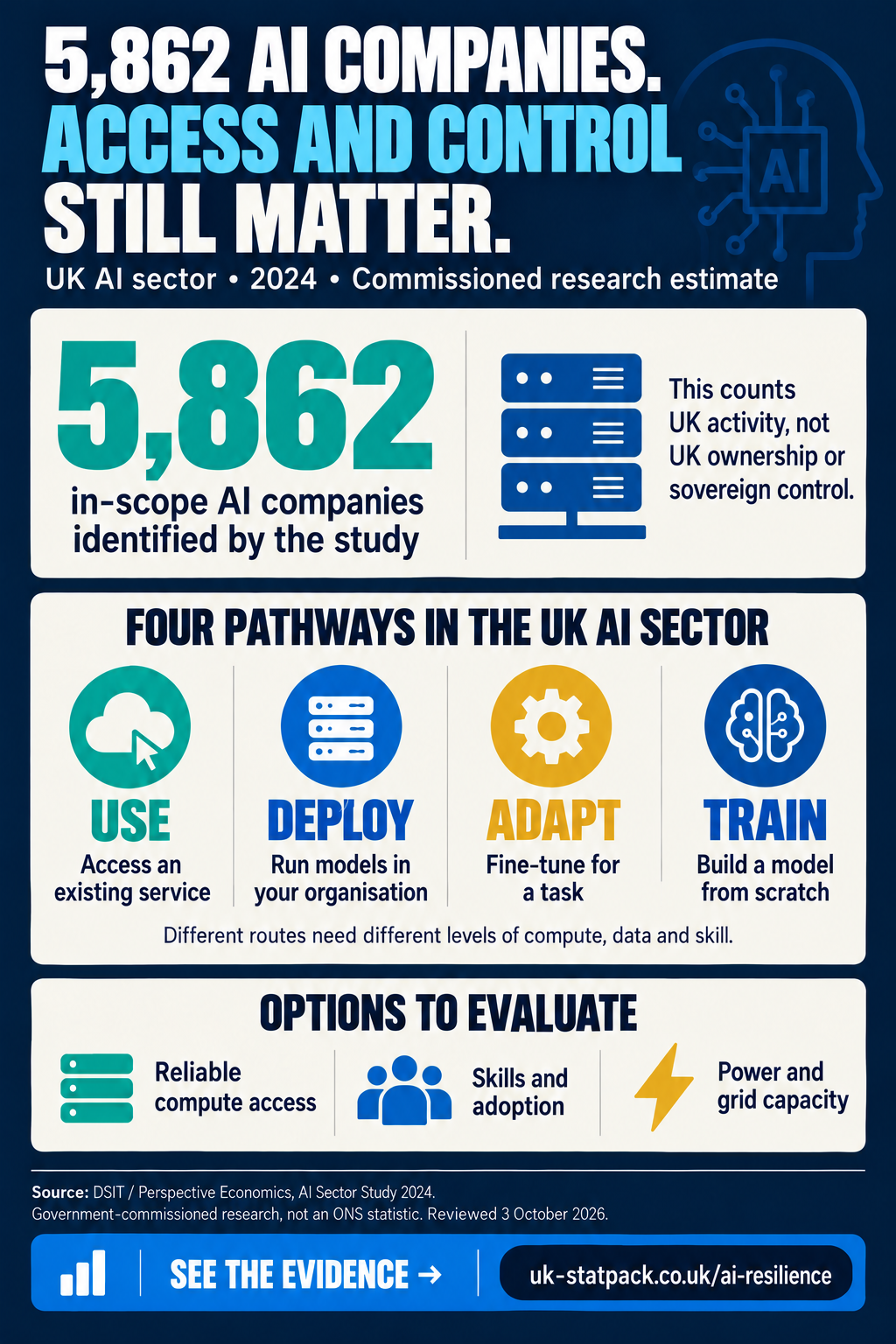
- 5,862in-scope AI companies, 2024 study
Self-reported (ONS BICS). Not a share of all UK businesses.
Text and data version
Britain is adopting AI. Two US giants dominate its cloud market. AWS and Microsoft each supplied 30–40% of UK cloud infrastructure and platform services in 2024, on Competition and Markets Authority estimates. Separately, 34.9% of UK businesses with ten or more employees reported using AI in June 2026. Cloud share is not a measure of all UK AI or model provision.
| Measure | Value | Period | Geography | Type | Source |
|---|---|---|---|---|---|
| UK businesses with ten or more employees using AI | 34.9% | June 2026 | United Kingdom | survey estimate | ONS, Business Insights and Conditions Survey wave 159, AI current usage |
| In-scope AI companies identified in the UK | 5,862 | 2024 study | United Kingdom | survey estimate | DSIT |
Image description: AI resilience infographic: the AI Sector Study 2024 identified 5,862 AI companies operating in the UK; this is not a measure of ownership or control.
Before production: Production /ai-resilience returned 404 in the July audit; the route must exist on production before this card is promoted.
All visual summaries, their source records and their publication state are listed on Shareable visuals.
Go deeper
What can UK users access today?Two public AIRR systems are open to eligible researchers and smaller firms by application; everything else is bought on commercial terms.The capability ledger: stage, access route and terms.Read the chapter → What can UK users access today? How much domestic compute is there, and what limits it?Public AIRR capacity was 21 AI ExaFLOPS in 2025; the 2030 target is 420. Total UK compute is not published.Facilities, funding, electricity use and prices.Read the chapter → How much domestic compute is there, and what limits it? Could organisations switch provider if they had to?Two providers hold 30–40% each of UK cloud infrastructure and platform services, and fewer than 1% of customers switch a year.Cloud and model dependency, and what regulators are doing.Read the chapter → Could organisations switch provider if they had to? Can the grid power new data centres?Connections are queued and reformed; data-centre demand is projected to rise several-fold.Electricity, grid and chips.Read the chapter → Can the grid power new data centres? Do people have the skills to use AI well?Training pipelines are measured; AI-specific skills and productive use are not.Skills and adoption outcomes.Read the chapter → Do people have the skills to use AI well? What if access to a major provider failed?No official estimate exists; a hypothetical stress test lets you explore assumptions without inventing a probability.Stress-test assumptions and methods.Read the chapter → What if access to a major provider failed?
Evidence → choices → outcomes
What could improve it?
AI that measurably improves services and productivity, with costs, dependency and continuity risks kept manageable.
Legacy systems leave services exposed
Resilience also depends on legacy systems and cyber controls. The NAO found significant control gaps and unfunded remediation for many vulnerable systems. AI adoption figures do not measure whether critical services can withstand an attack.
Evidence in the domain SWOT →These options link to their national assessment, including funding, delivery constraints and remaining uncertainties.
Assessed option · provisional
Make cloud exit and continuity work in practice
Select a critical service and test usable backups, data export and a proportionate recovery route.
8/10 criteria scored
Coverage of the appraisal, not an impact score.
Delivery: Amber
Whole-life costs incomplete
Evidence and delivery constraints
Concentration establishes exposure; it does not establish the cost-effective resilience design.
Run a costed service-level exercise before buying blanket duplication. No invented national AI-outage loss; retain service-specific risk thresholds.
Assessed option · provisional
Turn research into products and adoption
7/10 criteria scored
Coverage of the appraisal, not an impact score.
Delivery: Amber
Whole-life costs incomplete
Evidence and delivery constraints
The artifact offers weak support for its spinout/procurement package. Smart Grants evaluation is relevant to a different instrument and cannot validate the whole bundle.
Separate spinout terms, procurement trials, grants and firm adoption; define market failure, beneficiaries and comparator.
How we assessed these options
What would it take to improve this?
What would move the needle?
The outcome we want: AI that measurably improves services and productivity, with costs, dependency and continuity risks kept manageable.
The main constraint: Cloud supply is concentrated and switching is rare, and adoption figures do not show whether AI helps — so the binding constraints are market structure and evidence, which organisations, buyers and the CMA must address workload by workload rather than by counting compute or provider nationality.
Constraint type: market structure, evidence.
The options on the table
What is funded now, and the changes assessed against it — the current baseline and the alternatives, before the position today and the actions.
Provisional single-reviewer assessments from the 6 October 2026 review; not approved business cases, and not government policy.
Rehearse continuity for critical cloud-dependent servicesDelivery RAG: Amber
- Funded now
- Not yet stated in the record.
- The change assessed
- Select a critical service and test usable backups, data export and a proportionate recovery route.
Range if completed: 15.0–21.0 out of 30 (equal weights; not yet assessed: expected incremental benefit (Bn), incremental affordability (Co))
Assessed with another page as home
These options also bear on this topic. The full assessment sits on the home page named under each.
Turn research into products and adoptionDelivery RAG: Amber
Home: Innovation.
- Funded now
- Not yet stated in the record.
- The change assessed
- Not yet defined.
Range if completed: 11.0–20.0 out of 30 (equal weights; not yet assessed: increment beyond baseline (Ad), expected incremental benefit (Bn), incremental affordability (Co))
Alternatives already on record: 21 options listed under the points in the position today (13 without an action record), and 3 earlier options under other options compared. They have not been scored in the review.
The position today
Which quadrant a point sits in is our analytical judgement, not a statistical category. Each point says whether it is a measured fact, our synthesis or a risk.
What we can build on Strengths
Adoption is spreading: 34.9% of firms with ten or more staff used AI in June 2026, against 11.9% in September 2023.
Measured factConfidence: High· September 2023 to June 2026· United Kingdom
Source: Office for National Statistics, Artificial intelligence in UK businesses: 2023 to 2026 (Business Insights and Conditions Survey, firms with ten or more employees)
What government has committed to
Policy: The AI Opportunities Action Plan (January 2025), with 38 of 50 actions met by January 2026, including expansion of the BridgeAI adoption programme.
- Who and when:
- Starmer government (to July 2026), 13 January 2025.
- Since 20 July 2026:
- Changed by the Burnham government. AI strategy and public-sector adoption moved to a new PM’s AI Taskforce in the Office for the Prime Minister and Cabinet (24 July 2026); the plan itself was not explicitly restated. Source: Prime Minister’s Office / Cabinet Office, AI to power change at the heart of government as Lord Vallance appointed chair of new PM AI Taskforce (24 July 2026) (Press release text).
- Source:
- Department for Science, Innovation and Technology, AI Opportunities Action Plan: one year on (29 January 2026) (“Accelerating AI adoption in the private sector”)
Checked 4 October 2026. A commitment is not delivery.
Options (3)
ShortlistedMeasure useful AI adoption before scaling it
Judges adoption by outcomes against current processes, so the rise in use is matched by evidence it helps.
Who: Departments; Cabinet Office · Evidence: Untested proposal · Status: Site-editorial action
Source: Office for National Statistics, Artificial intelligence in UK businesses: 2023 to 2026 (Business Insights and Conditions Survey)
Help organisations adopt AI well
Adoption support reaches firms that would not adopt alone.
Who: Department for Business, Innovation, Science and Trade · Evidence: Experimental or quasi-experimental evaluation · Status: Established
Source: Department for Business and Trade, Made Smarter Adoption: impact and process evaluation (Ipsos) (Impact findings)
Expand publicly allocated compute
Shared compute lowers the cost of building and testing AI.
Who: Cabinet Office; UKRI · Evidence: Untested proposal · Status: Funded programme
Source: Department for Science, Innovation and Technology, UK Compute Roadmap (AI Research Resource section)
Resilience oversight has begun in one critical sector: Microsoft, Google Cloud, AWS and Oracle were designated critical third parties to the financial system, overseen directly by the Bank of England, PRA and FCA.
Measured factConfidence: Moderate· Designations effective 13 July 2026· United Kingdom (financial services)
Source: HM Treasury, UK financial system strengthened with new safeguards for major technology providers (Announcement text)
What government has committed to
Legislation: Four cloud and technology providers designated as Critical Third Parties to the financial system from 13 July 2026, in a rolling regime where more may be designated.
- Who and when:
- Starmer government (to July 2026), 10 July 2026.
- Since 20 July 2026:
- Not confirmed either way since the change of Prime Minister on 20 July 2026. No Burnham-era statement on the finance regime; beyond finance, the Cyber Security and Resilience Bill (designating data centres and critical suppliers) is continuing in the Lords.
- Source:
- HM Treasury, UK financial system strengthened with new safeguards for major technology providers (10 July 2026) (Press release text)
Checked 4 October 2026. A commitment is not delivery.
Options (3)
Make cloud exit and continuity work in practice
Tested exit plans extend resilience from finance to other critical services.
Who: Regulators; Cabinet Office · Evidence: Expert or audit recommendation · Status: Site-editorial action
Source: Competition and Markets Authority, Cloud services market investigation (case page; final decision 31 July 2025) (Summary of final decision, paragraphs 1–10)
Resilience rules for critical providers
Direct oversight of providers that many firms depend on.
Who: Bank of England; PRA; FCA · Evidence: Expert or audit recommendation · Status: Established
Source: HM Treasury, UK financial system strengthened with new safeguards for major technology providers (10 July 2026) (Press release text)
Pass the Cyber Bill’s critical-supplier and data-centre duties
Extends designation beyond finance to essential services.
Who: Parliament; DSIT/Cabinet Office; sector regulators · Evidence: Untested proposal · Status: Announced proposal
Source: UK Parliament, Cyber Security and Resilience (Network and Information Systems) Bill (bill 4035) (Bill stages; factsheets)
What is holding us back Weaknesses
Resilience also depends on legacy systems and cyber controls. The NAO found significant control gaps and unfunded remediation for many vulnerable systems. AI adoption figures do not measure whether critical services can withstand an attack.
Risk, not a certaintyConfidence: High· NAO audit, January 2025· UK central government
Source: National Audit Office, Government cyber resilience (Conclusions)
Cloud infrastructure is concentrated: Microsoft and AWS each held 30–40% of UK cloud infrastructure and platform services in 2024 (CMA estimates), and fewer than 1% of customers switch provider in a year.
Measured factConfidence: High· 2024· United Kingdom
Source: Competition and Markets Authority, Cloud services market investigation (case page; final decision 31 July 2025) (Summary of final decision, paragraphs 5–8)
Options assessed against this point: Rehearse continuity for critical cloud-dependent services (Amber delivery RAG)
What government has committed to
Policy: The CMA accepted Microsoft and Amazon actions on cloud egress fees and interoperability instead of formal investigations, with the Board to review progress after six months.
- Who and when:
- Competition and Markets Authority (regulator or independent body), 31 March 2026.
- Since 20 July 2026:
- The CMA said on 7 September 2026 that the formal strategic-market-status route “remains a possible avenue”.
Checked 4 October 2026. A commitment is not delivery.
Options (3)
ShortlistedMake cloud exit and continuity work in practice
Tested exits and portable workloads lower the cost of switching.
Who: Cabinet Office; regulators · Evidence: Expert or audit recommendation · Status: Site-editorial action
Source: Competition and Markets Authority, Cloud services market investigation (case page; final decision 31 July 2025) (Summary of final decision)
Make switching between cloud providers easier
Lower egress fees and interoperability reduce lock-in.
Who: CMA; providers · Evidence: Expert or audit recommendation · Status: Established
Source: Competition and Markets Authority, CMA announces package of actions on business software and cloud services (press release) (Press release text)
Buy public cloud in ways that reduce switching barriers
Public contracts that favour multi-cloud reduce concentration.
Who: Cabinet Office; Government Commercial Agency · Evidence: Expert or audit recommendation · Status: External proposal
Source: Competition and Markets Authority, Public procurement in the national interest: reflections from the CMA (8 September 2026) (“Cloud” box)
Adoption rates are not outcomes: the main evaluated adoption scheme found no statistically significant effect on productivity.
Our synthesisConfidence: Moderate
Source: Department for Business and Trade, Made Smarter Adoption: impact and process evaluation (Ipsos) (Impact findings)
What government has committed to
No commitment found. No commitment to evaluate whether AI adoption improves outcomes was found. The Department for Business, Innovation, Science and Trade published one trial evaluation (Redbox, 28 September 2026) without a comparison group.
Searched: gov.uk search “AI adoption”, “AI Opportunities Action Plan”, “evaluation” since 20 July 2026; 4 Oct 2026
Checked 4 October 2026. A commitment is not delivery.
Options (3)
ShortlistedMeasure useful AI adoption before scaling it
Compares AI pilots with current processes on quality and outcomes, not adoption rates.
Who: Departments; Cabinet Office · Evidence: Untested proposal · Status: Site-editorial action
Source: Department for Business and Trade, Made Smarter Adoption: impact and process evaluation (Ipsos) (Impact findings)
Publish all completed evaluations
Makes the evidence on what works searchable.
Who: Evaluation Task Force; departments · Evidence: Expert or audit recommendation · Status: External proposal
Source: National Audit Office, Lessons learned: a planning and spending framework that enables long-term value for money (HC 234, Session 2024-25) (Recommendation (a))
Use comparison-group designs
Separates the effect of AI from other change.
Who: Departments · Evidence: Synthesis of robust evaluations · Status: Established
Source: HM Treasury / Evaluation Task Force, The Magenta Book: Central Government guidance on evaluation (Chapter 1, sections 1.5–1.6)
What could improve things Opportunities
Tested exit plans for critical workloads, and evaluated AI pilots compared with current processes, would show where AI helps and where dependency is a real risk.
Depends on: Organisations fund realistic exit tests and design evaluations before rollout, with human review time counted.
Our synthesisConfidence: Moderate
Source: Competition and Markets Authority, Cloud services market investigation (case page; final decision 31 July 2025) (Summary paragraphs 1–10); HM Treasury / Evaluation Task Force, The Magenta Book: Central Government guidance on evaluation (Chapter 1, sections 1.5–1.6)
Options assessed against this point: Rehearse continuity for critical cloud-dependent services (Amber delivery RAG)
What government has committed to
No commitment found. No commitment to require tested exit plans for critical workloads outside financial services was found; regulators can assess resilience only for designated critical third parties in finance.
Searched: gov.uk search “cloud”, “exit”, “portability” since 20 July 2026; Cloud Challenge Book 2026; 4 Oct 2026
Checked 4 October 2026. A commitment is not delivery.
Options (3)
ShortlistedMake cloud exit and continuity work in practice
Tested exit plans for critical workloads show where dependency is a real risk.
Who: Cabinet Office; regulators · Evidence: Expert or audit recommendation · Status: Site-editorial action
Source: Competition and Markets Authority, Cloud services market investigation (case page; final decision 31 July 2025) (Summary of final decision)
ShortlistedMeasure useful AI adoption before scaling it
Evaluated pilots show where AI helps.
Who: Departments · Evidence: Untested proposal · Status: Site-editorial action
Critical-supplier duties under the Cyber Bill
Would let regulators require resilience of designated suppliers.
Who: Parliament; sector regulators · Evidence: Untested proposal · Status: Announced proposal
Source: UK Parliament, Cyber Security and Resilience (Network and Information Systems) Bill (bill 4035) (Factsheets)
What could make it worse Threats
Lock-in may persist: the CMA chose provider commitments on egress fees over formal cloud investigations, with a review after six months, so whether switching rises is untested.
Risk, not a certaintyConfidence: Moderate
Source: Competition and Markets Authority, CMA announces package of actions on business software and cloud services (press release) (Press release); Competition and Markets Authority, Cloud services market investigation (case page; final decision 31 July 2025) (Summary paragraphs 5–8)
Options assessed against this point: Rehearse continuity for critical cloud-dependent services (Amber delivery RAG)
What government has committed to
Policy: A six-month CMA review of the cloud providers’ actions, due around the end of September 2026, with formal investigation still possible.
- Who and when:
- Competition and Markets Authority (regulator or independent body), 31 March 2026.
- Since 20 July 2026:
- No review outcome had been published by 4 October 2026.
Checked 4 October 2026. A commitment is not delivery.
Options (3)
ShortlistedMake cloud exit and continuity work in practice
Tested exits reduce dependence whatever the CMA decides.
Who: Cabinet Office; regulators · Evidence: Expert or audit recommendation · Status: Site-editorial action
Source: Competition and Markets Authority, Cloud services market investigation (case page; final decision 31 July 2025) (Summary of final decision)
Open a formal cloud investigation if switching does not rise
Strategic market status would allow binding conduct requirements.
Who: CMA Board · Evidence: Expert or audit recommendation · Status: Announced proposal
Source: Competition and Markets Authority, On track: delivering the promises of the digital markets regime (7 September 2026) (Speech text)
Publish switching and multi-cloud rates after the review
Shows whether lock-in is easing.
Who: UK Facts · Evidence: Untested proposal · Status: Site-editorial action
Hidden review work, errors and automation bias can cancel out time saved if pilots count throughput but not quality.
Risk, not a certaintyConfidence: Limited
Source: HM Treasury / Evaluation Task Force, The Magenta Book: Central Government guidance on evaluation (Chapter 1)
What government has committed to
No commitment found. No government commitment to measure quality, errors or checking time in AI pilots was found; the Redbox evaluation reported longer checking for some tasks and hallucinations seen by about 20% of respondents.
Searched: gov.uk search “AI adoption”, “evaluation”, “AI Taskforce” since 20 July 2026; 4 Oct 2026
Checked 4 October 2026. A commitment is not delivery.
Options (3)
ShortlistedMeasure useful AI adoption before scaling it
Counts errors and review time alongside throughput.
Who: Departments; Cabinet Office · Evidence: Untested proposal · Status: Site-editorial action
Source: Department for Business, Innovation, Science and Trade, Redbox@DBT trial evaluation report (28 September 2026) (Printed pp.4–6)
Require quality and error metrics with a comparison group in pilots
Detects hidden review work and automation bias.
Who: Evaluation Task Force; departments · Evidence: Expert or audit recommendation · Status: External proposal
Source: HM Treasury / Evaluation Task Force, The Magenta Book: Central Government guidance on evaluation (Chapter 1)
Fund AI assurance tools
Better tools to check AI outputs.
Who: Cabinet Office · Evidence: Untested proposal · Status: Funded programme
Source: Department for Science, Innovation and Technology, AI Opportunities Action Plan: one year on (29 January 2026) (“Enabling safe and trusted AI”)
The actions worth examining
Our shortlist for this page. Research quality, policy status, cost and funding are judged separately; none of these is government policy unless its status says so.Our shortlist. None is government policy unless its status says so.
Action 1A43Policy status: site-editorial action
Make cloud exit and continuity work in practice
Map critical dependencies, require proportionate portability and exit plans in contracts, and test that a critical workload can actually be restored elsewhere.
The thread: issue, evidence, action
- Issue Weakness: Cloud infrastructure is concentrated: Microsoft and AWS each held 30–40% of UK cloud infrastructure and platform services in 2024 (CMA estimates), and fewer than 1% of customers switch provider in a year. Also: threat, opportunity
- Evidence Cloud customers switching provider in a year
- Action A43, this action
Assessment (draft, 6 October review)
A new scope of this action (A43v2): Rehearse continuity for critical cloud-dependent services
Delivery RAG: AmberGate: pending
Range if completed: 15.0–21.0 out of 30 (equal weights; not yet assessed: expected incremental benefit (Bn), incremental affordability (Co))
National plan: Resilience and sustainability appraisal queue
- Who decides:
- Technology owners and procurement teams in public and private organisations; the CMA and sector regulators (UK)
- Evidence:
- Expert or audit recommendation. A statutory market investigation documents the barriers; whether exit plans improve resilience needs workload-specific tests.
- Expected effect:
- Direction plausible; size not established.
- Cost and funding
Not yet costed
Funding: Not yet costed / funding not identified
Why it is shortlisted here: Concentration and rare switching are the page’s clearest measured weakness; exit only counts if it has been tested.
What it takes
The problem
Cloud supply is concentrated and switching is rare and costly, so organisations depend on providers they cannot easily leave if prices rise or a service fails.
Who is affected, and where
Public and private organisations running critical services in the cloud, and the people who use those services. Territory: UK. Competition regulation is UK-wide; public-sector technology policy is partly devolved.
Policy status
UK Facts proposal. Builds on regulatory action already under way: the CMA’s 2025 final decision, actions on egress fees and interoperability that Microsoft and Amazon set out in March 2026 (the CMA’s wording; not formal commitments), with a six-month review, and critical-third-party designations in financial services from July 2026. Tested exit plans for critical workloads are a UK Facts proposal.
The evidence
- What the research found:
- The CMA found competition not working well: Microsoft and AWS each held 30–40% of UK cloud infrastructure and platform services combined in 2024 (Appendix D, Table D.3; for infrastructure alone AWS had 40–50%), and egress fees and licensing practices harm switching. In March 2026 the CMA accepted provider commitments on egress fees and interoperability instead of opening cloud SMS investigations, with a review after six months.
- Evaluated on:
- UK cloud customers and providers (CMA market investigation); United Kingdom, market data to 2024
- Our recommendation (separate from the research):
- Run a realistic exit and restore test on a suitable critical workload and use contract renewals to add proportionate portability terms.
- Strongest counter-evidence:
- Multi-cloud is not automatically cheaper or safer; poor implementation can weaken security; provider nationality does not guarantee resilience.
Cost and funding
Cost completeness: Not yet costed. Funding: Not yet costed / funding not identified.
- Migration, egress, engineering, training and any duplicated capacity (administration; paid by central government, employers): Not yet costed. Multi-cloud is not automatically the cheapest solution; costs differ by workload.
- Who pays:
- Each organisation’s technology and resilience budget (migration, egress, engineering, training, duplicated capacity).
- Financing proposed:
- Each organisation’s own budget; regulator remedies do not pay migration costs.
- Gap remaining:
- Unknown.
What delivery needs
- Skills:
- Cloud architects and engineers.
- Operational capacity:
- Time for tests outside live operations.
- Infrastructure:
- Alternative capacity for restore tests.
- Permissions:
- Data residency and security approvals.
- Law:
- None new.
- Public consent:
- Boards accepting the cost of tests.
First step and stages
First step: Map critical dependencies and run a realistic exit and restore test on one suitable workload. (owner: Organisation technology owners (in government, departmental CTOs))
- Map critical cloud dependencies — Technology owners (proposed stage, not an official timetable)
- Test exit and restore for one workload — Technology owners (proposed stage, not an official timetable)
- Add proportionate terms at renewal — Procurement teams (proposed stage, not an official timetable)
Depends on: CMA review of provider commitments; Contract renewal cycles
Trade-offs
- Who gains and who loses:
- Service users gain from continuity; organisations bear test and migration costs.
- What else the money or effort could do:
- Engineering time not spent on new services.
- Strongest counterargument:
- Large providers are more resilient than most in-house alternatives; duplicating capacity is costly.
- Risks:
- Complexity, weaker security and confusing UK ownership with resilience.
How we would judge it
- Baseline:
- Fewer than 1% of UK cloud customers switch provider a year (CMA, 2024).
- Leading indicator:
- Critical workloads with a tested exit plan.
- Outcome:
- Tested recovery time; switching time and cost; material vendor dependencies.
- Continue, adapt or stop:
- Scale tests only where the first shows recovery is feasible at proportionate cost.
Earlier option on this page
This card replaces the option “Make switching between cloud providers easier” (operating: Microsoft case: proposed decision expected October 2026, statutory deadline 13 February 2027.). Its evidence: The CMA found that fewer than 1% of UK cloud customers switch provider a year, with egress fees and software licensing among the barriers. In March 2026 it chose not to open cloud strategic-market-status cases after Microsoft and AWS took steps on egress fees and interoperability, and to review progress; it opened a separate case on Microsoft’s business software, including cloud licensing, in May 2026. Whether these steps raise switching is not yet known. CMA, Cloud services market investigation: final decision · CMA, Microsoft’s business software ecosystem: strategic market status investigation
Sources
- Competition and Markets Authority, Cloud services market investigation (case page; final decision 31 July 2025), Summary of final decision, paragraphs 1–10 (2025-07-31; relevant passages checked)
- Competition and Markets Authority, CMA announces package of actions on business software and cloud services (press release), Press release (2026-03-31; relevant passages checked)
- Competition and Markets Authority, Cloud services market investigation (case page; final decision 31 July 2025), Summary paragraphs 5–8 (2025-07-31; relevant passages checked)
Source published July 2025 (CMA final decision); March 2026 (CMA announcement); evidence reviewed 2026-10-04. Reconsider if: The CMA Board’s review of provider commitments; The Microsoft business-software SMS decision (deadline 13 February 2027).
Action 2A44Policy status: site-editorial action
Measure useful AI adoption before scaling it
Pick low-risk service problems and compare an AI-assisted workflow with the current process — including human review and failure handling — before scaling.
The thread: issue, evidence, action
Assessment (draft, 6 October review)
Not assessed in the 6 October review; this action stays in the topic plan with its own evidence.
- Who decides:
- Accountable service owners and technology teams, with independent evaluators (UK)
- Evidence:
- Untested proposal. An evaluation-led proposal: the evidence shows adoption rising and one flagship scheme without a measurable productivity effect, not what this approach would achieve.
- Expected effect:
- Direction plausible; size not established.
- Cost and funding
Not yet costed
Funding: Not yet costed / funding not identified
Why it is shortlisted here: Adoption is rising fast; whether it improves services has to be measured before scaling.
What it takes
The problem
AI use is rising fast, but adoption rates do not show whether services or productivity improve, and the main evaluated adoption programme found no significant productivity effect.
Who is affected, and where
Public-service users and staff; firms adopting AI. Territory: UK. Public services are partly devolved; pilots would sit with each government.
Policy status
UK Facts proposal. A UK Facts proposal following the Magenta Book; government AI programmes were not audited in this review.
The evidence
- What the research found:
- ONS survey data show 34.9% of firms with ten or more staff used AI in June 2026, against 11.9% in September 2023. The Made Smarter Adoption evaluation found no statistically significant average effect on gross value added.
- Evaluated on:
- UK firms (ONS survey); manufacturers supported by Made Smarter Adoption (evaluation); United Kingdom, 2023–2026
- Our recommendation (separate from the research):
- Define baseline quality, acceptable error and evaluation design first; pilot, evaluate independently, then expand or stop with published reasons.
- Strongest counter-evidence:
- Evaluation slows adoption that may be beneficial; generic AI tools change quickly, so trial results can date fast.
Effects on record
- Staff workload and service quality when AI outputs need checking: A mixed effect; size not established. plausible spillover, limited confidence; United Kingdom. This is why pilots must count review time and errors, not only throughput.
Cost and funding
Cost completeness: Not yet costed. Funding: Not yet costed / funding not identified.
- Model and cloud use, integration, training, quality control, energy and exit (administration; paid by central government, councils): Not yet costed. Hidden human review work must be counted.
- Who pays:
- Service owners’ budgets (model and cloud use, integration, training, quality control, energy, exit costs) and evaluators.
- Financing proposed:
- A bounded pilot may use a named digital or innovation allocation; scaling needs a funded business case based on measured results.
- Gap remaining:
- Unknown.
What delivery needs
- Skills:
- Service designers, data scientists, evaluators.
- Operational capacity:
- Staff time to review AI outputs.
- Infrastructure:
- Secure compute and data access.
- Permissions:
- Data protection impact assessments.
- Law:
- Existing data protection and equality law.
- Public consent:
- Staff and users informed; human oversight.
First step and stages
First step: Define baseline quality, user needs, acceptable errors and the evaluation design for one service problem. (owner: The accountable service owner)
- Set baseline and evaluation design — Service owner; evaluator (proposed stage, not an official timetable)
- Pilot with human review — Service team (proposed stage, not an official timetable)
- Expand or stop, with published reasons — Service owner (proposed stage, not an official timetable)
Depends on: A43: exit plans for AI services; A42: trial and adoption route
Trade-offs
- Who gains and who loses:
- Users may gain faster service; people less able to use digital channels may lose; staff workloads can rise from hidden review work.
- What else the money or effort could do:
- Evaluation time and money; other improvements not made.
- Strongest counterargument:
- Waiting for evaluations means falling behind organisations that adopt quickly.
- Risks:
- Automation bias, surveillance, unequal access, hidden review work and vendor dependency.
How we would judge it
- Baseline:
- 34.9% of firms with ten or more staff used AI (ONS, June 2026).
- Leading indicator:
- Pilots with a published baseline and evaluation design.
- Outcome:
- Net time and cost, quality, errors, accessibility and user outcomes.
- Continue, adapt or stop:
- Stop if quality or error rates are worse than the current process after review costs.
Earlier option on this page
This card replaces the option “Help organisations adopt AI well” (operating). Its evidence: Use is rising (11.9% to 34.9% of firms with ten or more staff since September 2023), but the main evaluated adoption programme, Made Smarter Adoption, found no statistically significant effect on productivity. ONS, Artificial intelligence in UK businesses: 2023 to 2026 · Made Smarter Adoption: impact and process evaluation (Ipsos)
Sources
- Office for National Statistics, Artificial intelligence in UK businesses: 2023 to 2026, Business Insights and Conditions Survey, firms with ten or more employees (2026; relevant passages checked)
- Department for Business and Trade, Made Smarter Adoption: impact and process evaluation (Ipsos), Impact findings (2026-07-30; summary or abstract only)
- HM Treasury / Evaluation Task Force, The Magenta Book: Central Government guidance on evaluation, Chapter 1, sections 1.5–1.6 (2026-05-14; relevant passages checked)
- HM Treasury / Evaluation Task Force, The Magenta Book: Central Government guidance on evaluation, Impact evaluation chapter (2026-05-14; relevant passages checked)
Source published May 2026 (Magenta Book); July 2025 (CMA); evidence reviewed 2026-10-04. Reconsider if: Published evaluations of public-sector AI pilots; New ONS AI adoption data.
How the options are assessed
One shared record per option — the same one the national plan reads. Delivery RAG, gate and list membership are separate judgements.
Provisional single-reviewer assessments from the 6 October 2026 review; not approved business cases, and not government policy.
A43v2Delivery RAG: AmberGate: pending
Rehearse continuity for critical cloud-dependent services
A new scope of action A43 (A43v2); A43 itself is unchanged and nothing is inherited from it.
Provisional single-reviewer desk assessment, 6 October 2026.
- Who and where
- Select a critical service and test usable backups, data export and a proportionate recovery route. (from the 6 October review) Jurisdiction: not defined.
- Result so far
- Range if completed: 15.0–21.0 out of 30 (equal weights; not yet assessed: expected incremental benefit (Bn), incremental affordability (Co))
- Funded now (baseline)
- Funded baseline not yet stated
- The change assessed (marginal)
- Select a critical service and test usable backups, data export and a proportionate recovery route. (from the 6 October review)
- Domain home: AI capability
- In the national plan: Resilience and sustainability appraisal queue
What the evidence supports—and the next decision
A backup exists only as a resilience measure if data and services can actually be recovered within an acceptable time.
Codex — AI-assisted analytical follow-up · 8 October 2026. Proposed appraisal design; the attributed scores below are unchanged. No funding or delivery agreement is implied.
- Define the change
- Select a critical service, define recovery needs and rehearse loss of its cloud provider or identity layer using a proportionate alternate route.
- Test whether it works
- Demonstrated recovery time, data loss, integrity and essential-service continuity; use independently observed exercises and record failed tests.
- Establish the cost
- Backup, export, alternate capacity, licences, staff exercises and continuing maintenance. Do not invent a national outage-loss estimate.
- Protect against harm
- Protect sensitive data and avoid a nominal second provider that shares the same critical dependency.
Read with the outcome evidence and sources in the full assessment. Monitoring proposals are not existing baseline measurements. A numerical benefit or cost score needs evidence for the defined increment, not just the scale of the problem.
Full assessment of Rehearse continuity for critical cloud-dependent services: ten criteria, scenarios, delivery, costs and monitoring
The ten criteria (0–3)
Each criterion is scored 0 to 3 by the reviewer. “Not yet assessed” means unknown: it is never counted as zero.
Scale and severity (Sc)2 of 3 — Serious harm to a defined group or widespread moderate harm
Reviewer’s reason: Problem scale judged from the linked domain evidence; not a population estimate of those helped.
Increment beyond baseline (Ad)2 of 3 — Specific material change to existing delivery
Reviewer’s reason: Select a critical service and test usable backups, data export and a proportionate recovery route. This is a provisional marginal-change judgement, to confirm against commissioned delivery.
Confidence in the proposed action (Ev)0 of 3 — No effect evaluation
Reviewer’s reason: Concentration establishes exposure; it does not establish the cost-effective resilience design.
Expected incremental benefit (Bn)Not yet assessed
Reviewer’s reason: Unknown: no sufficiently supported magnitude for this exact change.
Residual harms (Hm)2 of 3 — Manageable harm with specified safeguards
Reviewer’s reason: Duplicated cost, security complexity and a nominal exit plan that fails operationally.
Incremental affordability (Co)Not yet assessed
Reviewer’s reason: Unknown: the proposed increment has not been costed and matched to an approved affordable allocation in this review. Existing programme envelopes are not that allocation.
Delivery capacity (Ca)2 of 3 — Stretched but plausibly obtainable
Reviewer’s reason: No invented national AI-outage loss; retain service-specific risk thresholds.
Distribution (Fa)2 of 3 — Mixed or broadly neutral with safeguards
Reviewer’s reason: Distribution assessed against the target group and the burdens described here: Duplicated cost, security complexity and a nominal exit plan that fails operationally.
Meaningful first outcome (Ti)3 of 3 — Within one year
Reviewer’s reason: Timing judgement concerns the first meaningful outcome in: Recovery time, data loss and continuity under a rehearsed disruption. It does not imply all long-term benefits arrive then.
Readiness (Rd)2 of 3 — Named commissioning/allocation/coordination step
Reviewer’s reason: Run a costed service-level exercise before buying blanket duplication. Owner: Service owners, procurement teams and relevant regulators.
Four weightings
Normalised as 10 × weighted sum ÷ sum of weights, on a 0–30 scale. Where a criterion is not yet assessed, the range is the lowest and highest result if it were later scored 0 or 3 — not a score, a confidence interval or a rank.
- Equal weights: Range if completed: 15.0–21.0 out of 30. Not yet assessed: expected incremental benefit (Bn), incremental affordability (Co). Funding gate: not passed.
- Evidence doubled: Range if completed: 13.6–19.1 out of 30. Not yet assessed: expected incremental benefit (Bn), incremental affordability (Co). Funding gate: not passed.
- Scale doubled: Range if completed: 15.5–20.9 out of 30. Not yet assessed: expected incremental benefit (Bn), incremental affordability (Co). Funding gate: not passed.
- Cost ignored (the funding gate still applies): Range if completed: 16.7–20.0 out of 30. Not yet assessed: expected incremental benefit (Bn), incremental affordability (Co). Funding gate: not passed.
Funding gate: Not passed — the cost is not yet assessed or no allocation is committed for this scope. Ignoring cost in a weighting never removes the gate.
Delivery RAG and gate
Delivery RAG shown: AmberReview’s claim: Amber. Best the recorded evidence allows: Amber.
Review’s reason: Incremental lifetime costs and funding not established. No invented national AI-outage loss; retain service-specific risk thresholds.
Why it is not Green yet
- Scope (population, place and increment) not verified against the delivery baseline.
- No verified owner with the powers in place.
- Delivery capacity not verified.
- Lifetime incremental costs not complete.
- No credible funding (a committed allocation for the scope).
- Safeguards not specified.
- Monitoring lacks a metric, a data source or a baseline.
Green needs verified scope, a verified owner with the powers, verified capacity, complete lifetime costs with credible funding, specified safeguards and monitoring with a metric, source and baseline. Amber means appraisal gaps remain; Red means a material delivery obstacle. Red does not mean unimportant.
Gate: Pending — appraisal incomplete (review label: “Pending cost, funding, scope and capacity appraisal”).
Why: Scores incomplete; Funding gate not passed (cost unknown or no credible funding).
The gate is separate from national list membership: being listed does not make an option eligible, and an eligible option need not be listed.
Cost and funding
Lifetime costing: Not established.
Still to cost: Incremental lifetime costs and funding not established. No invented national AI-outage loss; retain service-specific risk thresholds.
Funding status: not established in review.
Owner, powers and capacity
Proposed owner: Service owners, procurement teams and relevant regulators. (proposed, unverified).
Powers: needs a decision or allocation. Capacity: unverified.
Powers and capacity read from the review’s Rd and Ca anchors; no proposed owner has agreed to act (the review: “Proposed owners have not agreed to act”).
- England:
- not assessed
- Scotland:
- not assessed
- Wales:
- not assessed
- Northern Ireland:
- not assessed
Not defined in the review.
Dependencies, safeguards and risks
Depends on: No invented national AI-outage loss; retain service-specific risk thresholds.
Safeguards
None specified yet.
Risks and residual harms: Duplicated cost, security complexity and a nominal exit plan that fails operationally.
Monitoring and measured results
Metric: Recovery time, data loss and continuity under a rehearsed disruption.
Data source: Not yet named. Baseline: Not yet established.
Measures already on the domain page
- Cloud customers switching provider in a year: latest not published; baseline not published (United Kingdom).
A page measure is not necessarily the review’s metric; linking the two is an editorial decision still to be made.
Evidence for the outcome
Outcome: Recovery time, data loss and continuity under a rehearsed disruption.
Concentration establishes exposure; it does not establish the cost-effective resilience design.
SWOT points it addresses
- Cloud infrastructure is concentrated: Microsoft and AWS each held 30–40% of UK cloud infrastructure and platform services in 2024 (CMA estimates), and fewer than 1% of customers switch provider in a year.
- Lock-in may persist: the CMA chose provider commitments on egress fees over formal cloud investigations, with a review after six months, so whether switching rises is untested.
- Tested exit plans for critical workloads, and evaluated AI pilots compared with current processes, would show where AI helps and where dependency is a real risk.
Review record
Assessment version: working-review-2026-10-06 (A43v2@working-review-2026-10-06).
Reviewer: Author of the review blueprint (single reviewer, not named in uk-facts-complete-plan.json). Reviewed: 6 October 2026.
Carried from the earlier domain review (C record): must be calibrated jointly with the G/W/E/NG/NW/NE records before any combined comparison.
Decision route: Run a costed service-level exercise before buying blanket duplication.
An editorial screening framework by one reviewer, not a formal appraisal or business case. Proposed owners have not agreed to act.
Decision briefs
The leading option set out as a decision someone could take: who decides, who benefits, the best evidence, cost and funding, and the main trade-off. The full research record is one click away.
Decision briefPublic-policy proposalReviewed 2026-10-04
Prove one critical government service can be restored on other infrastructure — by actually doing it
The thread: issue, evidence, action
- Issue Weakness: Cloud infrastructure is concentrated: Microsoft and AWS each held 30–40% of UK cloud infrastructure and platform services in 2024 (CMA estimates), and fewer than 1% of customers switch provider in a year. Also: threat, opportunity
- Evidence Cloud customers switching provider in a year
- Action Make cloud exit and continuity work in practice
- Decision required
- The owner of one critical government service sets a recovery time objective, writes portability and exit terms into its cloud contract, and runs a real restore of the service on alternative infrastructure, publishing the measured recovery time and cost.
- Who and where
- Users of one critical government digital service. Applies in: UK.
- Accountable body
- The service-owning department (its CTO and senior responsible owner)
- Intervention
- Set a recovery objective, secure portability in the contract and run a live restore on a second platform.
- Best evidence, and where it applies
- The October 2025 AWS outage lasted about 14.5 hours and affected the Home Office, DVLA, DWP and HMRC; the CMA found fewer than 1% of cloud customers switch provider each year.Studied in: UK cloud infrastructure market (Market investigation, 2023–2025).How closely the comparison transfers to this decision: European Union — partial.
- Extra cost of this change
- Capital: none identified in the brief.Recurring: none identified in the brief.One-off or mixed: Migration, egress, engineering, training and any duplicated capacity — Not yet costed.
- Funding
- Not funded: no funding route identified yet.Committed to this change: none.Possible source, not an award: none identified.Unfunded: Not costed.
- Savings and wider benefits
- Not yet specified: no cashable saving or avoided cost has been costed for this change. Expected outcomes are listed one by one in the research appendix and are never added together or counted as money available.
- First 90-day step
- One department names the critical workload, publishes its recovery objectives and schedules a live restore testThe proposed first milestone; a 90-day date is not yet specified. Owner: The service-owning department. Proposed by UK Facts, not an official deadline.
- Twelve-month milestone
- Not yet specified.Time to a first useful result: The measured restore within a year.
- Outcome, and when to scale or stop
- Measure: Exit clauses agreed; test scheduled.Scale if: The service is restored within its objective at a cost the department judges proportionate; extend to the next critical workload.Stop if: Recovery on a second platform proves infeasible at proportionate cost — then invest in same-provider multi-region resilience instead and record why.
- Main trade-off
- A real restore test costs engineering time and duplicated capacity and can itself disrupt the service; a paper plan costs little but may not work.
- Source and review date
- Cloud services market investigation (case page; final decision 31 July 2025) (31 July 2025); Government cyber resilience (HC 546, Session 2024–25) (29 January 2025). Reviewed 2026-10-04.
An editorial proposal by UK Facts for discussion, not government policy. Records: A43 · costs C-A43-EXIT
Research appendix: study design, effect sizes and limits, alternatives, full costing, international comparisons and how we would know
1.The change, in plain words
Prove one critical government service can be restored on other infrastructure — by actually doing it
2.The decision requested
- Decision
- Select one critical citizen-facing service hosted with a single provider, set its recovery time and recovery point objectives, add portability and exit clauses at the next contract change, and run a live restore test on a second platform within the year, publishing the result.
- Accountable institution
- The service-owning department (its CTO and senior responsible owner)
- Geography
- UK
- Powers
- Existing departmental technology and procurement authority; GDS cloud and lock-in guidance; no legislation.
- Delivery partners
- Government Digital Service; Cabinet Office commercial function; Current and alternative cloud providers; National Cyber Security Centre; NAO (assurance)
3.Who it is for, and what changes beyond today
- Target population
- Users of one critical government digital service.
- Eligibility
- A citizen-facing service the department rates critical, currently dependent on one infrastructure provider, with data that can lawfully be held on the alternative platform.
- Scale
- One workload first; others only if the first restore is feasible at proportionate cost.
- Baseline
- AWS us-east-1 disruption on 19–20 October 2025 lasted about 14.5 hours; the government said the Home Office, DVLA, DWP and HMRC were affected and the cost was not yet known. The CMA estimated Microsoft and AWS each held 30–40% of UK cloud infrastructure and platform services combined in 2024 and fewer than 1% of customers switch a year. The NAO found 58 critical systems with significant gaps on independent review.
Source: Amazon Web Services; House of Commons, Summary of the Amazon DynamoDB service disruption in the Northern Virginia (US-EAST-1) Region, and written answer 84777 on UK government impacts (Opening paragraph; written answer 84777); Competition and Markets Authority, Cloud services market investigation (case page; final decision 31 July 2025) (Summary of final decision, paragraphs 5 and 24); National Audit Office, Government cyber resilience (HC 546, Session 2024–25) (Paragraph 19)
- Change beyond existing law or funding
- GDS guidance already asks business cases to include exit time and contingency plans to be tested; the finance sector has a critical-third-party regime. The change is one live, measured restore of a government service and contract terms that make it possible.
4.How it would work
Do: Set a recovery objective, secure portability in the contract and run a live restore on a second platform Changing: so that the department knows how long recovery takes and what blocks it before a real outage
Measured recovery time for the service against its objective
Hypothesis to test
The output of the test; whether continuity improves depends on fixing what the test finds.
Lower switching costs at the next contract renewal
Hypothesis to test
Depends on egress and licensing terms; the CMA accepted provider commitments on egress in March 2026 with a six-month review.
Outcomes are kept separate and never added into one impact figure.
5.Best evidence
Cloud services market investigation (case page; final decision 31 July 2025)
- Author or institution:
- Competition and Markets Authority
- Published:
- 31 July 2025
- Evaluation period:
- Market investigation, 2023–2025
- Design:
- Statutory market investigation
- Sample or population:
- UK cloud infrastructure market
- Effect and uncertainty:
- Microsoft and AWS each 30–40% of UK cloud infrastructure and platform services combined in 2024 (CMA ranges; AWS 40–50% of infrastructure alone); fewer than 1% of customers switch each year; egress fees a key commercial barrier.
- Limits:
- A competition finding, not a resilience evaluation.
Where: Summary of final decision, paragraphs 5, 24 and 26. Affiliation is provenance, not proof of quality.
Government cyber resilience (HC 546, Session 2024–25)
- Author or institution:
- National Audit Office
- Published:
- 29 January 2025
- Evaluation period:
- Assessments to 2024
- Design:
- Value-for-money audit
- Sample or population:
- UK central government IT systems
- Effect and uncertainty:
- 72 critical systems self-assessed, 58 independently reviewed with significant gaps; at least 228 legacy systems, 63 red-rated; the 2025 hardening aim will not be met.
- Limits:
- Cyber resilience, not provider-failure recovery specifically.
Where: Paragraphs 19–20. Affiliation is provenance, not proof of quality.
6.Alternatives, counter-evidence and who loses
- Closest feasible alternative
- Multi-region deployment within the same provider, which protects against a regional failure but not against provider-wide problems or commercial lock-in.
- Strongest counter-evidence
- Multi-cloud is not automatically cheaper or safer; poor implementation can weaken security; provider nationality does not guarantee resilience.
Source: Competition and Markets Authority, Cloud services market investigation (case page; final decision 31 July 2025) (Summary)
- Distributional effects
- Users who rely most on digital-only services gain most from continuity; costs fall on the department’s technology budget.
- Main downside
- Duplicated capacity costs money every year if kept warm; a cold standby may be cheaper but slower.
| Option | Who is reached | Evidence | Likely outcome and timing | Cost and funding | Main trade-off |
|---|---|---|---|---|---|
| The proposalLive restore test of one critical workload on a second platform, with exit terms in the contract | Users of one critical service | CMA market findings; NAO cyber audit; 2025 outage | Measured recovery time within a year | Not costed; departmental budget | Engineering cost and test risk |
| Current policyCurrent practice: guidance asks for exit plans and tested contingency; no published live test | All services, on paper | GDS lock-in guidance | No change | Existing budgets | Plans may not work when needed |
| AlternativeMulti-region resilience within the current provider | Same service | Protects against regional outages like October 2025 | Faster to implement | Extra capacity with one provider | No protection against provider-wide or commercial lock-in |
The options compared, including current policy
The proposal
Live restore test of one critical workload on a second platform, with exit terms in the contract
- Who is reached
- Users of one critical service
- Evidence
- CMA market findings; NAO cyber audit; 2025 outage
- Likely outcome and timing
- Measured recovery time within a year
- Cost and funding
- Not costed; departmental budget
- Main trade-off
- Engineering cost and test risk
Current policy
Current practice: guidance asks for exit plans and tested contingency; no published live test
- Who is reached
- All services, on paper
- Evidence
- GDS lock-in guidance
- Likely outcome and timing
- No change
- Cost and funding
- Existing budgets
- Main trade-off
- Plans may not work when needed
Alternative
Multi-region resilience within the current provider
- Who is reached
- Same service
- Evidence
- Protects against regional outages like October 2025
- Likely outcome and timing
- Faster to implement
- Cost and funding
- Extra capacity with one provider
- Main trade-off
- No protection against provider-wide or commercial lock-in
7.What other countries or the devolved nations show
Country lesson · European Union, Applies from 17 January 2025; first critical-provider designations November 2025
Mandatory tested exit plans for critical cloud services in EU finance
Evidence: Untested proposalPartial match: some conditions differ
- What was changed
- The Digital Operational Resilience Act requires financial firms to have exit strategies for technology services supporting critical functions, with exit plans “sufficiently tested and reviewed periodically”, and brings designated critical providers under EU oversight.
- Study design and population
- Legislation; no evaluation yet EU financial entities and 19 designated critical ICT providers
- Measured outcome there
- None measured yet: the rules are too recent for outcome data on tested exits or recovery times.
- Cost status
- Compliance costs not established.
- What failed or remains uncertain
- Whether tested exit plans would work in a real large-provider failure is unknown; testing may be paper-based.
- Why the UK differs
- The UK has its own critical third parties regime for finance (first designations from 13 July 2026) but no equivalent requirement for government’s own critical services.
- First change required here
- Require one critical government workload to complete a real restore on alternative infrastructure, and publish the measured recovery time.
Not a UK forecast: the effect above was measured in that place and population. Source: Official Journal of the European Union, Regulation (EU) 2022/2554 on digital operational resilience for the financial sector (DORA) (Articles 28(8), 31, 64). Reviewed 2026-10-04.
8.What delivery needs first
- procurement — Portability, data-export and exit-assistance clauses at the next contract change. (Requirement; owner: The department with the Cabinet Office commercial function)
- staff — Engineers able to run the service on a second platform. (Scarce resource shared with other priorities; owner: The department)
- data — Lawful basis and security accreditation for holding the data on the alternative platform. (Genuine veto: nothing proceeds without it; owner: The department with NCSC)
9.What it would cost
How the cost is built up: Engineering time + egress fees + alternative-platform capacity (test, then standby choice) + accreditation; set against the cost of an outage, which the government says is not yet known.
| Component | Unit and quantity | Unit cost or amount | Type, price year, period | Status |
|---|---|---|---|---|
| Migration, egress, engineering, training and any duplicated capacityOne critical workload | test plus standby per year; quantity to be set from need and capacity | Not yet costed (ledger C-A43-EXIT) | mixed; price year not stated; Test year and ongoing standby | Not yet established |
Migration, egress, engineering, training and any duplicated capacity
One critical workload
Not yet costed (ledger C-A43-EXIT)
mixed; price year not stated; Test year and ongoing standby; Not yet established
10.Who pays, and what is missing
- Programme envelope (a possible route, not an award)
- None identified
- Allocation committed to this change
- None
- Remaining gap
- Not costed.
- Proposed financing
- The department’s own technology and resilience budget; regulator remedies do not pay migration costs.
- Responsible payer
- central government
- Budget displaced
- Other work in the department’s technology programme.
11.First milestone and time to a useful result
One department names the critical workload, publishes its recovery objectives and schedules a live restore test (Owner: The service-owning department. Proposed by UK Facts, not an official deadline.)
Time to first useful result: The measured restore within a year.
What could delay it: Contract terms prevent data export without renegotiation Security accreditation of the second platform takes longer than expected
12.How we would know
- Baseline
- Untested exit plan; recovery time unknown.
- Comparison
- The recovery time objective set before the test.
- Leading indicator
- Exit clauses agreed; test scheduled.
- Follow-up
- Annual repeat tests; recovery time in any real incident.
- Continue if
- The service is restored within its objective at a cost the department judges proportionate; extend to the next critical workload.
- Adapt if
- The restore succeeds but slowly: fix the blockers (data transfer, licensing) and retest.
- Stop if
- Recovery on a second platform proves infeasible at proportionate cost — then invest in same-provider multi-region resilience instead and record why.
- Thresholds
- Not yet set: The recovery objective is set by the service owner from the service’s criticality before the test.
What is not yet known, and how to find out
- Cost of the test and of keeping a standby (cost)Next step: The department to obtain quotes from the alternative provider and estimate egress.Scope: One workload · Data or quotes needed: Provider quotes; egress pricing; engineering days · Who can estimate it: The service-owning department
- The cost of the October 2025 outage to government services (data)Next step: Ask DSIT for the assessment the written answer said was not yet known.
- Whether tested exit plans improve recovery in real incidents (effect)Next step: Record recovery times in future incidents for tested and untested services.Defensible route: evaluation of existing delivery
Sources last checked 4 October 2026 · Owner: Evidence editor (James Harris) · Next check: the first trigger: A further major cloud outage affecting government services.
Decision briefPublic-policy proposalReviewed 2026-10-04
Measure one AI-assisted workflow against a control group before rolling it out
The thread: issue, evidence, action
- Decision required
- A service owner chooses one low-risk, high-volume workflow (for example drafting replies to routine correspondence), measures its quality, error rate and staff time — including review time — and compares teams using an AI tool with teams that do not, before any wider roll-out.
- Who and where
- Users and staff of one public-service workflow. Applies in: UK.
- Accountable body
- The accountable service owner in the chosen department
- Intervention
- Compare an AI-assisted workflow, including human review and failure handling, with the current process in matched teams.
- Best evidence, and where it applies
- Government trials so far rely on self-reports: UK civil servants estimated 26 minutes a day saved and Australian participants about an hour, with no control groups; an evaluation of the Made Smarter adoption programme found no significant average effect on firms’ value added.Studied in: 20,000 employees in 12 organisations (7,115 survey responses) (30 September to 31 December 2024).How closely the comparison transfers to this decision: Australia (federal public service) — partial.
- Extra cost of this change
- Capital: none identified in the brief.Recurring: none identified in the brief.One-off or mixed: Model and cloud use, integration, training, quality control, energy and exit — Not yet costed; Independent evaluation — not yet established.
- Funding
- Not funded: no funding route identified yet.Committed to this change: none.Possible source, not an award: none identified.Unfunded: Not costed.
- Savings and wider benefits
- Not yet specified: no cashable saving or avoided cost has been costed for this change. Expected outcomes are listed one by one in the research appendix and are never added together or counted as money available.
- First 90-day step
- The service owner publishes the workflow, baseline quality and time measures, and the evaluation design before the tool is usedThe proposed first milestone; a 90-day date is not yet specified. Owner: The accountable service owner. Proposed by UK Facts, not an official deadline.
- Twelve-month milestone
- Not yet specified.Time to a first useful result: Three to six months of comparison data.
- Outcome, and when to scale or stop
- Measure: Net staff time per case including review.Scale if: Quality and errors are no worse and net staff time falls after counting review work.Stop if: Quality or error rates are worse than the current process after review costs.
- Main trade-off
- A controlled comparison delays roll-out by months; scaling on self-reported savings risks paying for time that is spent checking outputs.
- Source and review date
- Microsoft 365 Copilot Experiment: Cross-Government Findings Report (2 June 2025); Made Smarter Adoption: impact and process evaluation (Ipsos) (30 July 2026). Reviewed 2026-10-04.
An editorial proposal by UK Facts for discussion, not government policy. Records: A44 · effects E-A44-REVIEW · costs C-A44-PILOT
Research appendix: study design, effect sizes and limits, alternatives, full costing, international comparisons and how we would know
1.The change, in plain words
Measure one AI-assisted workflow against a control group before rolling it out
2.The decision requested
- Decision
- Run a controlled comparison in one workflow — randomised or staggered teams — with pre-registered measures of quality, errors, accessibility and total staff time, and make further licences conditional on the result.
- Accountable institution
- The accountable service owner in the chosen department
- Geography
- UK
- Powers
- Existing departmental authority; Magenta Book evaluation guidance; data-protection impact assessment for the workflow.
- Delivery partners
- Independent evaluator; Departmental digital and data teams; Trade unions and staff representatives; The tool supplier (data access, not the evaluation)
3.Who it is for, and what changes beyond today
- Target population
- Users and staff of one public-service workflow.
- Eligibility
- A high-volume, low-risk workflow with a measurable quality standard and human review of every output.
- Scale
- Enough teams for a comparison, set by the evaluator’s power calculation.
- Baseline
- AI use among firms with ten or more staff rose from 11.9% (September 2023) to 34.9% (June 2026). In the UK Copilot experiment (20,000 staff, late 2024) participants self-estimated 26 minutes a day saved, with no control group; in Australia’s trial (about 5,765 licences) perceived savings were around an hour a day and up to 7% said it added time.
Source: Office for National Statistics, Artificial intelligence in UK businesses: 2023 to 2026 (Firms with ten or more employees); Government Digital Service, Microsoft 365 Copilot Experiment: Cross-Government Findings Report (Findings and limitations); Digital Transformation Agency (Australian Government), Evaluation of the whole-of-government trial of Microsoft 365 Copilot: summary of evaluation findings (Summary of evaluation findings)
- Change beyond existing law or funding
- Trials have measured staff perceptions; none of those reviewed measured quality, errors and total time against a control. The change adds that comparison and ties scaling to it.
4.How it would work
Do: Compare an AI-assisted workflow, including human review and failure handling, with the current process in matched teams Changing: so that decisions to scale rest on measured quality and net time, not self-reported savings
Staff workload and service quality when AI outputs need checking
Hypothesis to testEffect record E-A44-REVIEW
This is why the comparison counts review time and errors, not only throughput.
Net staff time per case at equal or better quality
Hypothesis to test
Self-reported savings in the UK and Australian trials are not measured effects.
Outcomes are kept separate and never added into one impact figure.
5.Best evidence
Microsoft 365 Copilot Experiment: Cross-Government Findings Report
- Author or institution:
- Government Digital Service
- Published:
- 2 June 2025
- Evaluation period:
- 30 September to 31 December 2024
- Design:
- Survey and usage data; no control group
- Sample or population:
- 20,000 employees in 12 organisations (7,115 survey responses)
- Effect and uncertainty:
- Self-estimated average saving of 26 minutes a day; how saved time was used could not be identified.
- Limits:
- Self-reports; licence delays; festive-period disruption; no control.
Where: Findings and limitations. Affiliation is provenance, not proof of quality.
Made Smarter Adoption: impact and process evaluation (Ipsos)
- Author or institution:
- Ipsos, for the government
- Published:
- 30 July 2026
- Evaluation period:
- Programme period covered by the evaluation
- Design:
- Impact and process evaluation
- Sample or population:
- Manufacturing firms in the Made Smarter Adoption pilot regions (England)
- Effect and uncertainty:
- No statistically significant average effect on gross value added.
- Limits:
- Digital adoption in manufacturing, not public-service AI.
Where: Impact findings. Affiliation is provenance, not proof of quality.
6.Alternatives, counter-evidence and who loses
- Closest feasible alternative
- Roll out licences widely and monitor usage and satisfaction.
- Strongest counter-evidence
- Evaluation slows adoption that may be beneficial; generic AI tools change quickly, so trial results can date fast.
Source: HM Treasury / Evaluation Task Force, The Magenta Book: Central Government guidance on evaluation (Chapter 1, sections 1.5–1.6)
- Distributional effects
- Users may gain faster service; people less able to use digital channels may lose; staff workloads can rise from hidden review work; administrative roles were flagged as most affected in Australia.
- Main downside
- A tool may improve between the trial and roll-out, so the result may understate or overstate later performance.
| Option | Who is reached | Evidence | Likely outcome and timing | Cost and funding | Main trade-off |
|---|---|---|---|---|---|
| The proposalControlled comparison in one workflow before scaling | Users and staff of one workflow | Magenta Book; self-report limits of UK and Australian trials | Results in three to six months | Not costed; departmental allocation | Slower roll-out |
| Current policyCurrent practice: licence trials judged on self-reported time savings | Volunteer staff | UK 26 minutes a day self-estimated; no control | Fast | Licence costs | Hidden review work and quality unknown |
| AlternativeWait for vendor or academic evidence before any use | None now | Little public-service evidence exists | Indefinite | None | Forgoes possible gains |
The options compared, including current policy
The proposal
Controlled comparison in one workflow before scaling
- Who is reached
- Users and staff of one workflow
- Evidence
- Magenta Book; self-report limits of UK and Australian trials
- Likely outcome and timing
- Results in three to six months
- Cost and funding
- Not costed; departmental allocation
- Main trade-off
- Slower roll-out
Current policy
Current practice: licence trials judged on self-reported time savings
- Who is reached
- Volunteer staff
- Evidence
- UK 26 minutes a day self-estimated; no control
- Likely outcome and timing
- Fast
- Cost and funding
- Licence costs
- Main trade-off
- Hidden review work and quality unknown
Alternative
Wait for vendor or academic evidence before any use
- Who is reached
- None now
- Evidence
- Little public-service evidence exists
- Likely outcome and timing
- Indefinite
- Cost and funding
- None
- Main trade-off
- Forgoes possible gains
7.What other countries or the devolved nations show
Country lesson · Australia (federal public service), Six-month trial announced November 2023; evaluation 2024
A whole-of-government AI assistant trial in Australia
Evidence: Observational analysisPartial match: some conditions differ
- What was changed
- About 5,765 Microsoft 365 Copilot licences were issued across 56 agencies, with an independent evaluation of use, perceived productivity and risks.
- Study design and population
- Surveys, interviews and focus groups; self-nominated participants; no control group Australian Public Service staff who volunteered
- Measured outcome there
- Perceived time savings of around an hour a day on summarising, drafting and searching; 69% said it made them faster and 61% said it improved quality; only a third used it daily; up to 7% said it added time.
- Cost status
- Licence costs not reported in the summary; total trial cost not established.
- What failed or remains uncertain
- Self-reported savings from self-selected staff; inconsistent roll-out; concerns about jobs, bias and vendor lock-in. The UK’s own 2024 experiment (20,000 staff) also relied on self-estimates (26 minutes a day) with no control group.
- Why the UK differs
- Different public-service systems and licensing terms; both trials measured staff perceptions, not service quality or users’ outcomes.
- First change required here
- Choose one workflow, measure its quality, error rate and staff time before the tool, then compare with a control group doing the same work without it.
Not a UK forecast: the effect above was measured in that place and population. Source: Digital Transformation Agency (Australian Government), Evaluation of the whole-of-government trial of Microsoft 365 Copilot: summary of evaluation findings (Summary of evaluation findings); Government Digital Service, Microsoft 365 Copilot Experiment: Cross-Government Findings Report (Findings and limitations). Reviewed 2026-10-04.
8.What delivery needs first
- data — A quality standard and error measure for the workflow, applied blind to whether AI was used. (Requirement; owner: The service owner)
- law — A data-protection impact assessment and supplier terms that keep evaluation data with the department. (Genuine veto: nothing proceeds without it; owner: The department)
- staff — An independent evaluator and staff agreement to take part. (Requirement; owner: The service owner)
9.What it would cost
How the cost is built up: Licences or usage for treated teams + integration + training + blind quality scoring + evaluation; savings counted only as measured net staff time at equal quality.
| Component | Unit and quantity | Unit cost or amount | Type, price year, period | Status |
|---|---|---|---|---|
| Model and cloud use, integration, training, quality control, energy and exitOne low-risk workflow | pilot; quantity to be set from need and capacity | Not yet costed (ledger C-A44-PILOT) | one-off revenue; price year not stated; Trial period | Not yet established |
| Independent evaluationDesign, quality scoring and analysis | one evaluation; quantity to be set from need and capacity | Not yet established | one-off revenue; price year not stated; Trial period | Not yet established |
Model and cloud use, integration, training, quality control, energy and exit
One low-risk workflow
Not yet costed (ledger C-A44-PILOT)
one-off revenue; price year not stated; Trial period; Not yet established
Independent evaluation
Design, quality scoring and analysis
Not yet established one evaluation
one-off revenue; price year not stated; Trial period; Not yet established
10.Who pays, and what is missing
- Programme envelope (a possible route, not an award)
- None identified
- Allocation committed to this change
- None
- Remaining gap
- Not costed.
- Proposed financing
- A bounded pilot from a named departmental digital or innovation allocation; scaling needs a funded business case based on the measured result.
- Responsible payer
- central government
- Budget displaced
- Other digital projects in the department.
11.First milestone and time to a useful result
The service owner publishes the workflow, baseline quality and time measures, and the evaluation design before the tool is used (Owner: The accountable service owner. Proposed by UK Facts, not an official deadline.)
Time to first useful result: Three to six months of comparison data.
What could delay it: Supplier terms restrict evaluation data Staff decline to take part
12.How we would know
- Baseline
- Quality, error rate and staff time per case in the workflow before the trial.
- Comparison
- Randomised or staggered teams using the current process.
- Leading indicator
- Net staff time per case including review.
- Follow-up
- Quality and errors after three and six months; user complaints.
- Continue if
- Quality and errors are no worse and net staff time falls after counting review work.
- Adapt if
- Time falls but errors rise: add review steps and retest.
- Stop if
- Quality or error rates are worse than the current process after review costs.
- Thresholds
- Not yet set: Acceptable error margins come from the workflow’s quality standard and the evaluator’s power calculation.
What is not yet known, and how to find out
- Pilot and evaluation cost (cost)Next step: The service owner to price licences, integration and an evaluator for the chosen workflow.Scope: One workflow, three to six months · Data or quotes needed: Supplier pricing; evaluator quotes · Who can estimate it: The service-owning department
- Measured effect on quality and net time (effect)Next step: The controlled comparison.Defensible route: bounded pilot
Sources last checked 4 October 2026 · Owner: Evidence editor (James Harris) · Next check: the first trigger: Publication of a controlled evaluation of AI tools in government.
What it would take
The order things have to happen in
First, the prerequisite
Map critical cloud and AI dependencies; set baselines for one service problem
Owner: Organisation technology owners; service owners
No date: the timing depends on the steps before it.
Then, the decision
CMA Board reviews provider commitments on egress fees and interoperability
Owner: Competition and Markets Authority
Six months after 31 March 2026 (review timing as announced) — source
Then, delivery
Run an exit-and-restore test and an evaluated AI pilot
Owner: Technology owners; service teams; evaluators
No date: the timing depends on the steps before it.
Finally, the measured outcome
Tested recovery times; net time, cost and quality from pilots
Owner: Organisations; independent evaluators
No date: the timing depends on the steps before it.
Who pays, and what is still missing
Cost, committed funding and the remaining gap for the same scope and years. A programme envelope is not an award to a project; a proposal is not committed money. None of these costs has been established yet, so no total is shown.
Cost and funding ledger
Migration, egress, engineering, training and any duplicated capacity
A43 · administration · not costed
- Amount
- Not yet costed
- Who pays
- central government, employers
- Committed
- None identified
- Proposed, not committed
- —
- Gap
- Not established
Model and cloud use, integration, training, quality control, energy and exit
A44 · administration · not costed
- Amount
- Not yet costed
- Who pays
- central government, councils
- Committed
- None identified
- Proposed, not committed
- —
- Gap
- Not established
“Not yet costed” means no defensible cost has been found — not that the action is free. Lifetime benefits, benefit-cost ratios and forecast savings are never shown here as money available to spend.
Effects on record, with evidence ratings (1 record)
What the evidence says each action changes
| Action | Outcome and area | Effect | Compared with | Evidence |
|---|---|---|---|---|
| Measure useful AI adoption before scaling it | Staff workload and service quality when AI outputs need checking Public service delivery · mixed | Size not established | — | plausible spillover; limited confidence; United KingdomThis is why pilots must count review time and errors, not only throughput. |
How we would know
The outcome measures to watch. A baseline is where we start, not a target; where there is no official target we say so.
Firms with ten or more staff using AI
% of firms · United Kingdom
- Baseline
- 11.9%
- September 2023
- Latest
- 34.9%
- June 2026
Target: none — use is not an outcome; no target.
Source: Office for National Statistics, Artificial intelligence in UK businesses: 2023 to 2026 (Business Insights and Conditions Survey). Next release: survey waves roughly fortnightly; AI questions periodically (check the release calendar).
Cloud customers switching provider in a year
% of customers · United Kingdom
- Baseline
- Not published
- Latest
- fewer than 1%
- 2024
Target: none — no target; low switching is evidence of barriers, not a goal in itself.
Source: Competition and Markets Authority, Cloud services market investigation (case page; final decision 31 July 2025) (Summary of final decision). Next release: no scheduled update (check the release calendar).
Public AI Research Resource compute
AI exaFLOPS · United Kingdom
- Baseline
- 21
- 2025
- Latest
- Not published
Official target: 420 AI exaFLOPS by 2030 (Compute Roadmap).
Source: Department for Science, Innovation and Technology, UK Compute Roadmap (Action 1). Next release: no official progress update scheduled (check the release calendar).
Measured results
What each option would be judged on, and the latest value of the measures already on this page. A measure moving is not proof that an option caused it.
Rehearse continuity for critical cloud-dependent services
Judged on: Recovery time, data loss and continuity under a rehearsed disruption.
Data source: not yet named; baseline: not yet established.
- Cloud customers switching provider in a yearLatest: not published. Baseline: not published. United Kingdom.
National plan: Resilience and sustainability appraisal queue
Where the ideas come from
Research, counter-evidence and methods (8 sources; 1 claim held back)
- Artificial intelligence in UK businesses: 2023 to 2026 — Office for National Statistics, 2026.Official statistics (Business Insights and Conditions Survey); United Kingdom. Relevant passages checked, 2026-10-04. Limits: Use is self-reported and says nothing about whether AI improved productivity or services.
- UK financial system strengthened with new safeguards for major technology providers — HM Treasury, 10 July 2026.Government announcement; United Kingdom (financial services). Relevant passages checked, 2026-10-04.
- Government cyber resilience — National Audit Office, date not stated.Public audit; UK central government. Relevant passages checked, 2026-10-07.
- Cloud services market investigation (case page; final decision 31 July 2025) — Competition and Markets Authority, 2025-07-31.Statutory market investigation; United Kingdom. Relevant passages checked, 2026-10-04. Limits: The CMA Board later (31 March 2026) chose dialogue and provider commitments on egress fees instead of cloud SMS investigations, with a review after six months.
- Made Smarter Adoption: impact and process evaluation (Ipsos) — Department for Business and Trade, 2026-07-30.Programme evaluation; England (pilot regions). Summary or abstract only, 2026-10-04. Limits: Finding as recorded on the innovation page; the full evaluation was not re-read in this review.
- The Magenta Book: Central Government guidance on evaluation — HM Treasury / Evaluation Task Force, 2026-05-14.Official evaluation guidance; UK central government. Relevant passages checked, 2026-10-04. Limits: Guidance; supplies no policy result.
- CMA announces package of actions on business software and cloud services (press release) — Competition and Markets Authority, 2026-03-31.Regulator announcement; United Kingdom. Relevant passages checked, 2026-10-04.
- UK Compute Roadmap — Department for Science, Innovation and Technology, 2025-07-01.Government plan; United Kingdom. Relevant passages checked, 2026-10-04.
Counter-evidence and criticism
- Make cloud exit and continuity work in practice: Multi-cloud is not automatically cheaper or safer; poor implementation can weaken security; provider nationality does not guarantee resilience. (Competition and Markets Authority)
- Measure useful AI adoption before scaling it: Evaluation slows adoption that may be beneficial; generic AI tools change quickly, so trial results can date fast. (HM Treasury / Evaluation Task Force)
Claims held back
- Delivered public compute against the 2030 target — No official update on delivered AIRR capacity was found. Needed: A DSIT or UKRI progress report on AIRR capacity.
“Full text checked” means we read the report itself; “relevant passages” means the sections behind each figure; “summary or abstract only” means we could not read the full study, so no number from it is published here without another source.
Other options compared — not on the shortlist (3)
Other options compared
Options from earlier work on this page that are not on the shortlist. They remain valid choices; their evidence is shown as before.
- capacityStatus: funded
Expand publicly allocated compute (AIRR)
- Aims to:
- More researchers and smaller firms able to train and test models without buying commercial cloud.
- How:
- Government-funded supercomputers allocate GPU hours by application to eligible UK users.
- Who decides:
- BIST and UKRI (programme); host universities (operation).
- Main constraint:
- Chip supply, power and cooling; hardware ages quickly.
- Evidence:
- Not evaluated — a mechanism to test, not an evidenced fix
See the trade-offs and evidence
- What the evidence shows
- Isambard-AI has been fully running since July 2025 and access routes are open, but there is no published evaluation of what the allocations have produced, and no official update on delivered capacity against the 2030 target.
- Policy status
- Compute Roadmap commitment of up to £2bn to 2030; over £1bn for AIRR.
- Resources
- Capital for hardware; electricity and grid connections; specialist operations staff.
- Consent and decisions needed
- Spending Review allocations; local planning for sites.
- Time
- Target date 2030; individual systems take one to two years to commission.
- Cost and yield
- Up to £2bn (cash, mainly capital) for the roadmap; running costs not separately published.
- Trade-offs and who pays
- Public money competes with other research spending; public systems may lag commercial hardware.
- How we would know it worked
- Leading indicator: GPU hours allocated, and share going to UK firms. Outcome: Research outputs and products built on AIRR. It would not be working if: Capacity rises but allocations stay unused or concentrated in a few users.
- preventionStatus: operating
Resilience rules for critical providers
- Aims to:
- Essential services keep running if a major cloud or AI provider fails.
- How:
- Regulators can require designated providers to test scenarios, report incidents and fix weaknesses; organisations plan exits and fall-backs.
- Who decides:
- HM Treasury; Bank of England, PRA and FCA (finance); sector regulators and organisations elsewhere.
- Main constraint:
- Covers financial services; most sectors have no equivalent; providers are based abroad.
- Evidence:
- Not evaluated — a mechanism to test, not an evidenced fix
See the trade-offs and evidence
- What the evidence shows
- HM Treasury designated Microsoft, Google Cloud, Amazon Web Services and Oracle as critical third parties to the financial system from 13 July 2026, letting the Bank of England, PRA and FCA oversee their resilience directly. The regime is new and covers finance only.
- Policy status
- First designations effective 13 July 2026 (financial services only).
- Resources
- Regulatory supervision; organisations’ own continuity planning.
- Consent and decisions needed
- Extension to other sectors would need new law or designations.
- Time
- Supervision begins now; effects show in incident handling.
- Cost and yield
- Borne by providers and regulated firms; no public costing.
- Trade-offs and who pays
- Compliance costs may be passed on; duplicating systems for resilience is expensive.
- How we would know it worked
- Leading indicator: Scenario tests completed by designated providers. Outcome: Duration and impact of outages on critical services. It would not be working if: Major outages continue to stop critical services for long periods.
- capacityStatus: operating
Faster grid connections for data centres
- Aims to:
- Viable UK data centres connected and powered sooner.
- How:
- NESO’s connections reform reorders the queue by readiness; network build adds capacity.
- Who decides:
- NESO and Ofgem; network companies; DESNZ.
- Main constraint:
- Physical build times; competing large loads such as industry and electric heating.
- Evidence:
- Not evaluated — a mechanism to test, not an evidenced fix
See the trade-offs and evidence
- What the evidence shows
- The reformed pipeline retained 283 GW (8 December 2025); there is not yet evidence that connection dates for data centres have shortened.
- Resources
- Network investment recovered through bills.
- Consent and decisions needed
- Ofgem price controls; planning for new lines.
- Time
- Queue reform now; new transmission lines take most of a decade.
- Cost and yield
- Recovered through electricity bills; no AI-specific costing.
- Trade-offs and who pays
- Grid capacity given to data centres is not available to other users.
- How we would know it worked
- Leading indicator: Time from connection offer to energisation for data centres. Outcome: UK-sited compute capacity in operation. It would not be working if: Pipeline shrinks on paper but connection dates do not move.
| Option | Resources | Time | Evidence | Outcome to watch |
|---|---|---|---|---|
| Expand publicly allocated compute (AIRR) | Capital for hardware; electricity and grid connections; specialist operations staff. | Target date 2030; individual systems take one to two years to commission. | not evaluated | Research outputs and products built on AIRR. |
| Resilience rules for critical providers | Regulatory supervision; organisations’ own continuity planning. | Supervision begins now; effects show in incident handling. | not evaluated | Duration and impact of outages on critical services. |
| Faster grid connections for data centres | Network investment recovered through bills. | Queue reform now; new transmission lines take most of a decade. | not evaluated | UK-sited compute capacity in operation. |
Plan reviewed 2026-10-04. How we judge evidence.
How this connects
- Can the grid power new data centres?
Compute needs electricity and a connection date; the queue affects data centres and factories alike.
- Is the UK turning research into growth?
AI took 44% of equity raised by UK smaller businesses in 2025; adoption is the step where productivity gains are made.
- How do compute commitments fit the public finances?
AIRR and hardware funding are capital commitments within departmental budgets.
Funding figures from different programmes overlap and must not be summed.
- Is productivity rising?
AI adoption is meant to raise output per hour; the national figures show whether that is happening.
Rising adoption alongside productivity change is not evidence that one caused the other.
Sources and methods (8)
- DSIT, UK Compute Roadmap, Action 1 (released 2025-07-01) — AIRR baseline, target and funding
- BIST/UKRI, AI Research Resource (AIRR): advanced supercomputers for the UK (released updated 28 September 2026) — AIRR facilities and access routes
- CMA, Cloud services market investigation: final decision (released 31 July 2025) — cloud market shares and switching
- CMA, Microsoft’s business software ecosystem: strategic market status investigation (released opened 14 May 2026) — Microsoft strategic market status investigation
- HM Treasury, UK financial system strengthened with new safeguards for major technology providers (released 10 July 2026) — critical third parties designations
- ONS, Artificial intelligence in UK businesses: 2023 to 2026, Business Insights and Conditions Survey, wave 159 (15–28 June 2026) (released 20 July 2026) — business use of AI
- NESO, Connections reform: retained and prioritised pipeline (released 8 December 2025) — grid connections pipeline
- GOV.UK, Department for Business, Innovation, Science and Trade (organisation page) (released created 20 July 2026) — departmental responsibilities after July 2026
Method notes
- Four tests are kept separate — capability, access, dependency and adoption — and never combined into a score.
- Compute capacity is only compared where units and definitions match. Accelerator counts are hardware counts, not a common performance scale.
- Funding figures for overlapping programmes (the £2bn roadmap, the £1bn+ AIRR component, the £750m Edinburgh system, the £1.1bn+ Hardware Plan) are never added together.