Explore choices · Policy scenarios · UK · availability checked 3 October 2026
Change a tax or a pension rule. See who pays. Check the assumptions.
The Tax Lab shows what a rate change raises nationally, using HMRC’s published estimates, and what it does to one person’s tax at a chosen income; the Pensions Lab splits contributions between employees, employers and tax relief. Neither is a full analysis of every household, and the wider policy workbench stays withdrawn while its models are rebuilt.
Our purpose: Let users inspect the assumptions, limits and trade-offs in the models the site supports.
Evidence last reviewed 4 October 2026
Overview
The short version
Start with a working lab
Tax Lab · Calculated + Modelled
Change a tax rate
See the direct effect from HMRC’s ready reckoner, then the modelled behavioural range.
Example question: What would a change in income tax, National Insurance or corporation tax rates raise?
Direct effects come from HMRC’s published ready reckoner; behavioural responses are modelled within published ranges and labelled. Not a costing of any party’s plan.
Open Tax Lab →Pensions Lab · Calculated + Modelled
Change a pension rule
Follow contributions, tax relief and the State Pension through to their consequences for the system.
Example question: What would higher pension contributions or a different State Pension rule mean?
Contribution, tax-relief and State Pension levers traced to national totals and consequences, each step labelled by evidence type. Not personal financial advice.
Open Pensions Lab →
Status: the numerical policy workbench is unavailable
Withdrawn for rebuilding; no relaunch date has been set. The labs above and the option comparisons on each topic page work now.
Why the workbench was withdrawn
The previous interactive dials mixed estimates from different years, definitions and modelling assumptions, and showed point estimates with no stated baseline, range or method. They have been withdrawn rather than repaired in place.
The evidence
The evidence, question by question
Choose a policy question
Beyond the two labs: where each question can be explored today, and what kind of answer you will get.
| Question | Where | Type of output | Scope and limits |
|---|---|---|---|
| How should a land tax treat farmers, or the UK tax recent arrivals? | Policy design problems | Qualitative comparison | Design choices and their trade-offs, without a single revenue number. |
| How much might each revenue option actually raise? | Revenue options | Published estimates compared | Design-specific yield ranges from primary costings, with overlap notes. Not summed. |
| Which housing policies address which bottleneck? | Housing remedies | Qualitative comparison | Options matched to each step from permission to occupied home. |
| How could the nursing shortage be funded? | Shortage professions | Modelled | Four funding scenarios with every assumption shown; none recommended as correct. |
| Which public investments give the biggest return? | Investment returns | Published estimates compared | Published multipliers and benefit-cost ratios side by side; none derived or added together here. |
| What would cut NHS waiting times? | NHS options | Qualitative comparison | Options with evidence strength, owner, cost basis and what would show failure. |
Shareable visual summary
Visual summary
Editorial explainerAn explanation of how to read the evidence. It shows no statistic.
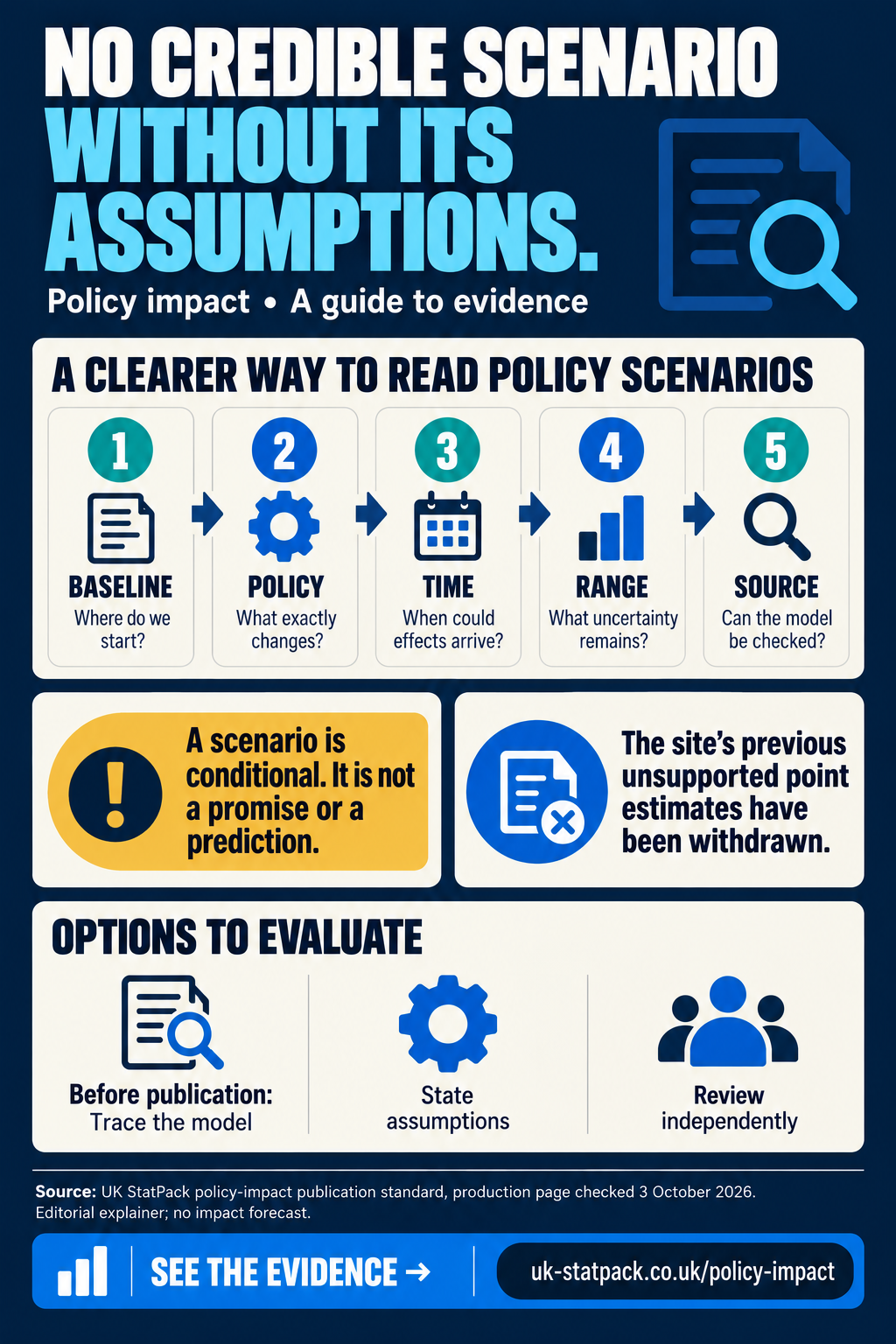
No credible scenario without its assumptions.
The page withdrew unsupported point estimates. Every scenario needs a source, baseline, horizon, range and stated assumptions.
How to read it
- Step 1Source
- Step 2Baseline
- Step 3Horizon
- Step 4Range
- Step 5Assumptions
Editorial explainer: no statistic is shown.
Text and data version
No credible scenario without its assumptions. The page withdrew unsupported point estimates. Every scenario needs a source, baseline, horizon, range and stated assumptions.
Editorial explainer: no statistic is shown.
Image description: No credible scenario without its assumptions — editorial explainer from UK Facts.
All visual summaries, their source records and their publication state are listed on Shareable visuals.
More tools and comparisons
Compare policy designsWhere the hard choices are in taxing land or recent arrivals, without a single headline number.Trade-offs, not totals.Read the chapter → Compare policy designs Compare revenue optionsWhat each design might raise, recurring or one-off, and where options overlap.Primary costings, not a combined total.Read the chapter → Compare revenue options Compare published returns on investmentEstimates differ by investment type, horizon and method.Side by side, with each source’s own caveats.Read the chapter → Compare published returns on investment Compare housing remediesWhich policy acts on which step of supply.Planning, finance, construction and affordable homes.Read the chapter → Compare housing remedies
How outputs are labelled
Every number in the labs carries one of these labels, so arithmetic is never presented as a forecast.
- Observed
- Directly reported by an authoritative source. Not derived or estimated.
- Calculated
- Arithmetic performed on observed values — the calculation is shown and reproducible.
- Modelled
- Generated using stated assumptions (e.g. investment return, compounding, uprating).
- Inferred
- A plausible secondary consequence supported by evidence, but not deterministic.
- Uncertain
- Direction and/or magnitude cannot currently be estimated reliably.
What a scenario model needs before it returns here
- A named owner for each model, and code and inputs that reproduce every output.
- A source, date and unit for every parameter, or an explicit “illustrative” label.
- The baseline, time horizon and a range — not only a central estimate.
- Direct arithmetic kept separate from behavioural responses and wider economic effects.
- Independent review before publication, and a dated record of changes.
Evidence → choices → outcomes
What the evidence can tell us
Policy comparisons on this site are reproducible and bounded, with baselines, assumptions, ranges and costs visible, and no tool published before it passes its own tests.
How we assessed these options
What would it take to improve this?
What would move the needle?
The outcome we want: Policy comparisons on this site are reproducible and bounded, with baselines, assumptions, ranges and costs visible, and no tool published before it passes its own tests.
The main constraint: No scenario model yet meets the publication standard — a named owner, reproducible inputs, sourced parameters, ranges and independent review — so the constraint is validation capacity and evidence, decided by this site’s editors, not the number of tools.
Constraint type: evidence, workforce.
The position today
Which quadrant a point sits in is our analytical judgement, not a statistical category. Each point says whether it is a measured fact, our synthesis or a risk.
What we can build on Strengths
Two bounded tools work now: the Tax Lab and Pensions Lab label every output as calculated or modelled, and the Tax Lab’s automated tests reproduce HMRC’s published ready-reckoner figures.
Our synthesisConfidence: Moderate
Source: HM Revenue & Customs, Direct effects of illustrative tax changes (bulletin) (Ready reckoner tables (reproduced in the Tax Lab test suite))
What government has committed to
No commitment found. No government commitment applies to the site’s tools. The reference the Tax Lab reproduces is HMRC’s June 2025 ready reckoner (Spring Statement 2025 baseline), whose 2026 update was deferred with no new date.
Searched: gov.uk “direct effects of illustrative tax changes”; HMRC statistics announcements; OSR correspondence; 4 Oct 2026
Checked 4 October 2026. A commitment is not delivery.
Options (2)
ShortlistedMake policy models reproducible before expanding the workbench
Keeps the reproduction tests and adds one that fails when the reference is older than the latest fiscal event.
Who: UK Facts · Evidence: Expert or audit recommendation · Status: Site-editorial action
Source: HM Revenue & Customs, Direct effects of illustrative tax changes (bulletin) (Ready reckoner tables)
Benchmark against an independent microsimulation model
A second model checks the labs’ results.
Who: UK Facts · Evidence: Untested proposal · Status: Site-editorial action
Official appraisal and evaluation guidance sets out how to separate affordability from social value, analyse who gains and loses, and plan evaluation before implementation.
Measured factConfidence: High· Green Book 2026; Magenta Book May 2026· UK central government
Source: HM Treasury, The Green Book (2026) (Chapters 6–9; affordability criteria); HM Treasury / Evaluation Task Force, The Magenta Book: Central Government guidance on evaluation (Chapter 1, sections 1.5–1.6)
What government has committed to
Policy: The Green Book (2026) sets appraisal rules, including affordability, optimism bias, distribution and a 3.5% discount rate; the Magenta Book (May 2026) says when and how to plan evaluation.
- Who and when:
- Starmer government (to July 2026), 5 February 2026.
- Since 20 July 2026:
- Changed by the Burnham government. Announced by the Burnham government (7 September 2026), following an independent review that recommended 3%; the published Green Book still said 3.5% on 4 October 2026. Source: HM Treasury, Chancellor John Healey’s Growth Speech 2026 (7 September 2026) (Section “Investment”: discount rate “from 3.5% to 3%”).
- Source:
- HM Treasury, The Green Book (2026) (Chapters 3, 6 and 7; discount rate)
Checked 4 October 2026. A commitment is not delivery.
Options (3)
Make policy models reproducible before expanding the workbench
Uses the Green and Magenta Books as the publication standard for site models.
Who: UK Facts · Evidence: Expert or audit recommendation · Status: Site-editorial action
Source: HM Treasury, The Green Book (2026) (Chapters 6–9); HM Treasury / Evaluation Task Force, The Magenta Book: Central Government guidance on evaluation (Chapter 1, sections 1.5–1.6)
Show results at both 3.5% and 3% until the guidance is revised
Makes the effect of the pending change visible.
Who: UK Facts · Evidence: Modelled scenario · Status: Site-editorial action
Source: HM Treasury, Green Book discount rate review 2026 (30 June 2026) (Review findings)
Follow the Magenta Book transparency annex
Analysis plans, open code and reproducibility.
Who: UK Facts · Evidence: Expert or audit recommendation · Status: Established
Source: HM Treasury, Magenta Book: central government guidance on evaluation (HTML, May 2026) (TIGER transparency annex)
What is holding us back Weaknesses
The wider workbench is unavailable: its dials mixed estimates from different years and definitions with no stated baseline or range, so most policy questions have no interactive tool.
Our synthesisConfidence: High
Source: HM Treasury, The Green Book (2026) (Chapters 6–9 (the standard the dials did not meet))
What government has committed to
Policy: The AQuA Book (2025) sets how government quality-assures analysis, including verification, validation and handling uncertainty; departments publish registers of business-critical models.
- Who and when:
- Starmer government (to July 2026), 30 July 2025.
- Since 20 July 2026:
- Not confirmed either way since the change of Prime Minister on 20 July 2026. No Burnham-era statement found.
- Source:
- Government Analysis Function, The AQuA Book (2025 edition) (Sections 1.3.3–1.3.4)
Checked 4 October 2026. A commitment is not delivery.
Options (2)
ShortlistedMake policy models reproducible before expanding the workbench
A withdrawn model returns only after verification, validation, sourced parameters, ranges and independent review.
Who: UK Facts · Evidence: Expert or audit recommendation · Status: Site-editorial action
Source: Government Analysis Function, The AQuA Book (2025 edition) (Section 1.3.3)
Publish a register of site models
Owner, baseline date and assurance status for each model.
Who: UK Facts · Evidence: Expert or audit recommendation · Status: Site-editorial action
Source: Government Analysis Function, The AQuA Book (2025 edition) (Business-critical models)
What could improve things Opportunities
Validating the existing labs and linking every model to the same funding ledger as the action plans would let users compare options on one set of cost records.
Depends on: Each model passes regression tests and independent review, and costs come from the shared ledger rather than being re-entered.
Our synthesisConfidence: Moderate
Source: HM Treasury, The Green Book (2026) (Affordability and distributional analysis); HM Treasury / Evaluation Task Force, The Magenta Book: Central Government guidance on evaluation (Chapter 1)
What government has committed to
Policy: HM Treasury publishes OBR-certified policy costings and a distributional analysis (“Impact on households”) alongside each fiscal event.
- Who and when:
- Starmer government (to July 2026), 27 November 2025.
- Since 20 July 2026:
- Not confirmed either way since the change of Prime Minister on 20 July 2026. The Budget on 28 October 2026 will show whether the practice continues.
- Source:
- HM Treasury, Supporting documents for Budget 2025 (Attachments “Policy costings” and “Impact on households”)
Checked 4 October 2026. A commitment is not delivery.
Options (3)
ShortlistedPublish one funding ledger across all action plans
Every tool reads costs from the same ledger, counted once.
Who: UK Facts · Evidence: Expert or audit recommendation · Status: Site-editorial action
Source: National Audit Office, Lessons learned: a planning and spending framework that enables long-term value for money (HC 234, Session 2024-25) (Summary paragraph 11)
Make policy models reproducible before expanding the workbench
Validates both labs before linking them to the ledger.
Who: UK Facts · Evidence: Expert or audit recommendation · Status: Site-editorial action
Source: HM Treasury, The Green Book (2026) (Chapters 6–9)
Take official costs only from OBR-certified costings, cited by row
Keeps site figures traceable to the fiscal event.
Who: UK Facts · Evidence: Expert or audit recommendation · Status: Site-editorial action
Source: HM Treasury, Supporting documents for Budget 2025 (Policy costings)
What could make it worse Threats
False precision, stale tax and benefit baselines after a fiscal event, and extrapolation beyond supported inputs can mislead users even when the arithmetic is right.
Risk, not a certaintyConfidence: Moderate
Source: HM Treasury, The Green Book (2026) (Optimism bias; uncertainty)
What government has committed to
Policy: A Budget on 28 October 2026 that resets tax and benefit baselines, and a lower Green Book discount rate announced but not yet published.
- Who and when:
- Burnham government (from 20 July 2026), 31 July 2026.
- Since 20 July 2026:
- Made by the current government. The HMRC ready reckoner remains on a Spring Statement 2025 baseline and its update is deferred.
Checked 4 October 2026. A commitment is not delivery.
Options (3)
ShortlistedMake policy models reproducible before expanding the workbench
Dates every baseline, re-baselines after the Budget and shows ranges.
Who: UK Facts · Evidence: Expert or audit recommendation · Status: Site-editorial action
Source: Government Analysis Function, The AQuA Book (2025 edition) (Section 1.3.4)
Restrict inputs to the ranges the sources support
Stops extrapolation such as scaling behavioural tax lines.
Who: UK Facts · Evidence: Modelled scenario · Status: Site-editorial action
Source: HM Revenue and Customs, Direct effects of illustrative tax changes (June 2025) (Ready-reckoner notes)
Flag outputs that depend on guidance pending revision
Warns users when the discount rate or appraisal method is about to change.
Who: UK Facts · Evidence: Untested proposal · Status: Site-editorial action
The actions worth examining
These actions concern transparency, accountability and informed choice — not a spending programme, and not a view on which party or system is right.
Action 1A46Policy status: site-editorial action
Make policy models reproducible before expanding the workbench
Validate the Tax Lab and Pensions Lab against published figures, disclose baseline, scope, formulas and uncertainty, and add any new model one at a time only after it passes the same tests.
The thread: issue, evidence, action
- Issue Weakness: The wider workbench is unavailable: its dials mixed estimates from different years and definitions with no stated baseline or range, so most policy questions have no interactive tool. Also: threat, strength
- Evidence Working policy labs; Withdrawn workbench models meeting the publication standard
- Action A46, this action
- Who decides:
- UK Facts, with qualified independent model reviewers (UK)
- Evidence:
- Expert or audit recommendation. HM Treasury’s appraisal and evaluation guidance sets the standard for separating cost, value, distribution and uncertainty; following it does not validate a model automatically.
- Expected effect:
- Direction plausible; size not established.
- Cost and funding
Not yet costed
Funding: Not a direct public-spending programme
Why it is shortlisted here: Puts trustworthy models before more sliders: validate the two working labs, publish their limits, then add one model at a time.
What it takes
The problem
The earlier policy dials mixed estimates from different years and definitions without baselines or ranges and were withdrawn; two bounded labs now work, and nothing yet meets the standard for a wider workbench.
Who is affected, and where
Users of the site’s policy tools. Territory: UK. The Tax Lab uses UK-wide HMRC figures; some taxes and rates are devolved (for example Scottish income tax), which each tool must state.
Policy status
UK Facts proposal. The Tax Lab and Pensions Lab work now and stay available. The wider workbench stays withdrawn until a model meets the publication standard on this page: a named owner, reproducible inputs, sourced parameters, ranges and independent review.
The evidence
- What the research found:
- The Green Book (2026) keeps affordability for public bodies separate from social value and requires distributional analysis and adjustment for optimism bias. The Magenta Book (May 2026) asks for evaluation to be planned before implementation, with a counterfactual. The Tax Lab already reproduces HMRC’s published ready-reckoner figures in automated tests.
- Evaluated on:
- Not applicable (official guidance); UK central government appraisal and evaluation practice
- Our recommendation (separate from the research):
- Reproduce known scenarios, publish where each model cannot support policy claims, and only then consider one additional model at a time.
- Strongest counter-evidence:
- Matching official figures can lend false authority: ready reckoners are static, behavioural responses remain uncertain, and baselines go stale after every fiscal event.
Cost and funding
Cost completeness: Not yet costed. Funding: Not a direct public-spending programme.
- Model validation, external review, data licensing and maintenance for the policy labs (private contribution; paid by UK Facts): Not yet costed. Site cost only; no public spending.
- Who pays:
- UK Facts: model development, external review, data licensing and maintenance.
- Financing proposed:
- UK Facts’ product and research budget.
- Gap remaining:
- Not costed.
What delivery needs
- Skills:
- Tax and pensions modellers; independent reviewers.
- Operational capacity:
- A regression test suite for each tool.
- Infrastructure:
- Versioned baselines updated after each fiscal event.
- Permissions:
- Data licences where needed.
- Law:
- None.
- Public consent:
- None.
First step and stages
First step: Reproduce known scenarios and identify where each model cannot support policy claims. (owner: UK Facts)
- Validate the existing labs against published figures — UK Facts with an independent reviewer (proposed stage, not an official timetable)
- Publish each tool’s limits and baseline date — UK Facts (proposed stage, not an official timetable)
- Consider one further model, on the same standard — UK Facts (proposed stage, not an official timetable)
Depends on: A47: one funding ledger, so model outputs and action costs use the same records
Trade-offs
- Who gains and who loses:
- No direct distributional effect; the tools themselves report who gains and loses within their scope.
- What else the money or effort could do:
- Development time not spent on new tools.
- Strongest counterargument:
- Users want answers to many questions now; a slow, validated approach leaves most questions without an interactive tool.
- Risks:
- False precision, extrapolation beyond supported inputs, and stale tax and benefit baselines.
How we would judge it
- Baseline:
- Two working labs; the wider workbench withdrawn (3 October 2026).
- Leading indicator:
- Share of lab outputs reproduced by automated tests against published figures.
- Outcome:
- Independent review sign-off for each tool, and users’ understanding of calculated versus modelled outputs.
- Continue, adapt or stop:
- Keep a tool withdrawn, or withdraw it, if it fails its regression tests or its baseline is out of date after a fiscal event.
Sources
- HM Treasury, The Green Book (2026), Chapters 6–9; affordability criteria; chapter 7 (distributional analysis) (2026-02-05; relevant passages checked)
- HM Treasury / Evaluation Task Force, The Magenta Book: Central Government guidance on evaluation, Chapter 1, sections 1.5–1.6 (2026-05-14; relevant passages checked)
- HM Revenue & Customs, Direct effects of illustrative tax changes (bulletin), Direct effects of illustrative tax changes (ready reckoner tables) (24 June 2025 edition; relevant passages checked)
Source published 5 February 2026 (Green Book); 14 May 2026 (Magenta Book); evidence reviewed 2026-10-04. Reconsider if: A fiscal event changes a tax or pension baseline; An independent review of either lab; A proposed new model meets the publication standard.
Action 2A47Policy status: site-editorial action
Publish one funding ledger across all action plans
Connect every action to unique cost and funding records with years, price basis and status, so totals are shown only when compatible and gaps stay visible.
The thread: issue, evidence, action
- Who decides:
- UK Facts editorial and data team; policy owners remain responsible for their own commitments (UK)
- Evidence:
- Expert or audit recommendation. An accounting control grounded in official appraisal guidance; not an intervention with an economic return.
- Expected effect:
- Direction plausible; size not established.
- Cost and funding
Not yet costed
Funding: Not a direct public-spending programme
Why it is shortlisted here: A scenario tool is only as honest as its cost records; one ledger stops the same money being counted twice across plans and tools.
What it takes
The problem
Proposals often count the same money twice, add incompatible figures or treat tax proposals and growth effects as money in the bank.
Who is affected, and where
Readers of UK Facts, including journalists, officials and voters. Territory: UK. Covers every action on the site, whichever nation it applies to.
Policy status
UK Facts proposal. Implemented on this site in October 2026 as the policy-plan ledger, with automatic checks for duplicate allocation, invalid funding labels and incompatible totals.
The evidence
- What the research found:
- The Green Book separates social value from affordability and requires attention to additionality and optimism bias; the NAO recommends realistic costs and published plans.
- Evaluated on:
- Not applicable; This website
- Our recommendation (separate from the research):
- Validate before showing any total; refresh with each Budget or policy update; keep unknowns unknown, never zero.
- Strongest counter-evidence:
- A neat ledger can imply more certainty than exists; it cannot judge whether a policy is worth doing.
Cost and funding
Cost completeness: Not yet costed. Funding: Not a direct public-spending programme.
- UK Facts ledger implementation and maintenance (administration; paid by UK Facts): Not yet costed. Site budget; no public money. Policy totals are inherited from the records, never created from generic assumptions.
- Who pays:
- UK Facts (editorial and development time).
- Financing proposed:
- The site’s own budget; no public money.
- Gap remaining:
- Not applicable to public funding; site time is not separately costed.
What delivery needs
- Skills:
- Data and editorial staff.
- Operational capacity:
- Refresh after each fiscal event.
- Infrastructure:
- The site’s validation suite.
- Permissions:
- None.
- Law:
- None.
- Public consent:
- None.
First step and stages
First step: Record periods, price bases, amounts or ranges, allocation, conditions and existing uses for every cost on the site. (owner: UK Facts data team)
- Validate records before publishing totals — UK Facts
- Refresh after each Budget or Spending Review — UK Facts (proposed stage, not an official timetable)
Depends on: Every domain action’s cost records
Trade-offs
- Who gains and who loses:
- Readers gain clearer information; no direct distributional effect.
- What else the money or effort could do:
- Editorial time not spent on other pages.
- Strongest counterargument:
- Official bodies (OBR, departments) already publish costings; a site ledger can duplicate them.
- Risks:
- Spurious certainty; missing data shown as zero (guarded against by validation).
How we would judge it
- Baseline:
- Duplicate allocations and unmatched years flagged by the validator.
- Leading indicator:
- Share of actions with complete cost and funding records.
- Outcome:
- Traceable evidence for every figure; unresolved gaps visible.
- Continue, adapt or stop:
- Never publish a combined total while any material cost is unknown.
Sources
- HM Treasury, The Green Book (2026), Chapters 6–9; affordability criteria (2026-02-05; relevant passages checked)
- National Audit Office, Lessons learned: a planning and spending framework that enables long-term value for money (HC 234, Session 2024-25), Summary paragraph 11 (2024-10-27; relevant passages checked)
- HM Treasury, The Green Book (2026), Affordability criteria (2026-02-05; relevant passages checked)
Source published February 2026 (Green Book); October 2024 (NAO); evidence reviewed 2026-10-04. Reconsider if: A Budget or Spending Review; A new domain plan is added.
Also on: Public finances — one shared record, so its cost is counted once.
Decision brief
The leading option set out as a decision someone could take: who decides, who benefits, the best evidence, cost and funding, and the main trade-off. The full research record is one click away.
Decision briefSite-maintenance taskReviewed 2026-10-04
Open the policy scenarios page with three guided questions that anyone can reproduce
The thread: issue, evidence, action
- Issue Weakness: The wider workbench is unavailable: its dials mixed estimates from different years and definitions with no stated baseline or range, so most policy questions have no interactive tool. Also: threat, strength
- Evidence Working policy labs; Withdrawn workbench models meeting the publication standard
- Action Make policy models reproducible before expanding the workbench
- Decision required
- UK Facts puts three worked questions at the top of the page — one tax question and two pension questions — each with its baseline, what the answer means, what it does not mean and a link that reproduces it in the Tax Lab or Pensions Lab.
- Who and where
- Users of the policy scenarios page and the two labs. Applies in: UK.
- Accountable body
- UK Facts editors
- Intervention
- Give each guided question a fixed preset, a dated baseline and an output reading.
- Best evidence, and where it applies
- The Tax Lab’s automated tests already reproduce HMRC’s published ready-reckoner figures; the Green Book and Magenta Book set the standard for stating baselines, ranges and who gains and loses.Studied in: UK central government appraisal (Not an evaluation: official appraisal guidance).
- Extra cost of this change
- Capital: none identified in the brief.Recurring: Validation, independent review and baseline refresh for the two labs — Not yet costed.
- Funding
- Not funded yet: a possible funding route exists, but nothing is allocated to this change.Committed to this change: none.Possible source, not an award: none identified.Unfunded: Staff time and review fees are not yet costed.
- Savings and wider benefits
- Not yet specified: no cashable saving or avoided cost has been costed for this change. Expected outcomes are listed one by one in the research appendix and are never added together or counted as money available.
- First 90-day step
- The three guided questions live at the top of /policy-impact, each passing an automated reproduction testThe proposed first milestone; a 90-day date is not yet specified. Owner: UK Facts developers. Proposed by UK Facts, not an official deadline.
- Twelve-month milestone
- Not yet specified.Time to a first useful result: One release cycle; baselines then refreshed after the 28 October 2026 Budget.
- Outcome, and when to scale or stop
- Measure: All three guided outputs pass their reproduction tests at each release.Scale if: The tests pass and readers can say what each output does and does not mean.Stop if: A guided output fails its test or its baseline is out of date after a fiscal event — the question is withdrawn until fixed.
- Main trade-off
- Three bounded questions answer less than a full workbench, but every answer can be checked; the withdrawn workbench mixed incompatible estimates.
- Source and review date
- The Green Book (2026) (2026). Reviewed 2026-10-04.
An editorial proposal by UK Facts for discussion, not government policy. Records: A46 · costs C-A46-REVIEW
Research appendix: study design, effect sizes and limits, alternatives, full costing, international comparisons and how we would know
1.The change, in plain words
Open the policy scenarios page with three guided questions that anyone can reproduce
2.The decision requested
- Decision
- Publish three guided questions (below), each tied to a lab preset, a dated baseline and a scope warning, and move the validation record and test results to the methods section of the page.
- Accountable institution
- UK Facts editors
- Geography
- UK
- Powers
- An editorial and product decision for this website. No public body or budget is involved.
- Delivery partners
- An independent model reviewer; HMRC and OBR, as publishers of the baselines the labs reproduce
3.Who it is for, and what changes beyond today
- Target population
- Users of the policy scenarios page and the two labs.
- Eligibility
- Questions the labs can already answer within their published scope: (1) what 1p on the basic rate of income tax raises, before and after behaviour (Tax Lab, HMRC ready reckoner baseline); (2) what doubling the employer auto-enrolment minimum from 3% to 6% means for savers and employers (Pensions Lab “Employers pay more” preset); (3) how State Pension spending in 2075/76 differs between the triple lock and earnings-linked uprating (Pensions Lab, OBR long-term projection).
- Scale
- Three questions; no new model until one passes the publication standard.
- Baseline
- The wider workbench is unavailable (withdrawn for rebuilding; no relaunch date has been set); two labs work. Baselines: HMRC ready reckoner (June 2025 edition); auto-enrolment minimums of 5% employee and 3% employer on qualifying earnings; OBR long-term State Pension projections (July 2026).
Source: HM Revenue & Customs, Direct effects of illustrative tax changes (bulletin) (Ready reckoner tables); Office for Budget Responsibility, Fiscal risks and sustainability (July 2026) (Long-term projections of State Pension spending)
- Change beyond existing law or funding
- The page currently lists where questions can be answered. The change adds three fully worked examples with a reproducible link, a stated baseline and price year, an “outside the model’s scope” warning, and puts the test results in the methods.
4.How it would work
Do: Give each guided question a fixed preset, a dated baseline and an output reading Changing: so that a reader gets the same answer every time and can see which parts are calculated and which modelled
Each guided output is reproduced by an automated test
Hypothesis to test
A quality measure for this site, not a policy effect.
Readers correctly tell a calculated figure from a modelled one
Hypothesis to test
To be checked in reader comprehension sessions; no effect size is claimed.
Outcomes are kept separate and never added into one impact figure.
5.Best evidence
- Author or institution:
- HM Treasury
- Published:
- 2026
- Evaluation period:
- Not an evaluation: official appraisal guidance
- Design:
- Guidance
- Sample or population:
- UK central government appraisal
- Effect and uncertainty:
- Requires affordability to be kept separate from social value, distributional analysis and adjustment for optimism bias.
- Limits:
- Sets a standard; does not test whether a website tool is understood.
Where: Chapters 6–9; affordability criteria; chapter 7 (distributional analysis). Affiliation is provenance, not proof of quality.
6.Alternatives, counter-evidence and who loses
- Closest feasible alternative
- Restore a wider workbench of sliders now, with caveats on each output.
- Strongest counter-evidence
- Matching official figures can lend false authority: ready reckoners are static or use fixed behavioural assumptions, and baselines go stale after each fiscal event.
Source: HM Treasury, The Green Book (2026) (Optimism bias; uncertainty)
- Distributional effects
- None from the tool itself; the tax and pension questions report who pays and who gains within their scope.
- Main downside
- Three questions leave many reader questions unanswered until another model passes review.
| Option | Who is reached | Evidence | Likely outcome and timing | Cost and funding | Main trade-off |
|---|---|---|---|---|---|
| The proposalThree guided, reproducible questions with baselines and scope warnings | Every visitor to /policy-impact | Lab tests reproduce published figures; official appraisal guidance | Usable answers in one release cycle | Site time, not yet costed | Narrow scope |
| Current policyCurrent page: a list of where questions can be answered | Readers who click through to a lab | Labs work; no worked example on the page | No change | Existing site time | Readers must learn the tools before getting an answer |
| AlternativeRestore the wider workbench with caveats | All visitors | The previous dials mixed incompatible years and definitions | Fast, but outputs not reproducible | Development time | False precision |
The options compared, including current policy
The proposal
Three guided, reproducible questions with baselines and scope warnings
- Who is reached
- Every visitor to /policy-impact
- Evidence
- Lab tests reproduce published figures; official appraisal guidance
- Likely outcome and timing
- Usable answers in one release cycle
- Cost and funding
- Site time, not yet costed
- Main trade-off
- Narrow scope
Current policy
Current page: a list of where questions can be answered
- Who is reached
- Readers who click through to a lab
- Evidence
- Labs work; no worked example on the page
- Likely outcome and timing
- No change
- Cost and funding
- Existing site time
- Main trade-off
- Readers must learn the tools before getting an answer
Alternative
Restore the wider workbench with caveats
- Who is reached
- All visitors
- Evidence
- The previous dials mixed incompatible years and definitions
- Likely outcome and timing
- Fast, but outputs not reproducible
- Cost and funding
- Development time
- Main trade-off
- False precision
8.What delivery needs first
- data — Baselines refreshed after each fiscal event (the next Budget is scheduled for 28 October 2026); an out-of-date baseline withdraws the question. (Requirement; owner: UK Facts developers)
- staff — An independent reviewer for each lab before its guided question is labelled reviewed. (Scarce resource shared with other priorities; owner: UK Facts editors)
9.What it would cost
How the cost is built up: Developer and editor time to build three presets and tests + independent review fee + refresh after each fiscal event. Site cost only.
| Component | Unit and quantity | Unit cost or amount | Type, price year, period | Status |
|---|---|---|---|---|
| Validation, independent review and baseline refresh for the two labsTax Lab and Pensions Lab; three guided questions | staff time and review fees; quantity to be set from need and capacity | Not yet costed (ledger C-A46-REVIEW) | recurring; price year not stated; After each fiscal event | Not yet established |
Validation, independent review and baseline refresh for the two labs
Tax Lab and Pensions Lab; three guided questions
Not yet costed (ledger C-A46-REVIEW)
recurring; price year not stated; After each fiscal event; Not yet established
10.Who pays, and what is missing
- Programme envelope (a possible route, not an award)
- None identified
- Allocation committed to this change
- None
- Remaining gap
- Staff time and review fees are not yet costed.
- Proposed financing
- UK Facts’ product and research budget; no public money.
- Responsible payer
- UK Facts
- Budget displaced
- Time not spent on new pages or a further model.
11.First milestone and time to a useful result
The three guided questions live at the top of /policy-impact, each passing an automated reproduction test (Owner: UK Facts developers. Proposed by UK Facts, not an official deadline.)
Time to first useful result: One release cycle; baselines then refreshed after the 28 October 2026 Budget.
What could delay it: The Budget changes the tax baseline and the ready reckoner is not yet republished An independent reviewer is available
12.How we would know
- Baseline
- Two working labs; no guided questions; workbench withdrawn.
- Comparison
- Published HMRC and OBR figures the labs reproduce.
- Leading indicator
- All three guided outputs pass their reproduction tests at each release.
- Follow-up
- After each fiscal event.
- Continue if
- The tests pass and readers can say what each output does and does not mean.
- Adapt if
- Readers misread modelled results as calculated ones; the wording or layout changes.
- Stop if
- A guided output fails its test or its baseline is out of date after a fiscal event — the question is withdrawn until fixed.
- Thresholds
- Not yet set: Pass/fail is defined by reproduction of the published figure; no numerical comprehension target is set before testing.
What is not yet known, and how to find out
- What validation, review and refresh will cost each year (cost)Next step: Record developer time for the first three presets and obtain a reviewer quote.Scope: Two labs, three guided questions · Data or quotes needed: Hours logged; reviewer quote · Who can estimate it: UK Facts
- Whether readers understand the calculated/modelled distinction (effect)Next step: Test the three questions in the planned reader sessions.Defensible route: bounded pilot
Sources last checked 4 October 2026 · Owner: Site methods editor (James Harris) · Next check: the first trigger: A change to the policy scenarios models or their inputs.
What it would take
The order things have to happen in
First, the prerequisite
Reproduce known scenarios in both labs and list what each cannot support
Owner: UK Facts with an independent reviewer
No date: the timing depends on the steps before it.
Then, the decision
Decide whether any withdrawn model meets the publication standard
Owner: UK Facts editors
No date: the timing depends on the steps before it.
Then, delivery
Link tool outputs to the shared funding ledger; add at most one further model at a time
Owner: UK Facts
No date: the timing depends on the steps before it.
Finally, the measured outcome
Every published output reproducible by tests; baselines dated after each fiscal event
Owner: UK Facts
No date: the timing depends on the steps before it.
Who pays, and what is still missing
Cost, committed funding and the remaining gap for the same scope and years. A programme envelope is not an award to a project; a proposal is not committed money. None of these costs has been established yet, so no total is shown.
Cost and funding ledger
Model validation, external review, data licensing and maintenance for the policy labs
A46 · private contribution · not costed
- Amount
- Not yet costed
- Who pays
- UK Facts
- Committed
- None identified
- Proposed, not committed
- —
- Gap
- Not established
UK Facts ledger implementation and maintenance
A47 · administration · not costed
- Amount
- Not yet costed
- Who pays
- UK Facts
- Committed
- None identified
- Proposed, not committed
- —
- Gap
- Not established
“Not yet costed” means no defensible cost has been found — not that the action is free. Lifetime benefits, benefit-cost ratios and forecast savings are never shown here as money available to spend.
What the evidence says each action changes
No effect has been established for these actions yet: direction plausible; size not established.
How we would know
The outcome measures to watch. A baseline is where we start, not a target; where there is no official target we say so.
Working policy labs
tools · United Kingdom
- Baseline
- Not published
- Latest
- 2 (Tax Lab, Pensions Lab)
- 3 October 2026
Target: none — more tools are not the aim; validated ones are.
Source: HM Revenue & Customs, Direct effects of illustrative tax changes (bulletin) (Figures the Tax Lab reproduces in its tests). Next release: after each fiscal event (baseline refresh) (check the release calendar).
Withdrawn workbench models meeting the publication standard
models · United Kingdom
- Baseline
- Not published
- Latest
- None
- 3 October 2026
Target: none — a model returns only when it passes; no number is targeted.
Source: HM Treasury / Evaluation Task Force, The Magenta Book: Central Government guidance on evaluation (Chapter 1, sections 1.5–1.6 (evaluation planned before release)). Next release: when a model is submitted for review (check the release calendar).
Where the ideas come from
Research, counter-evidence and methods (4 sources; 1 claim held back)
- Direct effects of illustrative tax changes (bulletin) — HM Revenue & Customs, 24 June 2025 edition.Official statistics (static costings); United Kingdom. Relevant passages checked, 2026-10-04. Limits: The published figures the Tax Lab reproduces in its automated tests; static estimates that exclude most behavioural responses.
- The Green Book (2026) — HM Treasury, 2026-02-05.Official appraisal guidance. Relevant passages checked, 2026-10-04. Limits: Guidance; a positive benefit-cost ratio identifies no funding source.
- The Magenta Book: Central Government guidance on evaluation — HM Treasury / Evaluation Task Force, 2026-05-14.Official evaluation guidance; UK central government. Relevant passages checked, 2026-10-04. Limits: Guidance; supplies no policy result.
- Lessons learned: a planning and spending framework that enables long-term value for money (HC 234, Session 2024-25) — National Audit Office, 2024-10-27.Audit synthesis of NAO value-for-money work (HC 234, 2024–25); UK central government. Relevant passages checked, 2026-10-04. Limits: Written before the 2025 Spending Review; a published plan is an input to accountability, not a service improvement.
Counter-evidence and criticism
- Make policy models reproducible before expanding the workbench: Matching official figures can lend false authority: ready reckoners are static, behavioural responses remain uncertain, and baselines go stale after every fiscal event.
- Publish one funding ledger across all action plans: A neat ledger can imply more certainty than exists; it cannot judge whether a policy is worth doing. (HM Treasury)
Claims held back
- Any revenue or cost figure from the withdrawn workbench — Its estimates mixed years, definitions and assumptions with no baseline or range. Needed: A rebuilt model that meets every point of the publication standard.
“Full text checked” means we read the report itself; “relevant passages” means the sections behind each figure; “summary or abstract only” means we could not read the full study, so no number from it is published here without another source.
Plan reviewed 2026-10-04. How we judge evidence.
How this connects
- Explore the assumptions behind a tax change
The working example of the standard on this page: calculated and modelled outputs are labelled separately.
- Explore a pension rule change
Household illustrations and national totals, with their scope stated.
Not personal financial advice or a full policy costing.
- Which priorities would make the biggest national difference?
National priorities chosen from every domain plan on a published selection table, each with a decision brief, and one funding view built on the same ledger as these labs.
- How could the nursing pipeline be funded?
Four funding scenarios, every assumption shown.
Sources and methods (2)
- HMRC, "Direct effects of illustrative tax changes" bulletin (released 24 June 2025 edition) — direct effects of tax changes used in Tax Lab
- OBR, Economic and fiscal outlook ready-reckoners (consistent with the March 2025 EFO), sheet Debt_interest_RR (released March 2025 (corrected 17 March 2026)) — debt-interest sensitivity used on /public-finances
Method notes
- A tool is listed here only if it works now and labels the type of each output.
- The numerical workbench will return only when a model meets every point of the publication standard above.