Public procurement · United Kingdom · spending 2025–26 · commitments June–September 2026

£461bn in public buying. What are we getting for it?

The public sector spent £461.3bn on procurement in 2025–26: gross current and capital purchasing, including purchases from other public bodies. UK Facts tracks eleven procurement commitments made since June 2026; three are published rules that start in 2027. Follow what gets bought, what arrives and what changes for the public.

Priority: Improve outcomes and whole-life value from named contracts and procurement decisions. What would change it →

Evidence last reviewed 3 October 2026

Overview

The short version

Three key measures

  • How much does the public sector spend buying things?

    £461.3bn

    Whole public sector gross procurement, current plus capital (central government alone: £295.9bn). Includes purchases from other public bodies, so it is not all spending with private firms.

    United Kingdom · 2025–26, outturn

    Source: How much does the public sector spend buying things?

    Site calculation · HM Treasury, Public Expenditure Statistical Analyses (PESA) 2026 — Tables 5.3 and 6.5

    Who buys what? →
  • How far have this year’s procurement promises got?

    0 of 11at contract stage

    Four are published rules (applying from 2027), five are announcements only, and two are outcomes with no measure yet.

    United Kingdom · Checked 28 Sept 2026

    Source: How far have this year’s procurement promises got?

    Administrative data · Cabinet Office, Measures to rewire the state (press release)

    From award to delivery →
  • How many major projects look undeliverable as planned?

    20%of rated projects rated Red

    34 of 172 rated government major projects at 31 March 2026, where successful delivery appears unachievable without major changes. 16 of the 189 projects had ratings withheld and 1 was not yet rated. In defence, 41% of rated projects.

    United Kingdom (government major projects portfolio) · 31 March 2026

    Source: How many major projects look undeliverable as planned?

    Official statistic · NISTA, Major Projects Annual Report 2025-26

    Changes, overruns and recoveries →
Who feels this most?

When a contract fails, the people who were meant to receive the service carry the cost first — and taxpayers pay twice if the work has to be bought again. The government’s own delivery-confidence ratings show where that risk is highest.

The evidence

From buying decisions to delivery and whole-life value

How far has each procurement commitment actually travelled?

None of eleven commitments has reached a contract; four are published rules

Each sourced commitment on public buying, insourcing and UK jobs, and the furthest stage evidenced: announced → rule in force → tender or award → delivery → measured outcome. Equal-width stages; no percent-complete figures.

United Kingdom (central government rules; English and UK bodies as stated in each rule) · Commitments announced June to September 2026; checked 28 September 2026
  • Reached
  • Published, not yet in force
  • Not yet
  • No measure exists
Commitment and latest verified stageAnnouncedRule in forceTender or awardDeliveryMeasured outcome
Central government bids scored at least 10% (from £1m) or 20% (from £5m) on jobs and skillsRule published, not yet in forceNext: Detailed guidance, promised for “autumn 2026”. Then the first tender notices from 1 January 2027.Cabinet Office (checked 28 Sept 2026)Reached: Yes (Aug 2026)Published, not yet in force: Published; applies later (see next)Not yet: —Not yet: —Not yet: —
Jobs and skills pledges on £5m+ contracts tracked by KPI and reported publiclyPendingNext: First contract performance notices covering social value KPIs. Timing depends on awards; UK Facts’ reading is 2028 at the earliest.Cabinet Office (checked 28 Sept 2026)Reached: Yes (Aug 2026)Not yet: —Not yet: —Not yet: —Not yet: Pending: depends on contracts not yet let
Utilities to use their own procurement to support manufacturing jobs and skillsPolicy announcedNext: Guidance to utilities or a bill, promised only “when parliamentary time allows”. No date given.Cabinet Office (checked 28 Sept 2026)Reached: Yes (Sept 2026)Not yet: —Not yet: —Not yet: —Not yet: —
Ofgem asked to factor UK supply chains, jobs and skills into electricity network procurementRule published, not yet in forceNext: Takes effect 17 November 2026 after a 40-day consideration period. Network companies to respond on a voluntary minimum 10% social value weighting in an Electricity Networks Sector Growth Plan (no date given).Department for Energy Security and Net Zero (checked 28 Sept 2026)Reached: Yes (Sept 2026)Published, not yet in force: Published; applies later (see next)Not yet: —Not yet: —Not yet: —
UK manufacturing jobs and apprenticeships created through utility procurementUnknown / not reportedNext: A published metric or reporting requirement. No date given.Cabinet Office (checked 28 Sept 2026)Reached: Yes (Sept 2026)Not yet: —Not yet: —Not yet: —No measure exists: No measure or baseline published
National Shipbuilding Office oversight of all future government civil ship procurementPolicy announcedNext: Shipbuilding and Maritime Technology Action Plan, “planned for later this year” (2026).Cabinet Office (checked 28 Sept 2026)Reached: Yes (Sept 2026)Not yet: —Not yet: —Not yet: —Not yet: —
Replacement Cefas research vessel built in a UK shipyardPolicy announcedNext: Engagement with UK shipbuilders “in the coming months”, then a tender and award. Vessel expected operational 2031 or 2032.Defra and Cefas (checked 28 Sept 2026)Reached: Yes (Sept 2026)Not yet: —Not yet: —Not yet: —Not yet: —
Insourcing Unit in the Office for the Prime Minister and CabinetPolicy announcedNext: Confirmation that the unit is established. No date given.Cabinet Office (checked 28 Sept 2026)Reached: Yes (Sept 2026)Not yet: —Not yet: —Not yet: —Not yet: —
Public Interest Test before contracting out central government services over £1mRule published, not yet in forceNext: 1 April 2027 start. First quarterly return (April to June 2027) due by 30 July 2027. Central publication of results: no date given.Cabinet Office (checked 28 Sept 2026)Reached: Yes (Jun 2026)Published, not yet in force: Published; applies later (see next)Not yet: —Not yet: —Not yet: —
Five-year Insourcing Strategies from bodies with £100m+ annual contract spendRule published, not yet in forceNext: Publication “within 30 days of 1 April 2027”, on each body’s GOV.UK pages or website.Cabinet Office (checked 28 Sept 2026)Reached: Yes (Jun 2026)Published, not yet in force: Published; applies later (see next)Not yet: —Not yet: —Not yet: —
Cabinet Office building management (including cleaning and security) brought back in-housePolicy announcedNext: A Public Interest Test result for these services, then a transition from 2028.Cabinet Office (checked 28 Sept 2026)Reached: Yes (Sept 2026)Not yet: —Not yet: —Not yet: —Not yet: —
The announcements are real, and several are now written rules with start dates in 2027. But no commitment has yet reached a contract, delivery or a measured outcome — the stages at which public benefit would show. That is a statement about timing, not failure: the rules do not apply until 2027, and the first reports on social-value pledges are unlikely before 2028.

United Kingdom (central government rules; English and UK bodies as stated in each rule) · Commitments announced June to September 2026; checked 28 September 2026 · Tracker of official documents; moves only when new evidence is published

Sources, definitions and data — None of eleven commitments has reached a contract; four are published rules
Geography:
United Kingdom (central government rules; English and UK bodies as stated in each rule)
Measure:
Stage reached (categorical)
Period:
Commitments announced June to September 2026; checked 28 September 2026
Status:
Tracker of official documents; moves only when new evidence is published
Calculation:
Each row is placed at the furthest stage for which a primary source exists. A rule that is published but not yet in force is shown as partly reached.
Not included / breaks:
A contract award notice names the supplier’s registered address, not where the work is done. No row counts jobs, savings or outcomes, because none has been published.

Source: Cabinet Office, Measures to rewire the state (press release) (released 2026-09-27). Chart PROC-01.

View the data as a table
CommitmentLatest stageAnnouncedRule in forceTender or awardDeliveryMeasured outcomeNext
Central government bids scored at least 10% (from £1m) or 20% (from £5m) on jobs and skillsRule published, not yet in forceYes (Aug 2026)Published; applies later (see next)———Detailed guidance, promised for “autumn 2026”. Then the first tender notices from 1 January 2027.
Jobs and skills pledges on £5m+ contracts tracked by KPI and reported publiclyPendingYes (Aug 2026)———Pending: depends on contracts not yet letFirst contract performance notices covering social value KPIs. Timing depends on awards; UK Facts’ reading is 2028 at the earliest.
Utilities to use their own procurement to support manufacturing jobs and skillsPolicy announcedYes (Sept 2026)————Guidance to utilities or a bill, promised only “when parliamentary time allows”. No date given.
Ofgem asked to factor UK supply chains, jobs and skills into electricity network procurementRule published, not yet in forceYes (Sept 2026)Published; applies later (see next)———Takes effect 17 November 2026 after a 40-day consideration period. Network companies to respond on a voluntary minimum 10% social value weighting in an Electricity Networks Sector Growth Plan (no date given).
UK manufacturing jobs and apprenticeships created through utility procurementUnknown / not reportedYes (Sept 2026)———No measure or baseline publishedA published metric or reporting requirement. No date given.
National Shipbuilding Office oversight of all future government civil ship procurementPolicy announcedYes (Sept 2026)————Shipbuilding and Maritime Technology Action Plan, “planned for later this year” (2026).
Replacement Cefas research vessel built in a UK shipyardPolicy announcedYes (Sept 2026)————Engagement with UK shipbuilders “in the coming months”, then a tender and award. Vessel expected operational 2031 or 2032.
Insourcing Unit in the Office for the Prime Minister and CabinetPolicy announcedYes (Sept 2026)————Confirmation that the unit is established. No date given.
Public Interest Test before contracting out central government services over £1mRule published, not yet in forceYes (Jun 2026)Published; applies later (see next)———1 April 2027 start. First quarterly return (April to June 2027) due by 30 July 2027. Central publication of results: no date given.
Five-year Insourcing Strategies from bodies with £100m+ annual contract spendRule published, not yet in forceYes (Jun 2026)Published; applies later (see next)———Publication “within 30 days of 1 April 2027”, on each body’s GOV.UK pages or website.
Cabinet Office building management (including cleaning and security) brought back in-housePolicy announcedYes (Sept 2026)————A Public Interest Test result for these services, then a transition from 2028.

Scroll the table sideways to see every column.

Who feels this most?

Where are big projects least likely to deliver as planned?

41% of rated defence projects are Red, against 14% in the rest of government

Share of rated government major projects with a Red delivery-confidence rating, 31 March 2026 (projects whose rating is withheld excluded).

United Kingdom (Government Major Projects Portfolio) · Ratings at 31 March 2026
Share of rated projects rated Red, 31 March 2026
  • Defence (Ministry of Defence)41%
  • Rest of government14%
People who depend on a programme feel its failure: soldiers waiting for equipment, patients for hospital buildings, councils for IT. Delivery confidence is lowest in defence, where projects are large, technically novel and bought from few suppliers. That pattern fits the National Audit Office’s repeated findings about over-commitment, but the ratings themselves do not explain why a project is Red.

United Kingdom (Government Major Projects Portfolio) · Ratings at 31 March 2026 · Official statistics; some ratings are departmental self-assessments where no independent rating was published

Sources, definitions and data — 41% of rated defence projects are Red, against 14% in the rest of government
Geography:
United Kingdom (Government Major Projects Portfolio)
Measure:
% of rated projects
Period:
Ratings at 31 March 2026
Status:
Official statistics; some ratings are departmental self-assessments where no independent rating was published
Calculation:
Red projects divided by rated projects (withheld ratings excluded).
Compare with:
Rest of government
Not included / breaks:
16 projects across government had ratings withheld and 1 was not yet rated (172 of 189 rated). A Red rating is a forward-looking judgement about delivery, not a finding of overspend or misconduct.

Source: NISTA, Major Projects Annual Report 2025-26 (released 13 July 2026). Chart PROC-03.

View the data as a table
Group% Red of rated
Defence (Ministry of Defence)41%
Rest of government14%
Shareable visual summary

Visual summary

Editorial explainer

An explanation of how to read the evidence. It shows no statistic.

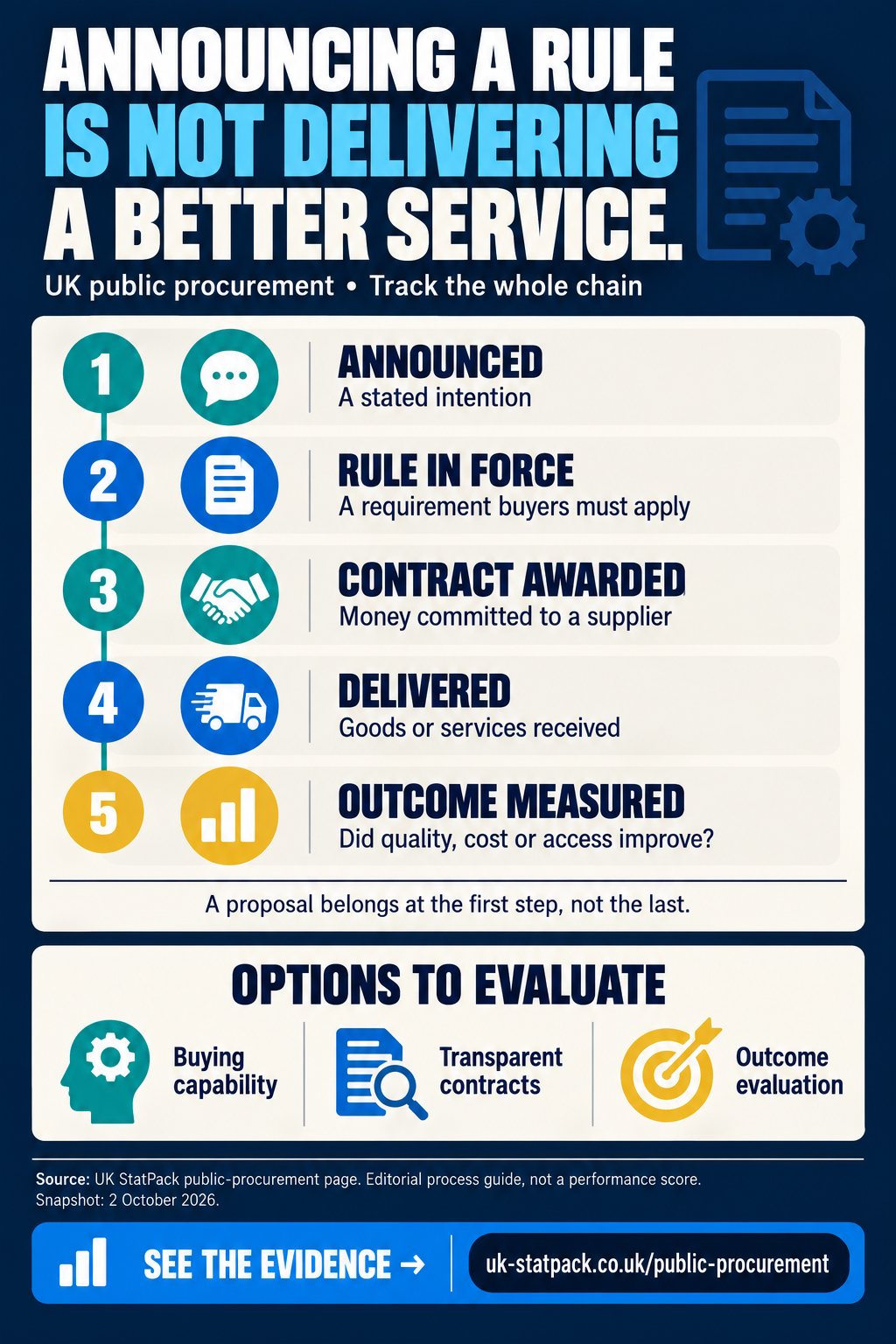
Announcing a rule is not delivering a better service.

Track the announcement, the rule in force, the contract award, delivery and the measured outcome separately.

How to read it

  1. Step 1Announcement
  2. Step 2Rule in force
  3. Step 3Contract award
  4. Step 4Delivery
  5. Step 5Measured outcome

Editorial explainer: no statistic is shown.

Editorial explainer. No statistic is shown.
Download image (PNG, 1024 by 1536 pixels)

Announcing a rule is not delivering a better service.

Announcing a rule is not delivering a better service — editorial explainer from UK Facts.
Text and data version

Announcing a rule is not delivering a better service. Track the announcement, the rule in force, the contract award, delivery and the measured outcome separately.

Editorial explainer: no statistic is shown.

Image description: Announcing a rule is not delivering a better service — editorial explainer from UK Facts.

Before production: Production /public-procurement returned 404; the route must exist on production before this image is promoted.

All visual summaries, their source records and their publication state are listed on Shareable visuals.

Chapter 1

Who buys what?

Most public spending is not procurement: pay, benefits, grants and debt interest are separate. Procurement is what public bodies spend buying goods, works and services. Three figures are commonly quoted for it. They measure different things and cannot be added, subtracted or compared as shares of one another.

£90bn a year

Central government contracts market, as described by government

Period:
“Per year”. No year is given.
Geography:
Not stated
Prices:
Not stated
Definition:
The release calls this “the £90 billion that is spent each year through government contracts”. It does not say which bodies, contract types or year it covers, or where the figure comes from. It is not a PESA measure.
Type:
Government statement (not an official statistic)

Source: Government orders that public spending must back British jobs and skills in every postcode (press release)

£295.9bn

Central government’s own gross procurement, current plus capital

Period:
2025-26, outturn
Geography:
UK
Prices:
Cash (nominal) terms
Definition:
Central government’s own spending on buying goods, works and services (“gross procurement”, current plus capital; PESA Table 6.5). It is a different measure from the £90bn “contracts market” above, and the two should not be compared.
Type:
UK Facts calculation from official statistics
Calculation:
Gross current procurement £214,716m + Gross capital procurement £81,198m. UK Facts sum of two published PESA lines. HM Treasury does not publish this total as a single figure.

Source: Public Expenditure Statistical Analyses (PESA) 2026 — Tables 5.3 and 6.5

£461.3bn

Whole public sector gross procurement, current plus capital

Period:
2025-26, outturn
Geography:
UK
Prices:
Cash (nominal) terms
Definition:
The whole public sector: central government, local government and public corporations (PESA Table 5.3). The National Audit Office notes that the Treasury’s procurement measure includes goods and services bought by one public body from another, so it is not all spending with private firms.
Type:
UK Facts calculation from official statistics
Calculation:
Gross current procurement £344,254m + Gross capital procurement £117,018m. UK Facts sum of two published PESA lines. The NAO’s £393bn estimate for 2022-23 came from the same Treasury statistics series.

Source: Public Expenditure Statistical Analyses (PESA) 2026 — Tables 5.3 and 6.5

A figure this page does not use. The August 2026 release also says public sector procurement “from the private sector” reached “£394.8 billion in 2024/25”, without naming a source. That is not the PESA measure: PESA 2026 puts whole public sector gross procurement at £437.8bn for 2024-25. The two use different definitions, so this page does not compare them or work out a “private sector share” from them.

Chapter 2

From award to delivery

Public money passes through five steps before any benefit can be measured. Select a step to see what the 2026 announcements change at that point and where the evidence will appear. The commitments themselves sit in the ledger above; the binding rule underneath them is the new scoring of bids on jobs and skills.

Step 1 of 5 · Public money

Most public spending is not procurement. Pay, benefits, grants and debt interest are separate. Procurement is what public bodies spend buying goods, works and services.

What the announcements touch
None of the measures changes how much is spent. They change the conditions attached to spending that was going to happen anyway.
What can be checked
HM Treasury publishes procurement totals each July in PESA. The latest year is 2025-26. See “The money, and what each number covers” below.

The rule underneath: scoring bids on jobs and skills (PPN 026)

In August 2026 the government set new rules for how central government scores bids on jobs and skills (“social value”).

  • Applies to central government departments, executive agencies and non-departmental public bodies. Other public bodies “may wish to adopt” it.
  • Covers procurements of £1m or more (total contract value, including VAT) under the Procurement Act 2023.
  • Minimum weighting: 10% of the total score for contracts from £1m to under £5m, and 20% from £5m.
  • Applies to procurements started on or after 1 January 2027. A procurement “commenced” when its tender notice is published.
  • Two outcomes, six criteria: good jobs (create or keep high-quality jobs, fair working conditions, fair pay) and skills (training and retraining, in-work progression, talent pipeline).
  • Contracts of £5m or more (including VAT) should carry at least one social value KPI. The Procurement Act 2023 requires contract KPIs to be published and reported on at least once every 12 months.
  • Does not apply to private utilities’ contracts or to contracts mainly for delivery overseas.

Detailed guidance “will be published in autumn 2026”. It had not appeared when this page was checked. PPN 026 says only that it replaces the “previous edition” of the model. It does not name the earlier note, so this page does not either.

Utilities and UK jobs Policy announced

The release says utility companies, “such as electricity, gas and water infrastructure providers”, will be expected to use their own buying to support “jobs and skills in manufacturing”. It adds: “If companies do not follow the government’s lead, legislation will be brought in when parliamentary time allows to ensure they act.”

Three different things that could all be described as “utilities backing UK jobs”

  1. An expectation: what exists now for utilities as a whole. It has no legal force, target or reporting duty, and it does not yet apply to any particular utility contract.
  2. A binding requirement: what legislation could create. No bill has been published or timetabled. Note that PPN 026, the new social value rules for public bodies, explicitly “does not apply to private utilities contracts”, so it does not fill this gap.
  3. An observed job or apprenticeship: what would show it worked. No measure, baseline or reporting route has been proposed, so there is currently nothing to count.

Electricity networks: one step further, through the regulator

On 14 September 2026 the Department for Energy Security and Net Zero published draft guidance to GEMA, Ofgem’s governing body, “in support of growth in electricity networks through increased domestic manufacturing and supply chain capability”. It takes effect on 17 November 2026. It asks the regulator to “consider where it can incorporate workforce and skills standards” into its approach to procurement, and to consider asking companies to report “domestic versus overseas supply chain spend”. It notes that network companies are not covered by PPN 026. Instead the government “welcomes ongoing discussion” with them on a voluntary minimum 10% social value weighting. This is guidance to a regulator, not a requirement on companies, and nothing equivalent has been published for gas or water.

UK Facts note: network investment by regulated utilities is largely recovered through customers’ bills under price controls set by the regulators. So any extra cost from buying British would be more likely to show up on bills than in public spending. The release does not estimate a cost; the Ofgem guidance says procurement should still support “value for money for billpayers”.

Source: Cabinet Office, Measures to rewire the state (press release), published 27 Sept 2026.

Source: Department for Energy Security and Net Zero, Electricity networks growth: draft social and environmental guidance to GEMA, published 14 Sept 2026.

Civil shipbuilding Policy announced

There are two separate measures here, and they have travelled different distances.

1. Oversight of future civil ship procurement: proposed

The National Shipbuilding Office “will be given oversight of all future civil ship procurement”. The aim is a “clearer and more predictable pipeline of demand” and “a simpler route for ship procurement, including working with our European allies”. How it will work is left to the Shipbuilding and Maritime Technology Action Plan, which the release says is “planned for later this year”. It had not been published when this page was checked.

2. The replacement Cefas research vessel: decided, not yet contracted

This is one specific ship. Defra has applied the national security exemption in the Procurement Act 2023, so “the build will be open only to UK shipyards”.

  • Replaces the RV Cefas Endeavour, in service since 2003 and “due to retire in the early 2030s”.
  • 85 metres long, with room for more than 40 people. It will survey fish stocks, map the seabed and monitor pollution.
  • Expected to be operational “in 2031 or 2032”. Delivery is led by Cefas, which has laboratories in Lowestoft and Weymouth.
  • Defra is applying the Procurement Act 2023’s national security exemption, so only UK shipyards can bid.

Not known yet. No shipyard has been chosen and no contract value published. The government says it will talk to UK shipbuilders “in the coming months” to plan the next stage of the procurement. This page will not suggest a likely yard or place until a contract award names one.

The vessel decision does not show how the wider oversight role will work, and the oversight role does not commit any other ship to a UK yard.

Source: Cabinet Office, Measures to rewire the state (press release), published 27 Sept 2026.

Source: Defra and Cefas, New research ship to be built in Britain, boosting British shipbuilding and transforming UK ocean science (press release), published 28 Sept 2026.

How we would know it worked

  • Relevant contracts are awarded, and where

    Partly published

    Award notices for civil ships (starting with the Cefas vessel) and for contracts scored under PPN 026, with supplier and place of delivery.

    Gap: Award notices give the supplier’s registered address, which is not necessarily where the work or the jobs are.

  • Apprenticeships and jobs delivered, compared with what bidders pledged

    Due to be published

    Social value KPIs on £5m+ contracts, reported at least once every 12 months, set against the commitments made at bid stage.

    Gap: KPIs are chosen contract by contract, so they will not add up to a national total. Nothing yet checks whether jobs are new or last beyond the contract.

  • Utility procurement supports UK manufacturing jobs

    No public data

    A published measure of utilities’ UK manufacturing content or related apprenticeships.

    Gap: No such measure exists. Draft guidance to Ofgem suggests electricity networks could report domestic versus overseas supply-chain spend; nothing is proposed for gas or water. Until then this cannot be tested.

  • Insourced services cost less over their life, or work better

    No public data

    Before-and-after whole-life cost and service quality for each insourced service, including transition costs.

    Gap: No requirement to publish post-insourcing evaluations has been announced. Contracted-out costs are often commercially confidential, so a fair baseline may not be public.

  • Departments publish Insourcing Strategies and Public Interest Test results

    Due to be published

    Strategies within 30 days of 1 April 2027; Test outcomes “published centrally” from quarterly returns.

    Gap: The form and timing of central publication are not stated, and authorities redact their own returns.

These commitments also appear in the wider tracker of the government’s commitments.

Chapter 3

Competition and supplier concentration

Competition is how buyers test price and quality, and it is thinnest where contracts are large, specialised or restricted. The new rules make market health an explicit test: the Public Interest Test asks about “limited providers” and “excessive incumbency advantage”, and the Cefas research ship is open only to UK yards under the national security exemption. Restricting a contract can support a domestic industry, but it reduces the number of possible bidders. This page does not yet hold a UK-wide measure of bids per tender; the test for each restricted contract is below.

  • Local-job promises may be hard to verify

    A bid scores on commitments. Whether the jobs are new, local, or would have existed anyway is not captured by a KPI that only counts them.

    Test: Compare delivered KPI figures with bid pledges once the first annual reports appear.

  • UK sourcing may cost more or narrow competition

    Restricting a contract to UK suppliers, as with the Cefas vessel, reduces the number of possible bidders. That can raise prices or lengthen timelines.

    Test: Number of bids received, the award price and the delivery date against plan.

  • Bringing services in-house needs capability and transition money

    PPN 024’s own Part Two asks whether the body can recruit, equip and govern the service. Where it cannot, insourcing risks disruption and cost.

    Test: Published transition costs and service performance before and after the switch.

  • A contract can create jobs without improving the service it buys

    Giving 20% of the score to social value leaves less weight on price and quality. Jobs are a benefit, but the service is still the thing being bought.

    Test: Whether service-quality KPIs hold up on contracts awarded under the new model.

These are risks to test, not findings: none has yet happened under the new rules.

Chapter 4

Changes, overruns and recoveries

Delivery is where contracts succeed or fail. The clearest records come from independent audit. Below is one well-documented case, with each date from its source. A finding, a dispute, a settlement and cash recovered are different things: of 55 disputed Covid PPE contracts (£1.26bn) in December 2024, 8 worth £325m in potential recoveries were still unresolved a year later — and a resolved dispute is not the same as money received.

Did the contract deliver what was bought, when it was promised?

Ajax: more than four years behind its first plan, with no new in-service date by 2022

Planned and actual milestones for the Army’s Ajax armoured vehicle programme, from primary audit and government sources. Dates, not a cost chart: the cost figures use different definitions.

United Kingdom (Ministry of Defence) · 2010 to 31 March 2026
  1. 2010 Plan

    Planning assumption: a deployable capability in 2017.

  2. 2014 Contract

    Manufacture contract signed: 589 vehicles for a firm price of £5.522bn (including VAT). Formal in-service target set for July 2020.

  3. June 2021 Missed

    Revised in-service target missed, after noise and vibration problems in trials.

  4. December 2021 Delivery

    £3.167bn paid; 26 vehicles received by the Army.

  5. March 2022 Official finding

    NAO: in-service date already extended by more than four years and no new target set; Department’s initial whole-life cost estimate “more than £10 billion”.

  6. 31 March 2026 Rating

    NISTA rates the programme Red (independent assessment); end date March 2030; whole-life cost £8.9bn on NISTA’s definition.

Ajax shows why a contract award is the start of delivery, not the end. A firm-price contract protected the budget for the vehicles themselves but not the timetable, and the Army planned around a capability that did not arrive. The NAO traced the difficulties partly to how the programme was set up; its report is about programme management, and an overrun alone is not evidence of wrongdoing.

United Kingdom (Ministry of Defence) · 2010 to 31 March 2026 · Official audit finding (NAO) and official rating (NISTA)

Sources, definitions and data — Ajax: more than four years behind its first plan, with no new in-service date by 2022
Geography:
United Kingdom (Ministry of Defence)
Measure:
Dates and £ (cash, as stated by each source)
Period:
2010 to 31 March 2026
Status:
Official audit finding (NAO) and official rating (NISTA)
Calculation:
None: each milestone is quoted from its source.
Compare with:
The 2010 planning assumption and the 2014 contract target
Not included / breaks:
The £5.522bn contract price (including VAT, 2014), the NAO’s “more than £10 billion” whole-life estimate (2022) and NISTA’s whole-life cost (2026) measure different things, so they are not drawn as an overrun. This page does not say when the vehicles entered service after March 2022; check the NISTA record.

Source: National Audit Office, The Ajax programme (released March 2022). Chart PROC-02.

View the data as a table
DateMilestoneStatusSource
2010Planning assumption: a deployable capability in 2017.PlanNational Audit Office, The Ajax programme
2014Manufacture contract signed: 589 vehicles for a firm price of £5.522bn (including VAT). Formal in-service target set for July 2020.ContractNational Audit Office, The Ajax programme
June 2021Revised in-service target missed, after noise and vibration problems in trials.MissedNational Audit Office, The Ajax programme
December 2021£3.167bn paid; 26 vehicles received by the Army.DeliveryNational Audit Office, The Ajax programme
March 2022NAO: in-service date already extended by more than four years and no new target set; Department’s initial whole-life cost estimate “more than £10 billion”.Official findingNational Audit Office, The Ajax programme
31 March 2026NISTA rates the programme Red (independent assessment); end date March 2030; whole-life cost £8.9bn on NISTA’s definition.RatingNISTA, Major Projects Annual Report 2025-26

Scroll the table sideways to see every column.

Chapter 5

Outsource or deliver in-house?

Neither model is cheaper by default. The insourcing strand is an announcement; the Public Interest Test beneath it is a published rule that starts in April 2027.

A new Insourcing Unit, based in the Office for the Prime Minister and Cabinet, is to “coordinate departmental insourcing activity, unblock barriers to delivery and identify cross-government opportunities to maximise value for money and restore direct operational accountability”. It will also support cutting consultancy spending “by building Civil Service talent and resources”. No budget, staffing or start date has been published.

The release calls this “the biggest wave of insourcing in a generation”. That describes an aim, not a measured result: no count or value of services to be brought in house has been published. The one named example is the Cabinet Office’s own building management, including cleaning and security. That is subject to a Public Interest Test, and the process would start “when current contracts end in 2028”.

The real choice: in-house, contracted out, or mixed

None of these is right for every service. Each one wins or loses on the same six tests. The table sets out what to check under each model; it is UK Facts’ summary, not an official assessment.

What to test for each delivery model, by criterion
CriterionIn-houseContracted outMixed
Whole-life costWhat does it cost over the full life of the service, not just the first contract?No supplier profit margin or re-tendering cost. But the public body carries pay, pensions, assets and future pay settlements.Competition can lower prices. But the price excludes the cost of letting and managing contracts, and of paying for changes the contract did not foresee.Can keep core control in-house and buy specialist capacity. But two sets of overheads, and the handover between them, both cost money.
Service qualityIs the service measurably better for the people using it?Easier to change the service as policy changes, without renegotiating a contract.Quality can be specified and enforced through KPIs, but only for what can be written into a contract.Depends on the split: quality problems can fall between the two parts.
AccountabilityWhen it goes wrong, who answers for it, and can the public see why?Ministers and officials answer for it directly. Freedom of information applies in full.Accountability runs through the contract. Commercial confidentiality can limit what is published.Both routes apply, which can blur who is responsible.
ResilienceWhat happens if the provider fails or the market dries up?No risk of a supplier collapsing. But the service depends on the public body keeping enough skilled staff.Exposed to supplier failure or a thin market. PPN 024’s guidance names “limited providers” and “excessive incumbency advantage”.Can keep a fallback in-house, if it is actually kept warm.
Workforce capacityAre the people and skills available to run it?Needs managers, specialists and systems. PPN 024’s Part Two asks whether the body can “realistically recruit, onboard and retain” them.Draws on the supplier’s workforce. Where labour is short, both sides compete for the same people.Needs the in-house skills to manage the supplier, a capability often lost after outsourcing.
Transition costWhat does switching cost, and who pays?Staff transfers (TUPE), pensions, buying or leasing assets, and the risk of disruption during handover.Mobilisation costs and a learning period for a new supplier. The same TUPE issues apply in reverse.Some of both, depending on which parts move.

The Public Interest Test (PPN 024): an assessment, not a mandate to insource

What it is
An “early-stage assessment to identify whether a service might be better delivered in-house”. The guidance expects it to take “at most two days”. Its result is a “Provisional Sourcing Decision” that “may be overturned” by later, fuller analysis.
Does it require insourcing?
It does not require insourcing. PPN 024 calls for a “case-by-case assessment”. If a service is not a good candidate under Part One, “the Provisional Sourcing Decision is to outsource”. The guidance does tell authorities to “avoid undue emphasis on risks or barriers to insourcing”, so the test leans towards considering the in-house option seriously.
Who it applies to
Applies “only to central government departments, their executive agencies and non-departmental public bodies”. The guidance excludes NHS trusts and foundation trusts. Other public bodies, such as councils, “may wish to adopt” it but are not required to. It does not apply to devolved Scottish or Welsh authorities, transferred Northern Ireland authorities or private utilities.
Threshold
Any planned service project, including re-procurements, with “an estimated value of more than £1 million (including VAT)” that may lead to a contract under the Procurement Act 2023.
When it starts
Public Interest Tests “should be applied from 1 April 2027”, to new projects and re-procurements only. Projects that have already passed an equivalent governance stage by that date are not caught.
What it asks
Part One asks whether the service is a good candidate: value for money “including wider economic and social impacts”, social value, and market health (limited providers, labour shortages, effects on small firms and charities). Part Two, reached only if Part One says yes, asks whether the body has the staff, assets, delivery vehicle and transition plan to do it.
Insourcing Strategies
Bodies with annual contract spend of £100 million (including VAT) or more should publish a five-year Insourcing Strategy “within 30 days of 1 April 2027”.
Reporting
Test outcomes go to the Government Commercial Agency each quarter. The first return covers 1 April to 30 June 2027 and is due by 30 July 2027. The guidance says results “will be published centrally”, but does not say when or in what form.
The ten exceptions (10)
  1. Direct awards under section 41 of the Act (e.g. extreme urgency, prototypes, exclusive rights), with one exception
  2. Direct awards under section 42 (to protect life or public safety)
  3. Contracts exempted under Schedule 2 of the Act
  4. Defence and security services delivered by the original equipment manufacturer
  5. Services delivered mainly outside the UK
  6. Regulated health-service procurement (Regulation 43 of the Procurement Regulations 2024)
  7. Some policy evaluation, research and technical data work
  8. Services already appraised in the body’s Insourcing Strategy with similar rigour
  9. Procurements only to set up a framework or dynamic market
  10. Call-offs from a framework or market where a Test has already been done for the same service

Source: Cabinet Office, Measures to rewire the state (press release), published 27 Sept 2026.

Source: Cabinet Office, PPN 024: The Public Interest Test and Insourcing Strategy, published 17 Jun 2026.

Source: Cabinet Office, Insourcing and the Public Interest Test — Guidance Note, published 17 Jun 2026.
Chapter 6

Lessons across NHS, defence and councils

Three patterns recur across sectors, each with its own evidence. Defence buys large, novel equipment from few suppliers, and 16 of its 39 rated major projects were Red in March 2026. Health bought protective equipment under emergency conditions in 2020; the Covid Counter Fraud Commissioner found the government bought far more than proved necessary, and some contract disputes were still unresolved five years later. Councils, whose funding fell furthest in the 2010s, protected statutory services and cut others, which shapes what they can afford to buy. None of these patterns shows that outsourcing or insourcing is better in general.

Go deeper

Evidence → choices → outcomes

What could improve it?

Public contracts that deliver the service or asset intended at a known whole-life cost.

These options link to their national assessment, including funding, delivery constraints and remaining uncertainties.

  • Assessed option · provisional

    Deliver what is already funded

    8/10 criteria scored

    Coverage of the appraisal, not an impact score.

    Delivery: Amber

    Whole-life costs incomplete

    Evidence and delivery constraints

    Audits diagnose failures; no general cash saving is established for this proposal.

    Name contracts, renewal dates and weaknesses; recruit commercial expertise; publish baselines, performance and remedies.

  • Assessed option · provisional

    Turn research into products and adoption

    7/10 criteria scored

    Coverage of the appraisal, not an impact score.

    Delivery: Amber

    Whole-life costs incomplete

    Evidence and delivery constraints

    The artifact offers weak support for its spinout/procurement package. Smart Grants evaluation is relevant to a different instrument and cannot validate the whole bundle.

    Separate spinout terms, procurement trials, grants and firm adoption; define market failure, beneficiaries and comparator.

This domain in the UK SWOT →UK National Action Plan →

How we assessed these options

What would it take to improve this?

What would move the needle?

The outcome we want: Public contracts that deliver the service or asset intended at a known whole-life cost.

The main constraint: Contracting authorities lack enough skilled commercial and contract-management staff, and specifications often start from a solution rather than the outcome — a workforce and coordination constraint that more money or new rules alone do not remove.

Constraint type: workforce, coordination, evidence.

The options on the table

What is funded now, and the changes assessed against it — the current baseline and the alternatives, before the position today and the actions.

Provisional single-reviewer assessments from the 6 October 2026 review; not approved business cases, and not government policy.

Assessed with another page as home

These options also bear on this topic. The full assessment sits on the home page named under each.

  • Deliver what is already fundedDelivery RAG: Amber

    Home: Follow the money.

    Funded now
    Not yet stated in the record.
    The change assessed
    Not yet defined.

    Range if completed: 14.0–20.0 out of 30 (equal weights; not yet assessed: expected incremental benefit (Bn), incremental affordability (Co))

  • Turn research into products and adoptionDelivery RAG: Amber

    Home: Innovation.

    Funded now
    Not yet stated in the record.
    The change assessed
    Not yet defined.

    Range if completed: 11.0–20.0 out of 30 (equal weights; not yet assessed: increment beyond baseline (Ad), expected incremental benefit (Bn), incremental affordability (Co))

Alternatives already on record: 22 options listed under the points in the position today (12 without an action record), and 3 earlier options under other options compared. They have not been scored in the review.

The position today

  • What we can build on (2)
  • What is holding us back (2)Interview-based research finds procurements often start from over-specified solutions, commercial staff are involved late, and senior commercial and contract-management capability is thin. (2024–25 policy context (published September 2025) · UK central government)
  • What could improve things (1)Outcome-led specification, funded contract management and bounded, evaluated innovation trials could turn more purchases into working services.
  • What could make it worse (2)

Which quadrant a point sits in is our analytical judgement, not a statistical category. Each point says whether it is a measured fact, our synthesis or a risk.

What we can build on Strengths

What is holding us back Weaknesses

What could improve things Opportunities

What could make it worse Threats

The actions worth examining

Our shortlist for this page. Research quality, policy status, cost and funding are judged separately; none of these is government policy unless its status says so.Our shortlist. None is government policy unless its status says so.

  1. Buy measurable results and manage contracts through delivery — not yet costed / funding not identified
  2. Use public buying to test useful innovations — not yet costed / funding not identified
  • Action 1A23Policy status: site-editorial action

    Buy measurable results and manage contracts through delivery

    Specify the outcome before tender, publish whole-life cost and milestones, and staff skilled contract management for the life of the contract.

    Assessment (draft, 6 October review)

    • A broad priority including this action (GRP-01): Deliver what is already funded

      Delivery RAG: AmberGate: pending

      Range if completed: 14.0–20.0 out of 30 (equal weights; not yet assessed: expected incremental benefit (Bn), incremental affordability (Co))

      National plan: Growth and prosperity list

    Who decides:
    Contracting authorities, the Cabinet Office (Government Commercial Function) and departments; the MOD for defence (UK)
    Evidence:
    Expert or audit recommendation. Consistent recommendations from research and audit; no evaluation estimates the savings or service effects.
    Expected effect:
    Direction plausible; size not established.
    Cost and funding

    Not yet costed

    Funding: Not yet costed / funding not identified

    Why it is shortlisted here: Contracts delivering the service is the outcome this page tracks; capability is the constraint audit evidence returns to.

    What it takes
    The problem

    Weak specification and thin contract-management capacity stop public purchases turning into the services and capabilities intended.

    Who is affected, and where

    Users of publicly contracted services and capabilities; suppliers, including small firms. Territory: UK. The Procurement Act 2023 applies to UK-wide and English bodies and Wales and Northern Ireland; Scotland largely keeps its own regime, not assessed here.

    Policy status

    UK Facts proposal. Builds on rules already in force: the Procurement Act 2023 (from 24 February 2025) requires KPIs and performance publication for larger contracts. Applying an outcome-and-milestone baseline to a named set of renewing contracts is a UK Facts proposal.

    The evidence
    What the research found:
    The Institute for Government finds government buys more than £400bn a year and that late commercial involvement, over-specified procurements, poor data and weak contract-management capacity block delivery. RUSI argues defence requirements should be set with budget and technical authority together. The NAO found the MOD’s 2023–2033 equipment plan £16.9bn over budget.
    Evaluated on:
    UK central government procurement (interviews); MOD equipment programmes (audit and commentary); United Kingdom, 2023–2026
    Our recommendation (separate from the research):
    Publish outcome, whole-life cost and milestones for a defined set of renewing contracts and report them through delivery; fund commercial staff from named budgets where justified.
    Strongest counter-evidence:
    More reporting can deter small suppliers and add cost; outcome contracts are hard to specify for complex services; social-value requirements complicate price comparison.
    Effects on record
    • Contracts delivering the specified service on time and near cost: Direction plausible; size not established. plausible spillover, limited confidence; United Kingdom. Recommended by research and audit; no evaluation estimates the effect.
    • Defence equipment programmes delivered closer to budget and schedule: Direction plausible; size not established. plausible spillover, limited confidence; United Kingdom. Audit and expert recommendations, not an evaluation: no source estimates how much better contract management would reduce overruns, and policy changes cause some of them.
    Cost and funding

    Cost completeness: Not yet costed. Funding: Not yet costed / funding not identified.

    • Commercial staff, contract oversight, transition, maintenance and supplier compliance (administration; paid by central government, councils): Not yet costed. Total procurement spending is not a fund or a savings base; no source estimates savings from better contract management.
    Who pays:
    Contracting authorities’ running budgets (commercial staff and oversight); suppliers bear compliance and reporting costs, partly passed back in prices.
    Financing proposed:
    From named procurement or programme budgets where a business case justifies it. Total procurement spending is a measure of buying, not a spare fund or a proven savings base.
    Gap remaining:
    Unknown: commercial capability has not been costed for any defined set of contracts.
    What delivery needs
    Skills:
    Commercial and contract-management professionals; technical specifiers.
    Operational capacity:
    Time for pre-market engagement and in-life management.
    Infrastructure:
    The central digital platform and contract data.
    Permissions:
    None.
    Law:
    Procurement Act 2023 duties already apply.
    Public consent:
    Suppliers willing to bid on outcome terms.
    First step and stages

    First step: Apply the approach to a defined set of renewing contracts and publish their baseline cost, outcome and milestones. (owner: Cabinet Office with lead departments (MOD for defence))

    1. Select renewing contracts and publish baselines — Cabinet Office, departments (proposed stage, not an official timetable)
    2. Design outcomes before tender — Contracting authorities (proposed stage, not an official timetable)
    3. Report milestones and outcomes through the contract — Contracting authorities; NAO (proposed stage, not an official timetable)

    Depends on: Procurement Act reporting data; A42 for innovation trials within the same rules

    Trade-offs
    Who gains and who loses:
    Service users gain if delivery improves; incumbent suppliers may lose; small firms gain or lose depending on reporting burden.
    What else the money or effort could do:
    Commercial staff are scarce; deploying them on these contracts leaves others less managed.
    Strongest counterargument:
    Procurement failures often stem from policy changes and unrealistic budgets, which better contract management cannot fix.
    Risks:
    Box-ticking reporting, supplier withdrawal and gaming of outcome measures.
    How we would judge it
    Baseline:
    Government major projects rated Red: 34 of 172 rated (NISTA, March 2026).
    Leading indicator:
    Share of renewing contracts with published outcomes, whole-life cost and milestones.
    Outcome:
    Delivery against milestones, change orders, late payment and supplier participation.
    Continue, adapt or stop:
    Expand where contracts meet milestones closer to cost than comparable contracts; drop measures that deter bidders without improving delivery.
    Earlier option on this page

    This card replaces the option “Build commercial and contract-management capability” (operating). Its evidence: NAO reports repeatedly link poor outcomes to weak specification and contract management; its 2024 study of common goods and services found scope for efficiency through better central buying. Independent evaluations of training programmes are scarce. National Audit Office, Efficiency in government procurement of common goods and services (HC 116, 2024-25) · National Audit Office, The Ajax programme

    Sources

    Source published September 2025 (IfG); July 2024 (RUSI); December 2023 (NAO); July 2026 (NISTA); evidence reviewed 2026-10-04. Reconsider if: First central publication of Procurement Act KPI data; A new NISTA annual report; An evaluation of outcome-based contracts.

    Also on: Follow the money, Defence — one shared record, so its cost is counted once.

  • Action 2A42Policy status: site-editorial action

    Use public buying to test useful innovations

    Run bounded, competitive trials against a defined service problem with a minimum acceptable result, an adoption route and independent evaluation — and publish failures.

    The thread: issue, evidence, action

    1. Issue Threat (Innovation): Finance gaps at the scale-up stage, weak demand and pilots without buyers can stop promising research reaching use. Also: opportunityHow acting here reaches it: A public body acting as a tested first customer gives a promising product a buyer, the missing demand that the innovation page names alongside scale-up finance gaps.
    2. Evidence Equity finance raised by smaller businesses
    3. Action A42, this action

    Assessment (draft, 6 October review)

    • A broad priority including this action (GRP-02): Turn research into products and adoption

      Delivery RAG: AmberGate: pending

      Range if completed: 11.0–20.0 out of 30 (equal weights; not yet assessed: increment beyond baseline (Ad), expected incremental benefit (Bn), incremental affordability (Co))

      National plan: Growth and prosperity list

    Who decides:
    A named commissioning body, with suppliers and independent evaluators (UK)
    Evidence:
    Expert or audit recommendation. A policy-design rationale backed by procurement research and evaluation guidance; each product needs its own evaluation.
    Expected effect:
    Direction plausible; size not established.
    Cost and funding

    Not yet costed

    Funding: Not yet costed / funding not identified

    Why it is shortlisted here: Public buying can test innovations that matter to services, if trials are bounded, evaluated and have a buyer.

    What it takes
    The problem

    Public bodies rarely act as early customers, and pilots often end without a route to adoption or an honest evaluation.

    Who is affected, and where

    Public-service users; innovative suppliers, including small firms. Territory: UK. The Procurement Act 2023 does not cover most Scottish devolved bodies; pilots there need Scottish rules.

    Policy status

    UK Facts proposal. The Procurement Act 2023 (in force February 2025) allows more flexible procedures; using them for evaluated innovation trials with adoption routes is a UK Facts proposal. A national allocation now exists: on 31 August 2026 the Burnham government launched the first competitions under a £100m Sovereign AI R&D Procurement Scheme. It covers AI products only and is not an evaluated-trial programme.

    The evidence
    What the research found:
    The Institute for Government recommends outcome-led procurement that starts from the problem, not a specified solution. The Magenta Book says evaluation should be planned before rollout so that comparison groups and baselines exist.
    Evaluated on:
    UK public procurement (research); evaluation practice (guidance); United Kingdom
    Our recommendation (separate from the research):
    State the service problem and minimum acceptable result before choosing technology; trial, evaluate, then adopt or stop.
    Strongest counter-evidence:
    Pilots often never scale; vendors can capture buyers; novelty can be bought without operational value.
    Cost and funding

    Cost completeness: Not yet costed. Funding: Not yet costed / funding not identified.

    • Trial, integration, staff training, security, maintenance and exit (administration; paid by central government, councils, NHS): Not yet costed. Not just licence fees; scaling needs a separate budget decision after evidence.
    Who pays:
    The commissioning body (trial, integration, training, security, maintenance and exit); suppliers (bid costs).
    Financing proposed:
    A named innovation or procurement allocation for the trial; scaling needs a separate budget decision after evidence.
    Gap remaining:
    Unknown.
    What delivery needs
    Skills:
    Commercial staff able to write outcome specifications; evaluators.
    Operational capacity:
    Service teams to host trials.
    Infrastructure:
    Integration with existing systems.
    Permissions:
    Data protection and security approval.
    Law:
    Procurement Act 2023 procedures.
    Public consent:
    Service users and staff.
    First step and stages

    First step: State the service problem and minimum acceptable result before selecting any technology. (owner: The commissioning body)

    1. Define problem and success threshold — Commissioning body (proposed stage, not an official timetable)
    2. Competitive trial with independent evaluation — Commissioning body; evaluator (proposed stage, not an official timetable)
    3. Adopt or stop, and publish results — Commissioning body (proposed stage, not an official timetable)

    Depends on: A23: contract-management capacity; A44: the same evaluation discipline for AI tools

    Trade-offs
    Who gains and who loses:
    Users gain if trials succeed; small suppliers gain access; failed trials cost money.
    What else the money or effort could do:
    Staff and budget used on trials instead of proven services.
    Strongest counterargument:
    Public bodies are risk-averse for good reasons; trials can disrupt services.
    Risks:
    Pilots without buyers; vendor lock-in.
    How we would judge it
    Baseline:
    No national measure of evaluated innovation trials was found.
    Leading indicator:
    Trials with a published success threshold and evaluation plan.
    Outcome:
    Service benefit, whole-life cost and adoption after trial.
    Continue, adapt or stop:
    Stop trials that miss the stated minimum result; publish the outcome either way.
    Sources

    Source published September 2025 (IfG); May 2026 (Magenta Book); evidence reviewed 2026-10-04. Reconsider if: Evaluation of Procurement Act flexible procedures; A named innovation-procurement fund.

    Also on: Innovation — one shared record, so its cost is counted once.

Decision briefs

  • Set realistic costs before spending, then manage the contracts that deliver the priorities to the result
  • Buy innovation only with a named buyer, a pass mark set in advance and money ready to adopt what works

The leading option set out as a decision someone could take: who decides, who benefits, the best evidence, cost and funding, and the main trade-off. The full research record is one click away.

Decision briefStatutory/accountability reformReviewed 2026-10-04

Set realistic costs before spending, then manage the contracts that deliver the priorities to the result

Decision required
Whether the Cabinet Office names the renewing contracts that deliver the housing, retrofit and pipeline priorities and publishes their baseline cost, outcome and milestones, with HM Treasury publishing consistent service cost baselines.
Who and where
Renewing public contracts and the services they buy. Applies in: UK.
Accountable body
The Cabinet Office (Government Commercial Function), with HM Treasury
Intervention
Specify outcomes before tender, publish whole-life cost and milestones, manage contracts through delivery, and set cost baselines before money is committed.
Best evidence, and where it applies
Audit and expert recommendation only: 34 of 172 rated major projects were Red (March 2026); no evaluation estimates savings from outcome-specified contracts.Studied in: UK government commercial function (Not an evaluation).
Extra cost of this change
Capital: none identified in the brief.Recurring: Commercial staff, oversight, transition and maintenance — Not yet costed; Analytical capacity for service cost baselines — Not yet costed.
Funding
Mainly a legal or regulatory change: administration costs still need a budget.Committed to this change: none.Possible source, not an award: none identified.Unfunded: Staff costs are not established; no saving is counted.
Savings and wider benefits
Not yet specified: no cashable saving or avoided cost has been costed for this change. Expected outcomes are listed one by one in the research appendix and are never added together or counted as money available.
First 90-day step
Named renewing contracts with published outcomes, whole-life cost and milestones.The proposed first milestone; a 90-day date is not yet specified. Owner: Cabinet Office with lead departments. Proposed by UK Facts, not an official deadline.
Twelve-month milestone
Not yet specified.Time to a first useful result: Publication within a year; delivery results at the next major projects report.
Outcome, and when to scale or stop
Measure: Contracts with published outcome and milestone baselines.Scale if: Named contracts meet milestones closer to cost than comparable contracts.Stop if: Baselines go unused within one spending review.
Main trade-off
Scarce commercial staff are moved from other contracts, and reporting can deter small suppliers.
Source and review date
The role of procurement in delivering mission-led government (September 2025). Reviewed 2026-10-04.

An editorial proposal by UK Facts for discussion, not government policy. Records: A23, A20 · effects E-A23-SERVICE, E-A23-DEFENCE · costs C-A23-CAPABILITY, C-A20-ANALYSIS

Research appendix: study design, effect sizes and limits, alternatives, full costing, international comparisons and how we would know

1.The change, in plain words

Set realistic costs before spending, then manage the contracts that deliver the priorities to the result

2.The decision requested

Decision
Name a set of renewing contracts — starting with those delivering housing, retrofit and pipeline projects — and publish their outcome, whole-life cost and milestones under existing Procurement Act duties; HM Treasury publishes a cost-of-current-standards baseline for the services concerned.
Accountable institution
The Cabinet Office (Government Commercial Function), with HM Treasury
Geography
UK
Powers
Existing duties under the Procurement Act 2023 (KPIs and performance publication) and Treasury spending controls.
Delivery partners
Spending departments and contracting authorities; National Audit Office; Parliament (Estimates scrutiny)

3.Who it is for, and what changes beyond today

Target population
Renewing public contracts and the services they buy.
Eligibility
Contracts above the Procurement Act thresholds that deliver the outcome priorities.
Scale
A named first set, chosen by the Cabinet Office with lead departments.
Baseline
34 of 172 rated major projects were Red in March 2026; departmental outcome delivery plans have not been published since July 2021.

Source: National Infrastructure and Service Transformation Authority, NISTA Major Projects Annual Report 2025–26 (ratings at 31 March 2026) (Delivery confidence ratings); National Audit Office, Lessons learned: a planning and spending framework that enables long-term value for money (HC 234, Session 2024-25) (Paragraph 1.17)

Change beyond existing law or funding
The legal duties exist; the change applies them to named contracts with published baselines and staffs contract management for the life of each contract.

4.How it would work

Do: Specify outcomes before tender, publish whole-life cost and milestones, manage contracts through delivery, and set cost baselines before money is committed. Changing: Fewer change orders and overruns on the contracts that deliver the priorities.

  • Contracts delivering the specified service on time and near cost

    Hypothesis to testEffect record E-A23-SERVICE

    Recommended by audit; no evaluation of the effect.

  • Defence equipment closer to budget and schedule

    Hypothesis to testEffect record E-A23-DEFENCE

    A plausible link; overruns also come from policy changes.

Outcomes are kept separate and never added into one impact figure.

5.Best evidence

  • The role of procurement in delivering mission-led government

    Author or institution:
    Ben Paxton and Nick Davies, Institute for Government (provenance, not proof of quality)
    Published:
    September 2025
    Evaluation period:
    Not an evaluation
    Design:
    Interview-based research and analysis
    Sample or population:
    UK government commercial function
    Effect and uncertainty:
    Senior commercial and contract-management capability is thin; no effect size
    Limits:
    No measured savings

    Where: Report PDF pp.4–5, p.19. Affiliation is provenance, not proof of quality.

6.Alternatives, counter-evidence and who loses

Closest feasible alternative
Bringing services back in-house where markets are thin (the insourcing Public Interest Test from April 2027).
Strongest counter-evidence
Many procurement failures stem from changing policy and unrealistic budgets, which better contract management cannot fix.

Source: National Audit Office, Lessons learned: a planning and spending framework that enables long-term value for money (HC 234, Session 2024-25) (Summary)

Distributional effects
Small suppliers may face higher reporting costs; services with weak outcome data risk easy cuts.
Main downside
Paperwork without better delivery.

The options compared, including current policy

  • The proposal

    Named contracts with published baselines and managed delivery

    Who is reached
    Contracts behind the priorities
    Evidence
    Audit recommendation
    Likely outcome and timing
    Publication in a year; effect unmeasured
    Cost and funding
    Staff costs not established
    Main trade-off
    Commercial staff diverted
  • Current policy

    Current policy: Procurement Act duties as applied

    Who is reached
    Larger contracts
    Evidence
    KPI data not centrally published
    Likely outcome and timing
    Unknown
    Cost and funding
    Within running costs
    Main trade-off
    No targeting at the priorities
  • Alternative

    Insource where markets are thin

    Who is reached
    Selected services
    Evidence
    Results do not exist yet
    Likely outcome and timing
    From April 2027
    Cost and funding
    Transition costs
    Main trade-off
    Different remedy

7.What other countries or the devolved nations show

No comparable evaluation found.

Searched: Evaluations of outcome-specified public contracts or published cost baselines that measure delivery or savings (UK and OECD). None found in this review.

Next step: Compare the named contracts with similar contracts outside the set at the next major projects report.

8.What delivery needs first

  • staff — Senior commercial and contract-management staff. (Scarce resource shared with other priorities; owner: Cabinet Office)
  • data — One ledger of costs and funding with consistent periods and price bases (A47). (Requirement; owner: HM Treasury)

9.What it would cost

How the cost is built up: Commercial staff per named contract + analytical staff for baselines; no saving is assumed.

  • Commercial staff, oversight, transition and maintenance

    Named renewing contracts

    Not yet costed (ledger C-A23-CAPABILITY)

    recurring; price year not stated; Contract lifetimes; Not yet established

  • Analytical capacity for service cost baselines

    Services behind the priorities

    Not yet costed (ledger C-A20-ANALYSIS)

    recurring; price year not stated; Each spending review; Not yet established

10.Who pays, and what is missing

Programme envelope (a possible route, not an award)
None identified
Allocation committed to this change
None
Remaining gap
Staff costs are not established; no saving is counted.
Proposed financing
Cabinet Office and departmental running costs.
Responsible payer
central government
Budget displaced
Commercial staff time on other contracts.

11.First milestone and time to a useful result

Named renewing contracts with published outcomes, whole-life cost and milestones. (Owner: Cabinet Office with lead departments. Proposed by UK Facts, not an official deadline.)

Time to first useful result: Publication within a year; delivery results at the next major projects report.

What could delay it: Departments release commercial staff. Suppliers accept outcome terms at renewal.

12.How we would know

Baseline
Milestones, change orders and forecast-versus-outturn for the named contracts at renewal.
Comparison
Similar contracts outside the named set.
Leading indicator
Contracts with published outcome and milestone baselines.
Follow-up
Delivery against milestones over the contract term.
Continue if
Named contracts meet milestones closer to cost than comparable contracts.
Adapt if
Reporting deters bidders, especially small suppliers.
Stop if
Baselines go unused within one spending review.
Thresholds
Not yet set: No business case sets them; agree with the NAO for the named set.

What is not yet known, and how to find out

  • How many commercial staff would the named contracts need? (cost)Next step: Cost from the first named set.Scope: Commercial and contract-management staff per named contract · Data or quotes needed: Contract values, complexity and current staffing · Who can estimate it: Cabinet Office (Government Commercial Function)
  • Do published baselines improve delivery? (effect)Next step: Compare named and unnamed contracts at the next major projects report.Defensible route: legal or accountability reform

Sources last checked 4 October 2026 · Owner: Evidence editor (James Harris) · Next check: the first trigger: National Audit Office reports on commercial capability or contract management.

Decision briefPublic-policy proposalReviewed 2026-10-04

Buy innovation only with a named buyer, a pass mark set in advance and money ready to adopt what works

The thread: issue, evidence, action

  1. Issue Threat (Innovation): Finance gaps at the scale-up stage, weak demand and pilots without buyers can stop promising research reaching use. Also: opportunityHow acting here reaches it: A public body acting as a tested first customer gives a promising product a buyer, the missing demand that the innovation page names alongside scale-up finance gaps.
  2. Evidence Equity finance raised by smaller businesses
  3. Action Use public buying to test useful innovations
Decision required
Before any innovation-procurement competition (such as an SBRI challenge) launches, the commissioning body names the service problem, the minimum acceptable result, the budget holder who will buy at scale if the trial passes, and the independent evaluation — and publishes the result either way.
Who and where
Users of public services where a defined problem could be met by a new product; innovative suppliers. Applies in: UK.
Accountable body
Cabinet Office (Government Commercial Function) with Innovate UK; the commissioning body for each trial
Intervention
Commit an adoption budget and a minimum acceptable result before a competition launches.
Best evidence, and where it applies
UKRI’s evaluation of SBRI (£788m awarded 2008–2020) found headcount gains in supplier firms but no significant effect on turnover or productivity, and did not robustly measure adoption by public buyers.Studied in: Firms awarded SBRI contracts (Contracts 2008–2020).How closely the comparison transfers to this decision: United States (Department of Energy) — partial.
Extra cost of this change
Capital: none identified in the brief.Recurring: none identified in the brief.One-off or mixed: Trial, integration, staff training, security, maintenance and exit — Not yet costed.
Funding
Not funded: no funding route identified yet.Committed to this change: none.Possible source, not an award: none identified.Unfunded: Not costed; no allocation identified.
Savings and wider benefits
Not yet specified: no cashable saving or avoided cost has been costed for this change. Expected outcomes are listed one by one in the research appendix and are never added together or counted as money available.
First 90-day step
One department publishes a service problem, minimum acceptable result, adoption budget holder and evaluation plan before launching a competitionThe proposed first milestone; a 90-day date is not yet specified. Owner: The commissioning body, with the Cabinet Office. Proposed by UK Facts, not an official deadline.
Twelve-month milestone
Not yet specified.Time to a first useful result: Trial results within one to two years of launch.
Outcome, and when to scale or stop
Measure: Competitions launched with a published pass mark and adoption budget.Scale if: The product meets the published minimum result and is adopted within the committed budget.Stop if: The trial misses its stated minimum result — then stop, and publish the result.
Main trade-off
Requiring an adoption budget before launch means fewer, larger competitions; without it, pilots end with no buyer.

An editorial proposal by UK Facts for discussion, not government policy. Records: A42 · costs C-A42-TRIALS

Research appendix: study design, effect sizes and limits, alternatives, full costing, international comparisons and how we would know

1.The change, in plain words

Buy innovation only with a named buyer, a pass mark set in advance and money ready to adopt what works

2.The decision requested

Decision
Adopt a rule for central government innovation procurement (including SBRI competitions) that no competition launches without a named adoption budget holder, a published minimum acceptable result, an exit and integration cost estimate and an independent evaluation plan; start with one named service problem in one department.
Accountable institution
Cabinet Office (Government Commercial Function) with Innovate UK; the commissioning body for each trial
Geography
UK
Powers
The Procurement Act 2023 (in force from 24 February 2025) allows flexible competitive procedures; the rule can be set through commercial guidance without new legislation.
Delivery partners
Innovate UK (SBRI); Commissioning departments, NHS bodies and councils; Suppliers, including small firms; Independent evaluators

3.Who it is for, and what changes beyond today

Target population
Users of public services where a defined problem could be met by a new product; innovative suppliers.
Eligibility
Central government innovation-procurement competitions; first one named service problem chosen by a department with an adoption budget.
Scale
One trial first; then each new competition under the rule.
Baseline
SBRI awarded £788m in 2008–2020; benefit-cost ratio 1.53 to 4.07 on firm-level benefits alone; an average 9.4% rise in headcount but no significant impact on turnover or productivity. No national measure of evaluated innovation trials or their adoption was found.

Source: UK Research and Innovation (by Steer), An Evaluation of the Small Business Research Initiative (SBRI) (Executive summary); Cabinet Office, Transforming Public Procurement (collection) — Procurement Act 2023 in force 24 February 2025 (In force 24 February 2025)

Change beyond existing law or funding
Innovation competitions exist; what is missing is a pre-committed buyer, a pass mark set before results are seen, and published outcomes including failures.

4.How it would work

Do: Commit an adoption budget and a minimum acceptable result before a competition launches Changing: so that trials that pass are bought at scale and trials that fail stop, with the result public

  • Tested products adopted by the public buyer after a successful trial

    Hypothesis to test

    The SBRI evaluation did not robustly measure adoption; this is the outcome to track.

  • Service benefit and whole-life cost in the targeted service

    Hypothesis to test

    Specific to each trial; measured against the stated minimum result.

Outcomes are kept separate and never added into one impact figure.

5.Best evidence

  • An Evaluation of the Small Business Research Initiative (SBRI)

    Author or institution:
    Steer, for UK Research and Innovation
    Published:
    January 2022
    Evaluation period:
    Contracts 2008–2020
    Design:
    Counterfactual analysis of firm outcomes and benefit-cost estimate
    Sample or population:
    Firms awarded SBRI contracts
    Effect and uncertainty:
    Benefit-cost ratio 1.53 to 4.07 on firm-level benefits; +9.4% average headcount over 2019–2020; no statistically significant impact on turnover or productivity.
    Limits:
    Commissioned by the funder; public-buyer and service benefits not measured robustly.

    Where: Executive summary. Affiliation is provenance, not proof of quality.

  • The role of procurement in delivering mission-led government

    Author or institution:
    Institute for Government
    Published:
    23 September 2025
    Evaluation period:
    Not an evaluation
    Design:
    Policy research and interviews
    Sample or population:
    UK public procurement
    Effect and uncertainty:
    Recommends outcome-led procurement that starts from the problem rather than a specified solution.
    Limits:
    Recommendation without an effect estimate.

    Where: Report PDF p.19. Affiliation is provenance, not proof of quality.

6.Alternatives, counter-evidence and who loses

Closest feasible alternative
Continue SBRI and similar competitions as they are, leaving adoption decisions to after the trial.
Strongest counter-evidence
Pilots often never scale; vendors can capture buyers; novelty can be bought without operational value.

Source: Institute for Government, The role of procurement in delivering mission-led government (Report PDF p.19)

Distributional effects
Small suppliers gain a route to a buyer; service users gain only if adoption follows; failed trials cost money.
Main downside
Fewer competitions run, because few budget holders will pre-commit adoption money.

The options compared, including current policy

  • The proposal

    Innovation competitions only with a named adoption budget holder and a pass mark set in advance

    Who is reached
    Service users in the targeted area; small suppliers
    Evidence
    SBRI evaluation; IfG recommendation
    Likely outcome and timing
    First trial result in one to two years
    Cost and funding
    Not costed; no allocation identified
    Main trade-off
    Fewer competitions
  • Current policy

    Current practice: SBRI-style competitions with adoption decided later

    Who is reached
    Supplier firms
    Evidence
    Firm headcount gains; no turnover or productivity effect; adoption unmeasured
    Likely outcome and timing
    Ongoing
    Cost and funding
    Existing programme budgets
    Main trade-off
    Pilots without buyers
  • Alternative

    Renew contracts with outcome baselines (national priority brief on this page)

    Who is reached
    Users of contracted services
    Evidence
    Audit and expert recommendation
    Likely outcome and timing
    At each renewal
    Cost and funding
    Commercial staff time
    Main trade-off
    Improves existing services rather than testing new ones

7.What other countries or the devolved nations show

Country lesson · United States (Department of Energy), Awards 1983–2013; study published 2017

Small proof-of-concept grants in the US SBIR programme

Evidence: Experimental or quasi-experimental evaluationPartial match: some conditions differ

What was changed
Competitive Small Business Innovation Research Phase I awards (small proof-of-concept grants), followed by larger Phase II awards for successful firms.
Study design and population
Regression discontinuity around the ranking cut-off for awards Small high-tech firms applying to two DOE offices (7,436 firms in the working-paper sample)
Measured outcome there
A Phase I award approximately doubled the probability of later venture capital and had large positive effects on patents and revenue; Phase II had no consistently positive effect on venture capital.
Cost status
Over $884m (2012 dollars) of awards in the sample; cost per additional financed firm not estimated.
What failed or remains uncertain
Effects are for firms near the cut-off in energy technologies; larger awards showed no extra finance effect; selection by programme managers matters.
Why the UK differs
UK proof-of-concept money is mostly for university research before a company exists; UK venture markets are smaller; SBIR has a set-aside of agency R&D budgets that the UK does not have.
First change required here
Allocate the proof-of-concept programme by scored competition and record the ranking, so firms just above and below the cut-off can be compared later.

Not a UK forecast: the effect above was measured in that place and population. Source: American Economic Association, Financing Innovation: Evidence from R&D Grants (American Economic Review 107(4): 1136–64) (Abstract). Reviewed 2026-10-04.

8.What delivery needs first

  • procurement — A budget holder willing to commit adoption money conditional on the trial result. (Genuine veto: nothing proceeds without it; owner: The commissioning body)
  • staff — Commercial and evaluation staff to set a defensible minimum acceptable result. (Scarce resource shared with other priorities; owner: The commissioning body with an evaluator)
  • data — A service baseline for the problem being targeted. (Requirement; owner: The commissioning body)

9.What it would cost

How the cost is built up: Competition and trial contracts + integration and security + evaluation + exit; scaling is a separate, pre-committed budget decision triggered only by a pass.

  • Trial, integration, staff training, security, maintenance and exit

    One bounded innovation trial by a named commissioning body

    Not yet costed (ledger C-A42-TRIALS)

    mixed; price year not stated; Trial period plus adoption decision; Not yet established

10.Who pays, and what is missing

Programme envelope (a possible route, not an award)
None identified
Allocation committed to this change
None
Remaining gap
Not costed; no allocation identified.
Proposed financing
A named innovation or procurement allocation for the trial and a conditional adoption commitment from the service budget; no national innovation-procurement allocation was verified.
Responsible payer
central government
Budget displaced
The commissioning body’s service budget if the product is adopted.

11.First milestone and time to a useful result

One department publishes a service problem, minimum acceptable result, adoption budget holder and evaluation plan before launching a competition (Owner: The commissioning body, with the Cabinet Office. Proposed by UK Facts, not an official deadline.)

Time to first useful result: Trial results within one to two years of launch.

What could delay it: No budget holder will pre-commit Suppliers bid less for a tougher pass mark

12.How we would know

Baseline
The service measure for the targeted problem before the trial.
Comparison
The current process, or a comparison site without the product.
Leading indicator
Competitions launched with a published pass mark and adoption budget.
Follow-up
Adoption and whole-life cost one and three years after the trial.
Continue if
The product meets the published minimum result and is adopted within the committed budget.
Adapt if
The product passes on quality but costs more than expected: renegotiate or re-tender at scale.
Stop if
The trial misses its stated minimum result — then stop, and publish the result.
Thresholds
Not yet set: Each trial sets its own minimum acceptable result before launch from the service baseline.

What is not yet known, and how to find out

  • Cost of a bounded trial including integration and exit (cost)Next step: The first commissioning body prices the trial with suppliers before launch.Scope: One trial · Data or quotes needed: Supplier quotes; integration and security costs · Who can estimate it: The commissioning body with Innovate UK
  • Whether pre-committed adoption raises adoption rates (effect)Next step: Track adoption for competitions under the rule against earlier SBRI competitions.Defensible route: bounded pilot

Sources last checked 4 October 2026 · Owner: Evidence editor (James Harris) · Next check: the first trigger: A change to innovation procurement policy or the Procurement Act 2023 guidance.

What it would take

The order things have to happen in, who pays, and the effects and appraisals on record.

The order things have to happen in

  1. First, the prerequisite

    Publish outcome, whole-life cost and milestones for a set of renewing contracts

    Owner: Cabinet Office with departments

    No date: the timing depends on the steps before it.

  2. Then, the decision

    Fund contract-management posts from named budgets; name an innovation trial and its success threshold

    Owner: Departments; commissioning bodies

    No date: the timing depends on the steps before it.

  3. Then, delivery

    Public Interest Tests apply to new projects and re-procurements

    Owner: Central government departments; Government Commercial Agency

    1 April 2027 — source

  4. Finally, the measured outcome

    Milestones, change orders and trial results published

    Owner: Contracting authorities; NISTA; NAO

    No date: the timing depends on the steps before it.

Who pays, and what is still missing

Cost, committed funding and the remaining gap for the same scope and years. A programme envelope is not an award to a project; a proposal is not committed money. None of these costs has been established yet, so no total is shown.

Cost and funding ledger

  • Commercial staff, contract oversight, transition, maintenance and supplier compliance

    A23 · administration · not costed

    Amount
    Not yet costed
    Who pays
    central government, councils
    Committed
    None identified
    Proposed, not committed
    —
    Gap
    Not established
  • Trial, integration, staff training, security, maintenance and exit

    A42 · administration · not costed

    Amount
    Not yet costed
    Who pays
    central government, councils, NHS
    Committed
    None identified
    Proposed, not committed
    —
    Gap
    Not established

“Not yet costed” means no defensible cost has been found — not that the action is free. Lifetime benefits, benefit-cost ratios and forecast savings are never shown here as money available to spend.

Effects on record, with evidence ratings (2 records)

What the evidence says each action changes

Effects on record — these measure different outcomes, so they are not drawn on one scale
ActionOutcome and areaEffectCompared withEvidence
Buy measurable results and manage contracts through deliveryContracts delivering the specified service on time and near cost Public service deliveryDirection plausible; size not established—plausible spillover; limited confidence; United KingdomRecommended by research and audit; no evaluation estimates the effect.
Buy measurable results and manage contracts through deliveryDefence equipment programmes delivered closer to budget and schedule Defence and securityDirection plausible; size not established—plausible spillover; limited confidence; United KingdomAudit and expert recommendations, not an evaluation: no source estimates how much better contract management would reduce overruns, and policy changes cause some of them.

How we would know

Government major projects rated Red; Insourcing Public Interest Test results published.

The outcome measures to watch. A baseline is where we start, not a target; where there is no official target we say so.

Where the ideas come from

Research, counter-evidence and methods (9 sources; 2 claims held back)
  • Transforming Public Procurement (collection) — Procurement Act 2023 in force 24 February 2025 — Cabinet Office, 2025-02-24.Legislation and implementation guidance; United Kingdom (Scotland largely separate). Relevant passages checked, 2026-10-04.
  • Public Expenditure Statistical Analyses 2026 — HM Treasury, 2026-07-16.Official statistics; United Kingdom. Relevant passages checked, 2026-10-04. Limits: Includes purchases by one public body from another; it is a measure of buying, not a fund or a savings base.
  • The role of procurement in delivering mission-led government — Institute for Government (Ben Paxton, Nick Davies), 2025-09-23.Interview-based analysis with recommendations; United Kingdom (mainly central government). Relevant passages checked, 2026-10-04. Limits: Qualitative: no estimate of savings or service effects. It does not contain a £461bn figure — the site’s £461.3bn whole-public-sector total comes from PESA 2026 (P-HMT-PESA-2026).
  • NISTA Major Projects Annual Report 2025–26 (ratings at 31 March 2026) — National Infrastructure and Service Transformation Authority, 2026-07-13.Official transparency data; United Kingdom. Relevant passages checked, 2026-10-04. Limits: A delivery-confidence rating is a judgement about a project’s prospects, not a measure of military readiness or of value for money.
  • The Magenta Book: Central Government guidance on evaluation — HM Treasury / Evaluation Task Force, 2026-05-14.Official evaluation guidance; UK central government. Relevant passages checked, 2026-10-04. Limits: Guidance; supplies no policy result.
  • Insourcing and the Public Interest Test — Guidance Note — Cabinet Office, 2026-06-17.Procurement policy note guidance; UK central government. Relevant passages checked, 2026-10-04.
  • Procurement Reform Starts with Requirement Formulation and the Supply Chain — Royal United Services Institute (Sir Julian Brazier, Ryan Shea), 2024-07-29.Expert commentary; United Kingdom (Ministry of Defence). Full text checked, 2026-10-04. Limits: Commentary with anecdotal examples; predates the 2025 Strategic Defence Review and the 2026 Defence Investment Plan. One author is a former defence minister.
  • The Equipment Plan 2023 to 2033 — National Audit Office, 2023-12.Public audit; United Kingdom. Relevant passages checked, 2026-10-04. Limits: Predates the 2025 Strategic Defence Review and 2026 Defence Investment Plan; the MOD stopped publishing an equipment plan after this edition.
  • Independent review of university spin-out companies (with government response and Annex D founder survey) — Irene Tracey / Andrew Williamson, published by DSIT and HM Treasury (Professor Irene Tracey, Dr Andrew Williamson), 2023-11-21.Independent review with stakeholder engagement and a founder survey; United Kingdom. Relevant passages checked, 2026-10-04. Limits: Recommendations, not causal evidence; the reviewers are a vice-chancellor and an investor. How far universities have adopted the recommended terms has not been checked here.

Counter-evidence and criticism

  • Buy measurable results and manage contracts through delivery: More reporting can deter small suppliers and add cost; outcome contracts are hard to specify for complex services; social-value requirements complicate price comparison. (Institute for Government)
  • Use public buying to test useful innovations: Pilots often never scale; vendors can capture buyers; novelty can be bought without operational value. (Institute for Government)

Claims held back

  • Supplier concentration and reporting burden erode value (brief threat, cited to S18) — The verification found fragmented buying in S18 but not supplier concentration or reporting burden. Needed: A source on supplier concentration in UK public contracts, or on reporting costs for small suppliers.
  • £461bn of purchases (brief, cited to S18) — S18 says “more than £400bn”; the £461.3bn on this page comes from PESA 2026. Needed: Nothing further: cited to PESA instead.

“Full text checked” means we read the report itself; “relevant passages” means the sections behind each figure; “summary or abstract only” means we could not read the full study, so no number from it is published here without another source.

Other options compared — not on the shortlist (3)

Other options compared

Options from earlier work on this page that are not on the shortlist. They remain valid choices; their evidence is shown as before.

  • preventionStatus: legislated

    Publish contract performance

    Aims to:
    Visible delivery against KPIs, so problems are found earlier.
    How:
    Under the Procurement Act 2023, KPIs for larger contracts must be published and reported at least every 12 months; performance notices make failure visible.
    Who decides:
    Contracting authorities; Cabinet Office (central digital platform).
    Main constraint:
    KPIs are chosen contract by contract and do not add up to a national picture.
    Evidence:
    Limited evidence — plausible mechanism, little direct evaluation
    See the trade-offs and evidence
    What the evidence shows
    The reporting duty is new (in force from February 2025), so no evaluation exists of whether publication improves delivery. The new social-value KPIs will be reported the same way.
    Resources
    Data systems and staff time to report.
    Consent and decisions needed
    Already law.
    Time
    Annual KPI reports for contracts let under the Act from 2026; social-value KPIs not before 2028.
    Cost and yield
    Administrative; not separately costed.
    Trade-offs and who pays
    Commercial confidentiality versus public scrutiny.
    How we would know it worked
    Leading indicator: Share of in-scope contracts with published KPI reports. Outcome: Earlier remedial action on failing contracts. It would not be working if: Reports published but failing contracts not acted on.
  • structuralStatus: announced

    Test whether services should come in-house

    Aims to:
    Each service delivered by the model with the better whole-life value.
    How:
    The Public Interest Test (PPN 024) asks before re-procurement whether a service might be better delivered in-house, then whether the body has the capacity to do it.
    Who decides:
    Central government departments and their bodies; Government Commercial Agency; Insourcing Unit (announced).
    Main constraint:
    Capability to run services; TUPE and pension costs; NHS trusts and councils not required to apply it.
    Evidence:
    Not evaluated — a mechanism to test, not an evidenced fix
    See the trade-offs and evidence
    What the evidence shows
    The test starts on 1 April 2027 and has no track record. It is a screening step, not a mandate: the guidance says the provisional decision may be overturned by fuller analysis.
    Policy status
    Rule published June 2026; applies from 1 April 2027.
    Resources
    Staff, assets and transition funding for any service brought in-house.
    Consent and decisions needed
    Departmental decisions; unions and suppliers both affected.
    Time
    Tests from April 2027; transitions as contracts end (for example 2028 for Cabinet Office facilities).
    Cost and yield
    No published estimate of transition costs or savings.
    Trade-offs and who pays
    Control and flexibility versus competition and supplier expertise.
    How we would know it worked
    Leading indicator: Number of tests run and published outcomes. Outcome: Whole-life cost and service quality before and after each switch. It would not be working if: Insourced services cost more without measurable quality gains.
  • immediate reliefStatus: operating

    Recover money from failed contracts

    Aims to:
    Cash returned from contracts that did not deliver, and deterrence.
    How:
    Disputes, mediation and litigation against suppliers; counter-fraud investigation where fraud is suspected.
    Who decides:
    DHSC (PPE), departments, Public Sector Fraud Authority, courts.
    Main constraint:
    Suppliers dissolve or lack assets; litigation is slow and uncertain.
    Evidence:
    Moderate evidence — evaluated, with limits on scope or transfer
    See the trade-offs and evidence
    What the evidence shows
    The Covid Counter Fraud Commissioner reported disputed PPE contracts reduced from 55 (£1.26bn) to 8 (£325m of potential recoveries) — resolution of a dispute is not the same as cash received. Across Covid schemes, £1.8bn was recovered of £10.9bn lost.
    Resources
    Lawyers, investigators, time.
    Consent and decisions needed
    Courts decide contested cases.
    Time
    Years per case.
    Cost and yield
    Legal costs; not netted off in published recovery figures.
    Trade-offs and who pays
    Settling early recovers less but faster; litigation risks costs.
    How we would know it worked
    Leading indicator: Cash received (not claimed) each year. Outcome: Fewer disputed contracts in future emergencies. It would not be working if: Announced recoveries not matched by receipts.
The options side by side
OptionResourcesTimeEvidenceOutcome to watch
Publish contract performanceData systems and staff time to report.Annual KPI reports for contracts let under the Act from 2026; social-value KPIs not before 2028.limitedEarlier remedial action on failing contracts.
Test whether services should come in-houseStaff, assets and transition funding for any service brought in-house.Tests from April 2027; transitions as contracts end (for example 2028 for Cabinet Office facilities).not evaluatedWhole-life cost and service quality before and after each switch.
Recover money from failed contractsLawyers, investigators, time.Years per case.moderateFewer disputed contracts in future emergencies.

Plan reviewed 2026-10-04. How we judge evidence.

How this connects

Sources and methods (9)

Method notes

  • An announcement is not a rule, a rule is not a contract, and a contract is not an outcome. Each row moves only when a primary document shows the next stage.
  • Procurement totals are cash, outturn, from PESA; the £90bn “contracts market” in a government release is a different, unsourced measure and is not compared with them.
  • An overrun, a donation or a supplier connection is not evidence of wrongdoing. Official findings, allegations, disputes, settlements and cash recoveries are reported as different statuses.