Polling · Westminster voting intention · Great Britain · fieldwork 10 Sept–5 October 2026
Labour leads in all six of the latest polls we checked. That is not a forecast.
In the latest poll from each of six British Polling Council members, with fieldwork between 10 September and 5 October 2026, Labour is ahead of Reform UK by four to six points. This is a dated selection of individual polls, not an average or a prediction; leads of this size are close to the polls’ margins of error.
Site purpose (informational): Provide dated, methodologically transparent polling context; polls are not a mandate or a forecast.
Evidence last reviewed 7 October 2026
Overview
The short version
Three key measures
Who is ahead in each checked poll?
6 of 6polls show Labour ahead
YouGov (4 Oct–5 Oct, 2,312): Labour 27%, Reform 22%; Opinium (30 Sept–2 Oct, 2,050): Labour 30%, Reform 25%; Find Out Now (30 Sept, 2,607): Labour 27%, Reform 23%; More in Common (25 Sept–29 Sept, 2,041): Labour 27%, Reform 21%; BMG Research (23 Sept–24 Sept, 1,515): Labour 28%, Reform 23%; Ipsos (10 Sept–15 Sept, 1,031): Labour 27%, Reform 23%. Reform UK ahead in 0. Individual polls, not an average, a prediction or a statistically established lead.
The individual polls →Great Britain (one poll UK-wide) · Fieldwork 10 Sept–5 October 2026
Source: Who is ahead in each checked poll?
Site calculation · British Polling Council, Officers and members
How much do recent polls differ?
27–30%Labour
Reform UK 21–25% across the same 6 polls; the Labour–Reform gap runs from +4 to +6 points. Differences of a few points between pollsters are normal: they use different samples, weighting and question methods.
Why there is no average yet →Great Britain (one poll UK-wide) · Fieldwork 10 Sept–5 October 2026
Source: How much do recent polls differ?
Site calculation · British Polling Council, Officers and members
How accurate were the final polls in 2024?
+3.9points on Labour
The 19 final polls averaged 38.6% for Labour against a GB result of 34.7%, and 21.4% for the Conservatives against 24.4%.
Method, weighting and house effects →Great Britain · General election, 4 July 2024
Source: How accurate were the final polls in 2024?
Independent analysis · British Polling Council, The performance of the polls in the 2024 general election
The evidence
The evidence, question by question
Individual polls and fieldwork dates
The most recent Westminster voting-intention poll from each of 6 British Polling Council members, newest fieldwork first, as checked on 7 October 2026. Fieldwork dates — when people were interviewed — matter more than publication dates.
| Pollster | Fieldwork (2026) | Labour | Reform UK | Conservative | Liberal Democrat | Green | SNP | Plaid Cymru | Restore Britain | Other | Sample · population · mode | Client | Source |
|---|---|---|---|---|---|---|---|---|---|---|---|---|---|
| YouGov | 4 Oct–5 Octpublished 6 October 2026 | 27% | 22% | 20% | 11% | 11% | 3% | 1% | 3% | 2% | 2,312 · GB adults 18+ · Online survey (YouGov panel) | The Times and Sky News | Release · Tables |
| Opinium | 30 Sept–2 Octpublished 3 October 2026 | 30% | 25% | 17% | 9% | 11% | 2% | 1% | — | 5% | 2,050 · UK adults 18+ · Online panel | The Observer | Release · Tables |
| Find Out Now | 30 Septpublished 1 October 2026 | 27% | 23% | 17% | 9% | 12% | 3% | 2% | — | 7% | 2,607 · GB adults (excludes Northern Ireland) · Online panel (Find Out Now panel) | None named | Release · Tables |
| More in Common | 25 Sept–29 Septpublished 30 September 2026 | 27% | 21% | 22% | 11% | 9% | 3% | 1% | 6% | 1% | 2,041 · GB adults (excludes Northern Ireland) · Online | None named | Release · Tables |
| BMG Research | 23 Sept–24 Septpublished 28 September 2026 | 28% | 23% | 20% | 8% | 9% | 3% | 1% | 7% | 2% | 1,515 · GB adults 18+ · Online (invitations to members of online panels) | The i Paper | Release · Tables |
| Ipsos | 10 Sept–15 Septpublished 20 September 2026 | 27% | 23% | 21% | 8% | 13% | 4% | 1% | 3% | 0% | 1,031 · GB adults 18+ · Online random-probability panel (Ipsos UK KnowledgePanel) | None named | Release · Tables |
“—” means the pollster does not publish that party separately. Restore Britain is listed separately by YouGov, More in Common, BMG and Ipsos; Opinium and Find Out Now include it in “Other”, so the Other column is not comparable across rows. YouGov’s headline figure comes from its constituency-level (MRP) model. Opinium covers the UK; the others Great Britain. Shares published as decimals are rounded here.
How far apart are recent polls?
6 polls, 26 days of fieldwork: Labour between 27% and 30%, Reform UK between 21% and 25%.
Lowest (open circle) and highest (filled circle) Westminster voting-intention share for each party across the 6 polls in the table below. Not an average.
Highest of the pollsLowest of the polls
- Labour (27–30%)30%
- Reform UK (21–25%)25%
- Conservative (17–22%)22%
- Liberal Democrat (8–11%)11%
- Green (9–13%)13%
The spread is the useful fact. Pollsters asking about the same weeks produced Labour shares 3 points apart and Reform UK shares 4 points apart. Some of that is sampling variation and some is method (“house effects”). Without a published method that models both, a single poll — or a lead of a point or two — cannot show who is ahead with confidence, and none of these numbers says how many seats any party would win.
Great Britain (Opinium: United Kingdom) · Fieldwork 10 Sept–5 October 2026 · Individual published polls; range is a site calculation
Sources, definitions and data — 6 polls, 26 days of fieldwork: Labour between 27% and 30%, Reform UK between 21% and 25%.
- Geography:
- Great Britain (Opinium: United Kingdom) — adults giving a voting intention; don’t knows excluded as each pollster publishes
- Measure:
- % of those giving a voting intention
- Period:
- Fieldwork 10 Sept–5 October 2026
- Status:
- Individual published polls; range is a site calculation
- Calculation:
- Lowest and highest published (rounded) share across the polls; no weighting, averaging or house-effect adjustment.
- Compare with:
- The 2024 GB result is not shown: a poll measures intention now, not a forecast of the next election.
- Not included / breaks:
- YouGov’s headline is derived from its constituency (MRP) model. Polls differ in how they treat don’t knows and which parties they prompt; Restore Britain is listed separately by four pollsters and inside “other” by two.
Source: British Polling Council, Officers and members. Chart POLL-03.
View the data as a table
| Pollster | Fieldwork | Labour | Reform UK | Conservative | Liberal Democrat | Green |
|---|---|---|---|---|---|---|
| YouGov | 4 Oct–5 Oct | 27% | 22% | 20% | 11% | 11% |
| Opinium | 30 Sept–2 Oct | 30% | 25% | 17% | 9% | 11% |
| Find Out Now | 30 Sept | 27% | 23% | 17% | 9% | 12% |
| More in Common | 25 Sept–29 Sept | 27% | 21% | 22% | 11% | 9% |
| BMG Research | 23 Sept–24 Sept | 28% | 23% | 20% | 8% | 9% |
| Ipsos | 10 Sept–15 Sept | 27% | 23% | 21% | 8% | 13% |
Scroll the table sideways to see every column.
Who feels this most?
Polls shape coverage, campaign strategy and how people think others will vote — so their errors are felt widely. In 2024 the final polls overstated Labour: the 19 final polls averaged 38.6% against Labour’s Great Britain result of 34.7%, and understated the Conservatives (21.4% against 24.4%). The British Polling Council described this as continuing a long-standing pattern. (The GB result differs from the UK share on the electoral-system page because it excludes Northern Ireland.)
Small parties are where polls are least precise relative to their size, and where tactical voting makes national shares hardest to translate into outcomes. A one- or two-point lead in a single poll is within the normal differences between pollsters shown above.
Source: British Polling Council, The performance of the polls in the 2024 general election (8 July 2024).
Polling average: in preparation
No polling average or trend line is published. An average is only as good as its rules — which polls count, how recent, how they are weighted, how each pollster’s systematic differences are handled — and those rules must be published and tested against past results before an average can be trusted. We have not finished that work, so we show the individual polls instead.
Trends on a consistent basis
A trend needs repeated polls on a consistent Great Britain basis with the same party list. Pollsters have added parties (such as Restore Britain) at different times and some report the UK rather than GB, so joining their numbers into one line would mix methods. The table above is a snapshot, not a trend.
Method, weighting and house effects
Pollsters recruit samples (mostly online panels; Ipsos uses a random-probability panel), weight them to match the population on age, sex, region, past vote and other factors, filter by likelihood to vote, and decide what to do with people who are undecided. Each choice moves the numbers, and the consistent difference between one pollster and the rest is called a house effect. British Polling Council members must publish their client, fieldwork dates, method, population, sample size and full tables: rules of disclosure.
No national vote share on this page is converted into seats. How votes become seats depends on where they are cast — see votes and seats.
Shareable visual summary
Visual summary
Editorial explainerAn explanation of how to read the evidence. It shows no statistic.
A poll is a snapshot. A small move may be noise.
The site does not yet publish a verified polling average. Individual polls carry margins of error and different methods.
How to read it
- Step 1One poll
- Step 2Margin of error
- Step 3Method differs
- Step 4Trend over many polls
Editorial explainer: no statistic is shown.
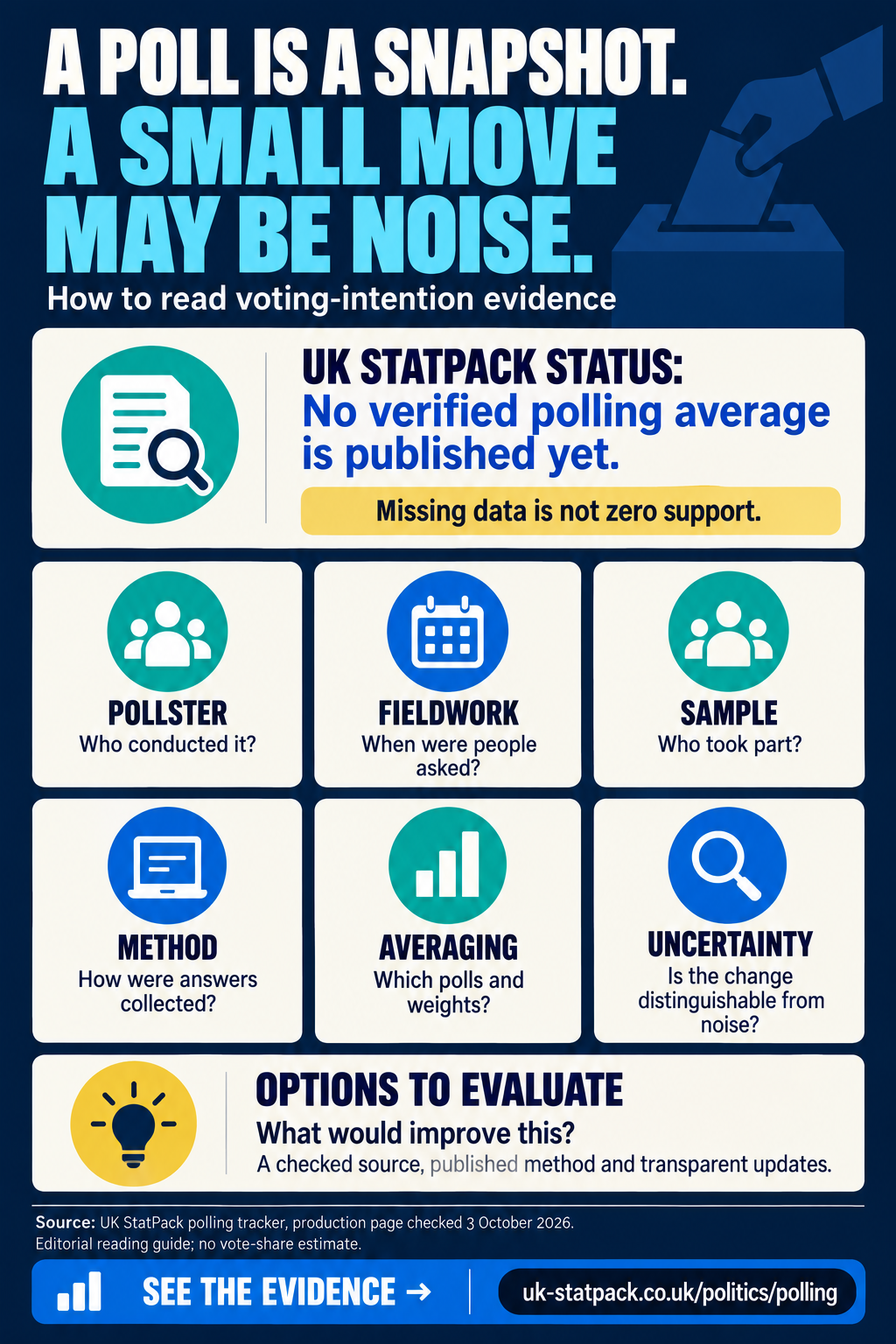
Text and data version
A poll is a snapshot. A small move may be noise. The site does not yet publish a verified polling average. Individual polls carry margins of error and different methods.
Editorial explainer: no statistic is shown.
Image description: A poll is a snapshot. A small move may be noise — editorial explainer from UK Facts.
All visual summaries, their source records and their publication state are listed on Shareable visuals.
Go deeper
What do the latest polls say?6 polls, fieldwork 10 Sept–5 Oct, each checked against the pollster’s tables.Fieldwork, sample, method and population for every poll.Read the chapter → What do the latest polls say? How do pollsters produce a number?Sampling, weighting, turnout filters and don’t-know treatment all differ.Why polls disagree, and what “house effects” are.Read the chapter → How do pollsters produce a number? Why is there no polling average here?Not yet: an average needs a published, tested method.What it would take, and the honest alternatives.Read the chapter → Why is there no polling average here? Can vote shares tell you seats?No. In 2024, 33.7% of the vote won 63.2% of the seats.How the electoral system turns votes into seats.Read the chapter → Can vote shares tell you seats?
Evidence → choices → outcomes
What the evidence can tell us
Readers understand what a poll can and cannot show — its method, its uncertainty and the errors polls have made before — and are never shown an average that has not been tested.
How we assessed these options
What would it take to improve this?
What would make a trustworthy tracker?
The outcome we want: Readers understand what a poll can and cannot show — its method, its uncertainty and the errors polls have made before — and are never shown an average that has not been tested.
The main constraint: Polls can share the same systematic error, so the constraint is method and validation, not data: a summary needs rules and a back-test against past elections, which is a decision for this site’s editors with independent review.
Constraint type: evidence.
The position today
Which quadrant a point sits in is our analytical judgement, not a statistical category. Each point says whether it is a measured fact, our synthesis or a risk.
What we can build on Strengths
British Polling Council members must publish client, fieldwork dates, method, population and sample size, with full tables within two working days, so each poll can be checked against its source.
Measured factConfidence: High· Rules in force, checked October 2026· United Kingdom
Source: British Polling Council, Rules of disclosure (Reporting survey findings; Further information)
What government has committed to
Policy: British Polling Council members must publish client, fieldwork dates, method, population and sample size, with full tables within two working days; the BPC found a member in breach of the client rule on 4 September 2026.
- Who and when:
- British Polling Council (membership body) (regulator or independent body), 4 September 2026.
- Since 20 July 2026:
- No statutory rule covers opinion polls other than the exit-poll ban; the Representation of the People Bill has no poll provisions.
Checked 4 October 2026. A commitment is not delivery.
Options (2)
ShortlistedMake every poll traceable to its methods
Checks each displayed poll against the disclosure rules and logs method changes.
Who: UK Facts · Evidence: Expert or audit recommendation · Status: Site-editorial action
Source: British Polling Council, Rules of disclosure (Reporting survey findings)
Strengthen independent oversight of poll disclosure, including who paid
Stronger enforcement of client disclosure beyond voluntary membership.
Who: British Polling Council; Parliament · Evidence: Expert or audit recommendation · Status: External proposal
Source: British Polling Council, Statement on the Channel 4 News investigation involving BPC member JL Partners (4 September 2026) (Statement text)
Every poll on this page (6 of 6, checked 7 October 2026) links to the pollster’s release and data tables.
Our synthesisConfidence: High
Source: British Polling Council, Rules of disclosure
What government has committed to
No commitment found. No government commitment applies: this is the site’s own link check against the BPC disclosure rules.
Searched: Not applicable (site method), 4 Oct 2026
Checked 4 October 2026. A commitment is not delivery.
Options (2)
Make every poll traceable to its methods
Automated checks on ingestion keep every poll linked.
Who: UK Facts · Evidence: Expert or audit recommendation · Status: Site-editorial action
Source: British Polling Council, Rules of disclosure (Reporting survey findings)
Publish individual polls only
Keeps each figure tied to its source.
Who: UK Facts · Evidence: Untested proposal · Status: Site-editorial action
What is holding us back Weaknesses
Small leads are hard to read: the BPC’s own standard statement says that, on recent elections, there is only a 9 in 10 chance a party’s true support is within 4 points of a poll’s estimate.
Measured factConfidence: High· Rules in force, checked October 2026· United Kingdom
Source: British Polling Council, Rules of disclosure (Further information: BPC statement on uncertainty)
What government has committed to
Policy: BPC rules require voting-intention releases to say there is a 9 in 10 chance the true value lies within 4 points of the estimate.
- Who and when:
- British Polling Council (membership body) (regulator or independent body), 20 May 2021.
- Source:
- British Polling Council, Rules of disclosure (Further information (uncertainty statement); rules page last modified 20 May 2021)
Checked 4 October 2026. A commitment is not delivery.
Options (2)
Test polling summaries against past errors before publishing them
Shows readers how far to trust a lead before it is published.
Who: UK Facts · Evidence: Observational analysis · Status: Site-editorial action
Source: British Polling Council, The performance of the polls in the 2024 general election (Final polls table)
A model-based average with uncertainty
Pools polls and shows the range, not a single figure.
Who: UK Facts · Evidence: Untested proposal · Status: External proposal
Polls can be wrong together: the 19 final polls of 2024 averaged 38.6% for Labour against a result of 34.7% (+3.9 points), the largest overestimate of Labour since 1979.
Measured factConfidence: High· General election, 4 July 2024· Great Britain
Source: British Polling Council, The performance of the polls in the 2024 general election (Final polls table); British Polling Council, Polling Lessons from 2024 (British Polling Council event summary) (Summary bullet: systematic polling error)
What government has committed to
No commitment found. No government or regulator commitment addresses shared polling error; the BPC reviewed the 2024 performance of the polls.
Searched: gov.uk; Hansard “opinion poll”, “British Polling Council” 2025–4 Oct 2026; BPC site; 4 Oct 2026
Checked 4 October 2026. A commitment is not delivery.
Options (2)
ShortlistedTest polling summaries against past errors before publishing them
Back-tests any summary against the 2024 miss.
Who: UK Facts · Evidence: Observational analysis · Status: Site-editorial action
Source: British Polling Council, The performance of the polls in the 2024 general election (Final polls table)
Make every poll traceable to its methods
A method-change log shows whether pollsters fixed what went wrong.
Who: UK Facts · Evidence: Expert or audit recommendation · Status: Site-editorial action
Source: British Polling Council, Polling Lessons from 2024 (British Polling Council event summary) (Summary bullets)
What could improve things Opportunities
Complete provenance for every poll, and a back-test of any proposed summary against past elections, would show readers how far to trust a number before it is published.
Depends on: An independent methods reviewer signs off the back-test, and its historical error is published with the method.
Our synthesisConfidence: Moderate
Source: British Polling Council, Polling Lessons from 2024 (British Polling Council event summary) (Summary bullets: transparency; communication of uncertainty)
What government has committed to
No commitment found. No government commitment on poll provenance or back-testing was found.
Searched: gov.uk; Hansard 2025–4 Oct 2026; 4 Oct 2026
Checked 4 October 2026. A commitment is not delivery.
Options (2)
ShortlistedMake every poll traceable to its methods
Complete provenance for every poll.
Who: UK Facts · Evidence: Expert or audit recommendation · Status: Site-editorial action
Source: British Polling Council, Rules of disclosure (Reporting survey findings)
ShortlistedTest polling summaries against past errors before publishing them
Back-tests any proposed summary.
Who: UK Facts · Evidence: Observational analysis · Status: Site-editorial action
Source: British Polling Council, The performance of the polls in the 2024 general election (Final polls table)
What could make it worse Threats
Shared systematic error and confident headlines can persist however many polls are published; constituency projections (MRP) carry extra uncertainty that media often present as certainty.
Risk, not a certaintyConfidence: Moderate
Source: British Polling Council, Polling Lessons from 2024 (British Polling Council event summary) (Summary bullets: MRP developments; media representation concerns); British Polling Council, The performance of the polls in the 2024 general election (MRP overview table)
What government has committed to
Policy: BPC rules require constituency-model (MRP) releases to give each party’s estimated chance of winning, or estimated vote shares, for each seat.
- Who and when:
- British Polling Council (membership body) (regulator or independent body), 20 May 2021.
- Source:
- British Polling Council, Rules of disclosure (Rules for constituency estimates)
Checked 4 October 2026. A commitment is not delivery.
Options (2)
ShortlistedTest polling summaries against past errors before publishing them
Shows the real error range so confident headlines can be checked.
Who: UK Facts · Evidence: Observational analysis · Status: Site-editorial action
Source: British Polling Council, The performance of the polls in the 2024 general election (MRP overview table)
Make every poll traceable to its methods
Labels MRP intervals and method with each estimate.
Who: UK Facts · Evidence: Expert or audit recommendation · Status: Site-editorial action
Source: British Polling Council, Polling Lessons from 2024 (British Polling Council event summary) (Summary bullets: MRP)
The actions worth examining
These actions concern transparency, accountability and informed choice — not a spending programme, and not a view on which party or system is right.
Action 1A39Policy status: site-editorial action
Make every poll traceable to its methods
Show fieldwork dates, sample, population, mode, client and a link to the original tables for every poll, and keep uncertainty visible in every chart and headline.
The thread: issue, evidence, action
- Who decides:
- UK Facts, with pollsters as data suppliers (Great Britain)
- Evidence:
- Expert or audit recommendation. Methodological good practice set by the British Polling Council and its review of 2024; transparency helps readers judge a poll but does not remove polling error.
- Expected effect:
- Direction plausible; size not established.
- Cost and funding
Not yet costed
Funding: Not a direct public-spending programme
Why it is shortlisted here: Builds on the current table so that every number can be traced to its method and source before anything is summarised.
What it takes
The problem
Headline vote shares travel without the fieldwork dates, sample, weighting and client that decide what a poll can and cannot show.
Who is affected, and where
Readers of polls on this site. Territory: Great Britain. Westminster voting intention, mostly Great Britain samples (one pollster is UK-wide). Polls for devolved elections are not covered.
Policy status
UK Facts proposal. Partly operating: the poll table already records fieldwork, sample, mode, population, client and tables for each British Polling Council member checked. The full audit, checks on ingestion and a log of method changes are proposed.
The evidence
- What the research found:
- BPC rules require members to publish the client, fieldwork dates, method, population, percentages and sample size, with full tables within two working days, and a standard statement that on recent elections there is a 9 in 10 chance a party’s true support lies within 4 points of the estimate. The BPC’s 2025 review called for more transparency and better communication of uncertainty.
- Evaluated on:
- BPC member polls; Great Britain
- Our recommendation (separate from the research):
- Audit every displayed poll against its original tables, fix provenance gaps, validate on ingestion and record when a pollster changes its method.
- Strongest counter-evidence:
- Full disclosure did not stop the 2024 polls overstating Labour: transparency lets readers judge a poll but does not fix an error shared by many pollsters.
Cost and funding
Cost completeness: Not yet costed. Funding: Not a direct public-spending programme.
- Poll provenance audit and ingestion checks (private contribution; paid by UK Facts): Not yet costed. Site staff time; no public cost.
- Who pays:
- UK Facts: data curation and editorial review time, plus any licensed data cost.
- Financing proposed:
- UK Facts’ product and editorial budget; no government funding implied.
- Gap remaining:
- Staff time not costed.
What delivery needs
- Skills:
- Survey-methods literacy.
- Operational capacity:
- Checking time at each update.
- Infrastructure:
- The poll data file with checks on ingestion.
- Permissions:
- Pollsters’ terms of use for their tables.
- Law:
- None.
- Public consent:
- None.
First step and stages
First step: Audit every displayed poll against its original tables and correct any provenance gaps. (owner: UK Facts editors)
- Audit displayed polls against original tables — UK Facts editors (proposed stage, not an official timetable)
- Validate each new poll on ingestion — UK Facts editors (proposed stage, not an official timetable)
- Review when a pollster changes method — UK Facts editors (proposed stage, not an official timetable)
Trade-offs
- Who gains and who loses:
- No direct distributional effect.
- What else the money or effort could do:
- Editorial time.
- Strongest counterargument:
- Most readers never open the tables; method detail can crowd out the main message.
- Risks:
- Overstating the precision of non-probability samples, and treating a count of polls as certainty.
How we would judge it
- Baseline:
- Polls displayed with release and tables links (checked 3 October 2026).
- Leading indicator:
- Share of displayed polls with every BPC disclosure field and a working tables link.
- Outcome:
- Timely corrections, and readers’ understanding of uncertainty in comprehension testing.
- Continue, adapt or stop:
- Remove any poll whose figures cannot be matched to the pollster’s own tables.
Sources
- British Polling Council, Rules of disclosure, Reporting survey findings; Further information (uncertainty statement) (date not stated; full text checked)
- British Polling Council, Polling Lessons from 2024 (British Polling Council event summary), Summary bullets: MRP developments; media representation concerns (2025-04-26 (event held 6 May 2025); relevant passages checked)
- British Polling Council, The performance of the polls in the 2024 general election, Final polls table (2024-07-08; full text checked)
Source published BPC rules of disclosure (current); 26 April 2025 (BPC lessons); evidence reviewed 2026-10-04. Reconsider if: The BPC changes its disclosure rules; A pollster changes its method; A BPC statement about a member.
Action 2A40Policy status: site-editorial action
Test polling summaries against past errors before publishing them
Keep showing individual polls unless a documented summary method has been back-tested on past elections for bias, interval coverage and sensitivity to which pollsters are included.
The thread: issue, evidence, action
- Issue Weakness: Polls can be wrong together: the 19 final polls of 2024 averaged 38.6% for Labour against a result of 34.7% (+3.9 points), the largest overestimate of Labour since 1979. Also: threat, opportunity
- Evidence Error of the average of final polls on Labour’s share, last general election
- Action A40, this action
- Who decides:
- UK Facts, with a qualified independent methods reviewer (Great Britain)
- Evidence:
- Observational analysis. The case for back-testing rests on observed errors at past elections. No back-test of a specific method has been run for this site, and past error does not fix future error.
- Expected effect:
- Direction plausible; size not established.
- Cost and funding
Not yet costed
Funding: Not a direct public-spending programme
Why it is shortlisted here: Sets the test any polling average must pass first; it builds on the documented-median option without adopting it.
Builds on the option A documented simple average compared below.
What it takes
The problem
An average of polls looks more certain than any single poll, but polls can share the same error: in 2024 the average of the final polls overstated Labour by almost 4 points.
Who is affected, and where
Readers of polls on this site. Territory: Great Britain. Westminster voting intention; seat projections and devolved elections are out of scope.
Policy status
UK Facts proposal. The site publishes individual polls and no average. A documented median and a model-based average are options on this page; neither has been adopted.
The evidence
- What the research found:
- The final polls averaged 38.6% for Labour against a GB result of 34.7% (+3.9 points) and 21.4% for the Conservatives against 24.4% (−3.0). The average MRP projection gave Labour 441 seats against 412 won. The BPC calls it the largest overestimate of Labour since 1979, with causes still unclear.
- Evaluated on:
- 19 final Great Britain polls and seven BPC members’ final MRP seat projections, 2024 general election; Great Britain, June–July 2024
- Our recommendation (separate from the research):
- Define what a summary would estimate and whether the available polls justify it; back-test it against past general elections with an independent reviewer; publish the method and its historical error before release.
- Strongest counter-evidence:
- A well-built average does reduce single-poll noise, and readers average tables informally anyway; refusing to summarise can leave them with a worse average of their own.
Cost and funding
Cost completeness: Not yet costed. Funding: Not a direct public-spending programme.
- Back-testing and independent review of any polling summary (private contribution; paid by UK Facts): Not yet costed. Site cost only; no new polling is commissioned.
- Who pays:
- UK Facts: research, back-testing and maintenance, plus any independent reviewer’s fee.
- Financing proposed:
- UK Facts’ product and research budget; no new polling is commissioned.
- Gap remaining:
- Not costed.
What delivery needs
- Skills:
- Statistical modelling and independent review.
- Operational capacity:
- An archive of historical polls for back-testing.
- Infrastructure:
- Reproducible code.
- Permissions:
- Rights to use historical poll data.
- Law:
- None.
- Public consent:
- Editorial sign-off before release.
First step and stages
First step: Define what a summary would estimate and whether the available polls justify it. (owner: UK Facts editors with an independent methods reviewer)
- Define the estimate and assemble past polls — UK Facts editors (proposed stage, not an official timetable)
- Back-test and independent review — Independent methods reviewer (proposed stage, not an official timetable)
- Release the method, or keep individual polls only — UK Facts editors (proposed stage, not an official timetable)
Depends on: A39: complete provenance for every poll
Trade-offs
- Who gains and who loses:
- No direct distributional effect.
- What else the money or effort could do:
- Research time not spent elsewhere.
- Strongest counterargument:
- Aggregators already publish averages; declining to do so may look like caution for its own sake.
- Risks:
- Shared systematic error, overfitting to past elections and misleading constituency precision.
How we would judge it
- Baseline:
- No polling average published (3 October 2026).
- Leading indicator:
- Back-test error and interval coverage at past elections.
- Outcome:
- Historical calibration, sensitivity to the mix of pollsters, and readers’ understanding of what the summary covers.
- Continue, adapt or stop:
- Do not publish if back-test error is larger than that of a typical single final poll, or if intervals miss results more often than stated.
Sources
- British Polling Council, The performance of the polls in the 2024 general election, Final polls table; MRP overview table (2024-07-08; full text checked)
- British Polling Council, Polling Lessons from 2024 (British Polling Council event summary), Summary bullet: systematic polling error (2025-04-26 (event held 6 May 2025); relevant passages checked)
- British Polling Council, Polling Lessons from 2024 (British Polling Council event summary), Summary bullet: future recommendations (methodological pluralism) (2025-04-26 (event held 6 May 2025); relevant passages checked)
Source published 8 July 2024 (BPC review); 26 April 2025 (BPC lessons); evidence reviewed 2026-10-04. Reconsider if: A documented method is back-tested; The British Election Study probability survey reports on 2024 non-response; A general election is called.
Decision brief
The leading option set out as a decision someone could take: who decides, who benefits, the best evidence, cost and funding, and the main trade-off. The full research record is one click away.
Decision briefSite-maintenance taskReviewed 2026-10-04
Write polling provenance and back-testing into this site’s methods, and show readers what changed
The thread: issue, evidence, action
- Issue Opportunity: Complete provenance for every poll, and a back-test of any proposed summary against past elections, would show readers how far to trust a number before it is published. Also: strength
- Evidence Displayed polls with release and data-tables links
- Action Make every poll traceable to its methods
- Decision required
- UK Facts’ editors adopt two publication standards for this page: every displayed poll must match the pollster’s own tables, and no polling average is published until its method has been back-tested against past elections. The page then shows what changed since the last update and how far pollsters disagree.
- Who and where
- Readers of the poll table and charts on /politics/polling. Applies in: Great Britain.
- Accountable body
- UK Facts editors
- Intervention
- Write the two standards into the methods page and check every poll against them on entry.
- Best evidence, and where it applies
- British Polling Council review: the average of the final 2024 polls overstated Labour by 3.9 points, the largest overestimate since 1979, with causes still unclear.Studied in: Final voting-intention polls by BPC members (Final polls before the general election of 4 July 2024).
- Extra cost of this change
- Capital: none identified in the brief.Recurring: Poll provenance audit and ingestion checks — Not yet costed.One-off or mixed: Back-test and independent review of any summary method — Not yet costed.
- Funding
- Not funded yet: a possible funding route exists, but nothing is allocated to this change.Committed to this change: none.Possible source, not an award: none identified.Unfunded: Staff time and any reviewer fee are not yet costed; they are a site cost, not a public one.
- Savings and wider benefits
- Not yet specified: no cashable saving or avoided cost has been costed for this change. Expected outcomes are listed one by one in the research appendix and are never added together or counted as money available.
- First 90-day step
- A “Polling standards” section published on the methods page, with every displayed poll audited against its tablesThe proposed first milestone; a 90-day date is not yet specified. Owner: UK Facts editors. Proposed by UK Facts, not an official deadline.
- Twelve-month milestone
- Not yet specified.Time to a first useful result: The first table update after the standard is written; the back-test only when a summary method is proposed.
- Outcome, and when to scale or stop
- Measure: Share of displayed polls that pass the audit at each update.Scale if: Every displayed poll matches its tables and the reader panels are understood in comprehension testing.Stop if: Any proposed summary does worse in the back-test than a typical single final poll, or its intervals miss results more often than stated — then individual polls only.
- Main trade-off
- Individual polls with their spread are less tidy than one average, but an average that has not been tested against past errors would look more certain than the evidence allows.
- Source and review date
- The performance of the polls in the 2024 general election (2024). Reviewed 2026-10-04.
An editorial proposal by UK Facts for discussion, not government policy. Records: A39, A40 · costs C-A39-EDITORIAL, C-A40-EDITORIAL
Research appendix: study design, effect sizes and limits, alternatives, full costing, international comparisons and how we would know
1.The change, in plain words
Write polling provenance and back-testing into this site’s methods, and show readers what changed
2.The decision requested
- Decision
- Adopt the provenance standard and the back-testing standard as written rules on the methods page, apply them at every table update, and add a “what changed” and “how far pollsters disagree” panel to the reader page.
- Accountable institution
- UK Facts editors
- Geography
- Great Britain
- Powers
- An editorial decision for this website. No public body, budget or legal power is involved.
- Delivery partners
- British Polling Council members, as publishers of the tables the audit checks; An independent methods reviewer (for any proposed summary)
3.Who it is for, and what changes beyond today
- Target population
- Readers of the poll table and charts on /politics/polling.
- Eligibility
- Every Great Britain voting-intention poll displayed on the page, from pollsters that publish full tables.
- Scale
- All polls displayed at each update; no new polling is commissioned.
- Baseline
- 6 of 6 displayed polls had both a release and a data-tables link when checked on 7 October 2026. No polling average is published. The BPC disclosure rules set the fields each poll must carry.
Source: British Polling Council, Rules of disclosure (Reporting survey findings)
- Change beyond existing law or funding
- Today the provenance fields are recorded but the rule is not written down and nothing checks it on entry; there is no written test for a summary; and readers cannot see what changed or how far pollsters disagree. The change writes both rules into the methods, checks them at every update and adds the two reader panels.
4.How it would work
Do: Write the two standards into the methods page and check every poll against them on entry Changing: so that each displayed number can be traced to its tables and any summary carries its historical error
Readers can trace each poll to its fieldwork dates, sample, client and tables
Hypothesis to test
A presentation outcome for this site, measured by the share of displayed polls that pass the audit; not a policy effect.
Fewer readers treat a lead inside the stated uncertainty as decisive
Hypothesis to test
Testable only through reader comprehension testing; no effect size is claimed.
Outcomes are kept separate and never added into one impact figure.
5.Best evidence
The performance of the polls in the 2024 general election
- Author or institution:
- British Polling Council (industry body of polling companies)
- Published:
- 2024
- Evaluation period:
- Final polls before the general election of 4 July 2024
- Design:
- Comparison of each member’s final published poll with the Great Britain result
- Sample or population:
- Final voting-intention polls by BPC members
- Effect and uncertainty:
- Average final-poll Labour share 38.6% against a result of 34.7% (+3.9 points); Conservatives 21.4% against 24.4%. Average MRP projection 441 Labour seats against 412 won.
- Limits:
- One election. The BPC is the industry’s own body; it says the causes of the error are not yet established.
Where: Final polls table; MRP overview table. Affiliation is provenance, not proof of quality.
6.Alternatives, counter-evidence and who loses
- Closest feasible alternative
- Publish a simple median of recent polls now, with a caption, as many outlets do.
- Strongest counter-evidence
- A well-built average does reduce single-poll noise, and readers average polls informally anyway; refusing to summarise can leave them with a worse average of their own.
Source: British Polling Council, Polling Lessons from 2024 (British Polling Council event summary) (Summary bullet: systematic polling error)
- Distributional effects
- None between groups of people. The risk is presentational: a summary that favours pollsters with more frequent polls would tilt the picture.
- Main downside
- More visible uncertainty can read as “polls are useless”, which the evidence does not support either.
| Option | Who is reached | Evidence | Likely outcome and timing | Cost and funding | Main trade-off |
|---|---|---|---|---|---|
| The proposalWrite the two standards into the methods, add “what changed” and pollster-spread panels | Every reader of the poll page | BPC disclosure rules; BPC 2024 review of final-poll error | Traceable polls from the next update; any summary only after a back-test | Site staff time, not yet costed; site budget | Less tidy than one headline number |
| Current policyCurrent practice: individual polls with provenance fields, no written rule and no average | Every reader of the poll page | Fields recorded for each poll; not checked on entry | No change; gaps found only by manual review | Existing site time | Readers cannot see what changed or how far pollsters disagree |
| AlternativePublish a simple median of recent polls now | Every reader of the poll page | Reduces single-poll noise; does not remove error shared by all pollsters, as in 2024 | Immediate, but untested against past elections | Low site cost | Implies precision the 2024 error shows is not there |
The options compared, including current policy
The proposal
Write the two standards into the methods, add “what changed” and pollster-spread panels
- Who is reached
- Every reader of the poll page
- Evidence
- BPC disclosure rules; BPC 2024 review of final-poll error
- Likely outcome and timing
- Traceable polls from the next update; any summary only after a back-test
- Cost and funding
- Site staff time, not yet costed; site budget
- Main trade-off
- Less tidy than one headline number
Current policy
Current practice: individual polls with provenance fields, no written rule and no average
- Who is reached
- Every reader of the poll page
- Evidence
- Fields recorded for each poll; not checked on entry
- Likely outcome and timing
- No change; gaps found only by manual review
- Cost and funding
- Existing site time
- Main trade-off
- Readers cannot see what changed or how far pollsters disagree
Alternative
Publish a simple median of recent polls now
- Who is reached
- Every reader of the poll page
- Evidence
- Reduces single-poll noise; does not remove error shared by all pollsters, as in 2024
- Likely outcome and timing
- Immediate, but untested against past elections
- Cost and funding
- Low site cost
- Main trade-off
- Implies precision the 2024 error shows is not there
8.What delivery needs first
- data — Working links to each pollster’s full tables; a poll whose figures cannot be matched is removed. (Requirement; owner: UK Facts editors)
- staff — A qualified methods reviewer independent of the editors, before any average is published. (Scarce resource shared with other priorities; owner: UK Facts editors)
- data — Final polls and results for past general elections in a consistent form, for the back-test. (Requirement; owner: UK Facts editors)
9.What it would cost
How the cost is built up: Audit time per update × updates a year + one back-test and review for each candidate summary method. Site cost only; no public money.
| Component | Unit and quantity | Unit cost or amount | Type, price year, period | Status |
|---|---|---|---|---|
| Poll provenance audit and ingestion checksEvery displayed poll at each update | staff time per update; quantity to be set from need and capacity | Not yet costed (ledger C-A39-EDITORIAL) | recurring; price year not stated; Each table update | Not yet established |
| Back-test and independent review of any summary methodOne candidate method tested against past general elections | one review; quantity to be set from need and capacity | Not yet costed (ledger C-A40-EDITORIAL) | one-off revenue; price year not stated; Before any summary is published | Not yet established |
Poll provenance audit and ingestion checks
Every displayed poll at each update
Not yet costed (ledger C-A39-EDITORIAL)
recurring; price year not stated; Each table update; Not yet established
Back-test and independent review of any summary method
One candidate method tested against past general elections
Not yet costed (ledger C-A40-EDITORIAL)
one-off revenue; price year not stated; Before any summary is published; Not yet established
10.Who pays, and what is missing
- Programme envelope (a possible route, not an award)
- None identified
- Allocation committed to this change
- None
- Remaining gap
- Staff time and any reviewer fee are not yet costed; they are a site cost, not a public one.
- Proposed financing
- UK Facts’ editorial and product budget. No government funding is implied.
- Responsible payer
- UK Facts
- Budget displaced
- Editorial time that would otherwise go to new pages or updates elsewhere on the site.
11.First milestone and time to a useful result
A “Polling standards” section published on the methods page, with every displayed poll audited against its tables (Owner: UK Facts editors. Proposed by UK Facts, not an official deadline.)
Time to first useful result: The first table update after the standard is written; the back-test only when a summary method is proposed.
What could delay it: Pollsters keep publishing full tables at stable addresses A qualified reviewer is available for any summary method
12.How we would know
- Baseline
- Polls with release and tables links: 6 of 6 (7 October 2026). No average published.
- Comparison
- For any summary: a typical single final poll at past general elections, and the stated interval coverage.
- Leading indicator
- Share of displayed polls that pass the audit at each update.
- Follow-up
- At each table update; the summary test at the next general election.
- Continue if
- Every displayed poll matches its tables and the reader panels are understood in comprehension testing.
- Adapt if
- Readers misread the disagreement panel, or pollsters change where they publish tables.
- Stop if
- Any proposed summary does worse in the back-test than a typical single final poll, or its intervals miss results more often than stated — then individual polls only.
- Thresholds
- Not yet set: The back-test comparison is defined (a typical single final poll); no numerical margin is set until a candidate method and its historical errors exist.
What is not yet known, and how to find out
- How much editorial time the audit and any back-test will take (cost)Next step: Log the time taken by the first full audit and price the reviewer’s fee before commissioning a back-test.Scope: Audit at each update; one back-test per candidate method · Data or quotes needed: Hours per audit; reviewer quotes · Who can estimate it: UK Facts editors
- Whether the disagreement panel improves readers’ understanding of uncertainty (effect)Next step: Include the panel in the planned reader comprehension sessions and compare with the current table.Defensible route: bounded pilot
Sources last checked 4 October 2026 · Owner: Site methods editor (James Harris) · Next check: the first trigger: A British Polling Council rule change or a major polling miss.
What it would take
The order things have to happen in
First, the prerequisite
Audit each displayed poll against its original tables
Owner: UK Facts editors
No date: the timing depends on the steps before it.
Then, the decision
Define what any summary would estimate, and whether available polls justify one
Owner: UK Facts editors with an independent methods reviewer
No date: the timing depends on the steps before it.
Then, delivery
Back-test the candidate method against past general elections
Owner: Independent methods reviewer
No date: the timing depends on the steps before it.
Finally, the measured outcome
Publish the method with its historical error, or keep individual polls only
Owner: UK Facts editors
No date: the timing depends on the steps before it.
Who pays, and what is still missing
Cost, committed funding and the remaining gap for the same scope and years. A programme envelope is not an award to a project; a proposal is not committed money. None of these costs has been established yet, so no total is shown.
Cost and funding ledger
Poll provenance audit and ingestion checks
A39 · private contribution · not costed
- Amount
- Not yet costed
- Who pays
- UK Facts
- Committed
- None identified
- Proposed, not committed
- —
- Gap
- Not established
Back-testing and independent review of any polling summary
A40 · private contribution · not costed
- Amount
- Not yet costed
- Who pays
- UK Facts
- Committed
- None identified
- Proposed, not committed
- —
- Gap
- Not established
“Not yet costed” means no defensible cost has been found — not that the action is free. Lifetime benefits, benefit-cost ratios and forecast savings are never shown here as money available to spend.
What the evidence says each action changes
No effect has been established for these actions yet: direction plausible; size not established.
How we would know
The outcome measures to watch. A baseline is where we start, not a target; where there is no official target we say so.
Displayed polls with release and data-tables links
polls · Great Britain
- Baseline
- Not published
- Latest
- 6 of 6
- 7 October 2026
Proposed ambition (UK Facts, not official): every displayed poll — a proposed editorial standard
Source: British Polling Council, Rules of disclosure (Disclosure fields checked for each poll on this page). Next release: at each table update (check the release calendar).
Error of the average of final polls on Labour’s share, last general election
percentage points · Great Britain
- Baseline
- Not published
- Latest
- +3.9 points
- General election, 4 July 2024
Target: none — the benchmark any proposed summary must beat in a back-test; not a target the site controls.
Source: British Polling Council, The performance of the polls in the 2024 general election (Final polls table). Next release: the next general election (check the release calendar).
Where the ideas come from
Research, counter-evidence and methods (3 sources; 2 claims held back)
- Rules of disclosure — British Polling Council, date not stated.Industry disclosure rules; United Kingdom. Full text checked, 2026-10-04.
- The performance of the polls in the 2024 general election — British Polling Council, 2024-07-08.Industry review of final polls; Great Britain. Full text checked, 2026-10-04.
- Polling Lessons from 2024 (British Polling Council event summary) — British Polling Council, 2025-04-26 (event held 6 May 2025).Summary of member presentations at a BPC/Market Research Society event; United Kingdom. Relevant passages checked, 2026-10-04. Limits: A short summary; the 23MB slide deck was not reviewed. Industry body of pollsters.
Counter-evidence and criticism
- Make every poll traceable to its methods: Full disclosure did not stop the 2024 polls overstating Labour: transparency lets readers judge a poll but does not fix an error shared by many pollsters. (British Polling Council)
- Test polling summaries against past errors before publishing them: A well-built average does reduce single-poll noise, and readers average tables informally anyway; refusing to summarise can leave them with a worse average of their own. (British Polling Council)
Claims held back
- A polling average or trend line — No method has been back-tested for this site; publishing one would imply a precision the evidence does not support. Needed: A documented method that passes the A40 back-test and independent review.
- The causes of the 2024 overestimate of Labour — The BPC says the causes remain unclear; the British Election Study probability survey was awaited. Needed: Published analysis of differential non-response in 2024.
“Full text checked” means we read the report itself; “relevant passages” means the sections behind each figure; “summary or abstract only” means we could not read the full study, so no number from it is published here without another source.
Other options compared — not on the shortlist (3)
Other options compared
Options from earlier work on this page that are not on the shortlist. They remain valid choices; their evidence is shown as before.
- immediate reliefStatus: operating
Publish individual polls only
- Aims to:
- Readers see real, sourced polls without a manufactured average.
- How:
- Record the latest poll from each British Polling Council member checked, from the pollster’s own tables, with fieldwork dates, sample and method.
- Who decides:
- This site’s editors.
- Main constraint:
- Goes stale within weeks without regular updates.
- Evidence:
- Not evaluated — a mechanism to test, not an evidenced fix
See the trade-offs and evidence
- What the evidence shows
- An editorial practice. It avoids presenting an unvalidated average, but readers may still average the table themselves.
- Resources
- An hour or two of checking per update.
- Consent and decisions needed
- None required.
- Time
- Operating now.
- Cost and yield
- Editorial time only.
- Trade-offs and who pays
- Honest and simple; no trend line and no uncertainty estimate.
- How we would know it worked
- Leading indicator: Table updated at least monthly. Outcome: No reader is shown a poll older than six weeks as current. It would not be working if: The table falls more than a month behind.
- capacityStatus: proposed
A documented simple average
- Aims to:
- One headline figure per party that follows published rules.
- How:
- For example, the median of the latest poll from each member pollster with fieldwork in the last 14 days, with the rule, inclusions and exclusions published.
- Who decides:
- This site’s editors.
- Main constraint:
- No uncertainty band can honestly be attached without a model.
- Evidence:
- Limited evidence — plausible mechanism, little direct evaluation
See the trade-offs and evidence
- What the evidence shows
- Simple averages reduce single-poll noise but cannot remove a shared error: in 2024 the average of 19 final polls overstated Labour by 3.9 points.
- Resources
- Automated or weekly manual ingestion; a methods note.
- Consent and decisions needed
- Editorial sign-off of the rules before publication.
- Time
- Weeks to set up and backtest on 2024.
- Cost and yield
- Editorial and development time; no external cost.
- Trade-offs and who pays
- A clearer headline; risk that readers treat it as more precise than it is.
- How we would know it worked
- Leading indicator: Rules published and backtested against 2024. Outcome: Average within published tolerance of the next election result. It would not be working if: Backtest error larger than the typical single poll.
- structuralStatus: external option
A model-based average with uncertainty
- Aims to:
- A trend line with uncertainty bands that come from the method itself.
- How:
- A statistical model that weights polls by recency and sample, estimates each pollster’s systematic difference, and reports intervals.
- Who decides:
- This site’s editors, with statistical review.
- Main constraint:
- Hardest to explain and to keep correct; errors would carry the site’s name.
- Evidence:
- Limited evidence — plausible mechanism, little direct evaluation
See the trade-offs and evidence
- What the evidence shows
- Widely used by aggregators; performance depends on the shared industry error, which no model can see in advance (2024 review).
- Resources
- Statistical expertise, code review, continuous maintenance.
- Consent and decisions needed
- Editorial approval after independent review.
- Time
- Months.
- Cost and yield
- No costing; substantial staff time.
- Trade-offs and who pays
- Best use of the data; highest risk of false confidence.
- How we would know it worked
- Leading indicator: Published code and backtests. Outcome: Intervals cover the result at the stated rate over several elections. It would not be working if: Results repeatedly fall outside the stated intervals.
| Option | Resources | Time | Evidence | Outcome to watch |
|---|---|---|---|---|
| Publish individual polls only | An hour or two of checking per update. | Operating now. | not evaluated | No reader is shown a poll older than six weeks as current. |
| A documented simple average | Automated or weekly manual ingestion; a methods note. | Weeks to set up and backtest on 2024. | limited | Average within published tolerance of the next election result. |
| A model-based average with uncertainty | Statistical expertise, code review, continuous maintenance. | Months. | limited | Intervals cover the result at the stated rate over several elections. |
Plan reviewed 2026-10-04. How we judge evidence.
How this connects
- Why a vote share is not a seat count
In 2024, Reform UK won 14.3% of the vote and 5 seats; Labour 33.7% and 411. Seats depend on where votes fall.
- What do the parties actually propose?
Polls measure support; the comparison shows what each party has published on the main issues.
- When are the next elections?
Polls matter most as elections approach. The calendar lists upcoming elections and legal deadlines.
Sources and methods (11)
- YouGov, Westminster voting intention, fieldwork 4 Oct–5 Oct 2026, release and data tables (released 6 October 2026) — One row of POLL-02; the data tables are linked from the row.
- Opinium, Westminster voting intention, fieldwork 30 Sept–2 Oct 2026, release and data tables (released 3 October 2026) — One row of POLL-02; the data tables are linked from the row.
- Find Out Now, Westminster voting intention, fieldwork 30 Sept 2026, release and data tables (released 1 October 2026) — One row of POLL-02; the data tables are linked from the row.
- More in Common, Westminster voting intention, fieldwork 25 Sept–29 Sept 2026, release and data tables (released 30 September 2026) — One row of POLL-02; the data tables are linked from the row.
- BMG Research, Westminster voting intention, fieldwork 23 Sept–24 Sept 2026, release and data tables (released 28 September 2026) — One row of POLL-02; the data tables are linked from the row.
- Ipsos, Westminster voting intention, fieldwork 10 Sept–15 Sept 2026, release and data tables (released 20 September 2026) — One row of POLL-02; the data tables are linked from the row.
- British Polling Council, Officers and members — Membership of each pollster, checked 3 October 2026.
- British Polling Council, Rules of disclosure — What members must disclose with each poll.
- British Polling Council, The performance of the polls in the 2024 general election (released 8 July 2024) — Accuracy of the final 2024 polls (GB).
- British Polling Council, Polling lessons from 2024 (released 6 May 2025) — Follow-up review of the 2024 error.
- British Polling Council statement, 4 September 2026 (client disclosure, JL Partners) — Why one member’s recent polls are not included.
Method notes
- Selection: the most recent Westminster voting-intention poll from each British Polling Council member checked (YouGov, More in Common, BMG Research, Opinium, Find Out Now, Ipsos), as of 7 October 2026. Techne was checked but its published tables could not be matched to a recent poll. JL Partners’ polls are not included following the BPC’s 4 September 2026 statement on client disclosure. Other members have not yet been checked.
- Every share was read from the pollster’s own release or data tables, not from news reports or aggregators. Where tables give decimals, shares are rounded to whole numbers; nothing else is computed per poll.
- Shares exclude don’t knows, as each pollster publishes them; pollsters differ in turnout filters and in “squeezing” undecided respondents.
- No margin of error is attached to an individual poll or to the range: online panels are not simple random samples, and a textbook margin would understate real uncertainty.
- No vote share is converted into seats.